Facts
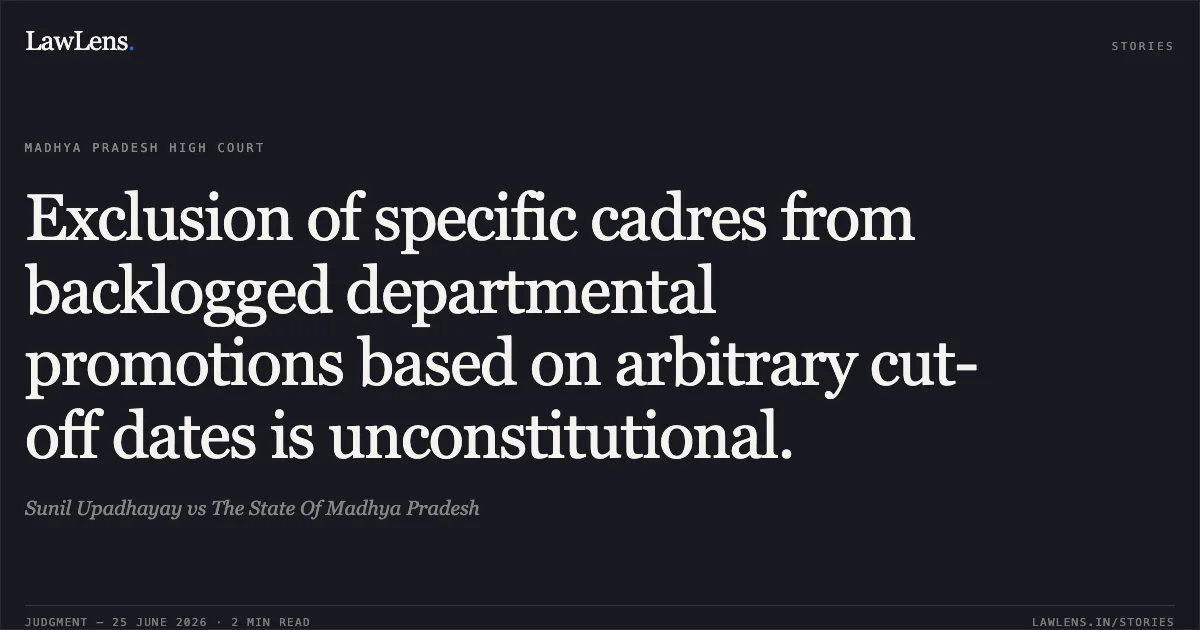
The petitioners, serving as I.T. Operators/Data Entry Operators in the Madhya Pradesh Excise Department, challenged a restrictive proviso in a Gazette Notification dated September 25, 2023.
Source reference: para 1This notification amended Rule 6 of the Madhya Pradesh Excise Subordinate Class III (Executive) Services Recruitment Rules, 1982, formally making I.T. Operators eligible for the Limited Departmental Competitive Examination (L.D.C.E.) for promotion to Excise Sub-Inspector.
Source reference: para 1, 3.8However, the proviso restricted their eligibility to vacancies arising only from the year 2023 onwards, thereby excluding them from applying for earlier vacancies despite meeting other criteria.
Source reference: para 1, 3.9The petitioners contended that since their cadre was integrated into the ministerial services as early as 2007, this temporal restriction was arbitrary.
Source reference: para 3.5, 6Issues
1. Whether the proviso in the notification dated 25.09.2023, restricting I.T. Operators' eligibility for promotion to vacancies arising in 2023 and beyond, is unconstitutional and discriminatory under Articles 14 and 16.
Source reference: para 1, 42. Whether the delay by the State in amending recruitment rules can be used to deny promotional opportunities to a specific cadre for past vacancies.
Source reference: para 18, 19Law Applied
The court applied the principles of equality in public employment under Articles 14 and 16 of the Constitution of India, which prohibit arbitrary classification within the same cadre.
Source reference: para 4, 13The court relied on the Madhya Pradesh Excise Subordinate Class III (Ministerial) Services Recruitment Rules, 1983, which previously recognized I.T. Operators as part of the ministerial staff.
Source reference: para 1, 15The court also referenced the precedent in Panchi Devi v. State of Rajasthan, regarding the prospective nature of subordinate legislation and the creation of substantive rights.
Source reference: para 11Reasoning
The court found that I.T. Operators were integrated into the ministerial staff cadre of the Excise Department in 2007 and held pay scales equivalent to other eligible clerical staff.
Source reference: para 15, 18The court reasoned that the State’s failure to synchronize the Executive Rules of 1982 with the Ministerial Rules of 1983 for over fifteen years constituted an administrative delay for which the employees should not be penalized.
Source reference: para 18, 19By allowing other clerical staff to participate in the L.D.C.E. for pre-2023 vacancies while excluding I.T. Operators based solely on a newly inserted date-based restriction, the State created an "unreasonable and arbitrary classification".
Source reference: para 4, 19The court determined there was no valid justification for treating the promotional rights of this specific group as having been "created" only in 2023, given their long-standing inclusion in the service.
Source reference: para 19Holding
The High Court followed the coordinate bench decision in Mukesh Vishwakarma v. State of M.P. and struck down the restrictive proviso of Rule 6 of the Executive Rules, 1982.
The court held that the exclusion was legally unsustainable.
Source reference: para 19It directed the respondents to declare the examination results of the petitioners (who had appeared under interim orders) and to promote those who secured the necessary qualifying marks.
Source reference: para 20The writ petitions were allowed.
Source reference: para 21Original Court PDF
Sunil UpadhayayvsThe State Of Madhya Pradesh
Click to open original judgment
Original judgment, available to read, download and summarize on LawLens.in