Facts
The dispute concerned family property allegedly allotted to the informant’s branch under a family partition dated 24 December 1978.
Source reference: paras. 3–5, 8–9, 19The informant alleged that the petitioner’s late father, Ishwar Dayal Sinha, fraudulently used a forged succession certificate to obtain mutation of the property in his name in 2001–02.
Source reference: paras. 3–5, 8–9, 19The petitioner and his brothers later executed a sale deed dated 28 October 2020 in favour of a third party.
Source reference: paras. 3–5, 8–9, 19The informant filed Title Suit No. 152 of 2021 challenging that sale deed, and thereafter lodged the FIR on 8 May 2022 alleging offences under Sections 406, 420, 467, 468, 471 read with Section 34 IPC.
Source reference: paras. 3–5, 8–9, 19After investigation, the police submitted a final report treating the dispute as civil in nature.
Source reference: paras. 6, 35–37The Magistrate nevertheless took cognizance on 27 April 2023 and issued summons, observing both that the dispute was civil and that a prima facie criminal case existed on the basis of paragraphs 1, 4 and 5 of the case diary.
Source reference: paras. 6, 35–37The petitioner challenged the cognizance order and the consequential criminal proceedings under Section 482 CrPC/Section 528 BNSS.
Source reference: paras. 2, 38–41Issues
Whether the allegations in the FIR and materials collected during investigation disclosed the ingredients of offences under Sections 406, 420, 467, 468 and 471 read with Section 34 IPC against the petitioner?
Source reference: paras. 23–30Whether execution of the sale deed by the petitioner, who claimed ownership over the property, constituted forgery when the petitioner was neither alleged to be the maker of the earlier forged document nor to have impersonated or acted under the authority of another person?
Source reference: paras. 23–26Whether the criminal proceedings constituted an abuse of process because the dispute was predominantly civil, was subject to pending revenue and civil proceedings, and the FIR was lodged after substantial delay?
Source reference: paras. 20–22, 31–33, 39–40Whether the Magistrate’s order taking cognizance was sustainable despite the final report treating the dispute as civil and despite relying on case-diary paragraphs that substantially reproduced the FIR and witness statements?
Source reference: paras. 35–37Law Applied
The Court applied Sections 406, 420, 467, 468 and 471 IPC, particularly the requirements of dishonest misappropriation, deception and inducement for cheating, and the statutory concept of making a “false document” under Section 464 IPC.
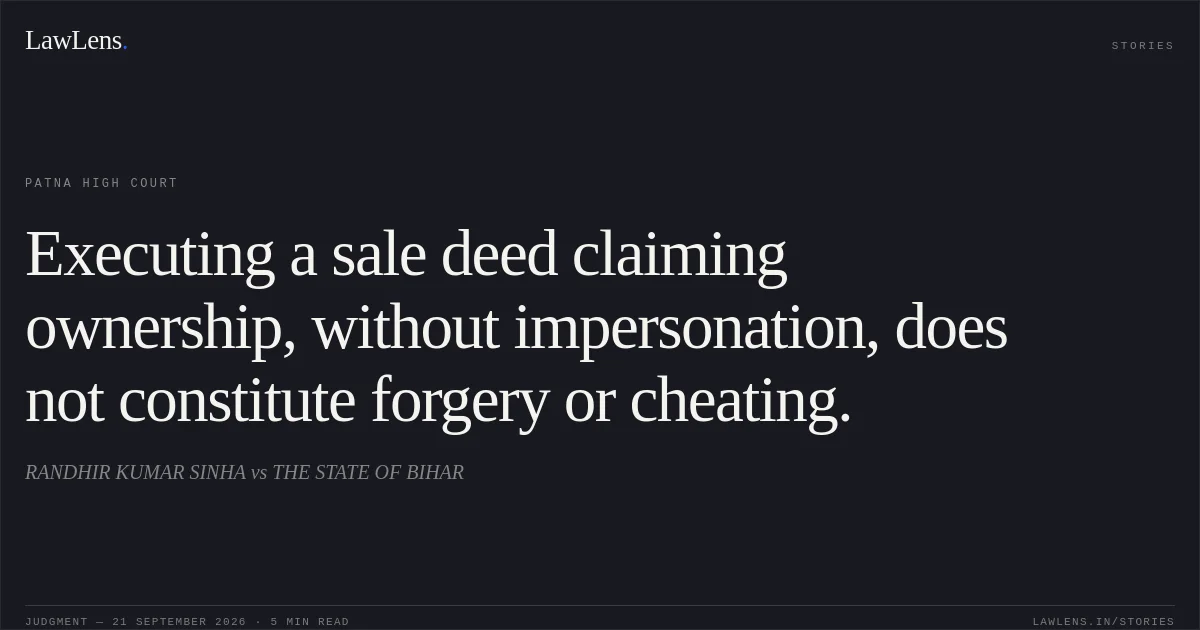
Source reference: paras. 23–30Under Mohd. Ibrahim v. State of Bihar, (2009) 8 SCC 751, execution of a sale deed by a person claiming the property as his own does not, by itself, amount to making a false document unless the person impersonates another or falsely claims authority to act for another; consequently, Sections 467 and 471 are not attracted without forgery.
Source reference: para. 24Sheila Sebastian v. R. Jawaharaj, (2018) 7 SCC 581, establishes that a person who is not the maker of the alleged forged document cannot ordinarily be charged with forgery.
Source reference: para. 25The Court also applied the principles governing inherent jurisdiction under Section 482 CrPC/Section 528 BNSS, including State of Haryana v. Bhajan Lal, 1992 Supp (1) SCC 335, where proceedings may be quashed if the allegations do not constitute an offence or are manifestly mala fide.
Source reference: paras. 21–22, 31, 33, 39Chandrapal Singh v. Maharaj Singh, (1982) 1 SCC 466, Kishan Singh v. Gurpal Singh, (2010) 8 SCC 775, and Usha Chakraborty v. State of West Bengal, (2023) 15 SCC 135, caution against using criminal proceedings as a weapon in predominantly civil disputes.
Source reference: paras. 21–22, 31, 33, 39Pepsi Foods Ltd. v. Judicial Magistrate, (1998) 5 SCC 749, and GHCL Employees Stock Option Trust v. India Infoline Ltd., (2013) 4 SCC 505, recognise that summoning an accused is a serious judicial act requiring application of mind and a prima facie basis founded on specific allegations and supporting material.
Source reference: para. 34Reasoning
The Court found that the allegation of preparing the forged succession certificate was directed primarily against the petitioner’s deceased father and related to events of 2001–02.
Source reference: paras. 18, 23–26There was no specific allegation that the petitioner prepared, altered or forged that document, impersonated the informant, or claimed authority to execute a document on the informant’s behalf.
Source reference: paras. 18, 23–26The petitioner executed the sale deed while claiming ownership based on the existing mutation and jamabandi in his father’s name.
Source reference: paras. 24–26Applying Mohd. Ibrahim and Sheila Sebastian, the Court held that even if the petitioner’s title ultimately proved defective, the sale deed did not thereby become a “false document” made by him, and the ingredients of forgery under Sections 467 and 471 IPC were absent.
Source reference: paras. 24–26The ingredients of cheating were also not established because the informant was not the purchaser, there was no allegation that the petitioner deceived or induced the informant to deliver property or money, and the petitioner did not impersonate him.
Source reference: paras. 27–30The long-standing family property dispute, extensive revenue litigation, pending title suit, suppression of material civil proceedings in the FIR, and the unexplained delay between knowledge of the alleged forgery in 2014 and registration of the FIR in 2022 indicated that the criminal case was being used to advance a civil claim and exert pressure on the petitioner.
Source reference: paras. 19–22, 33The cognizance order was additionally found internally inconsistent: it described the dispute as civil while simultaneously finding a prima facie criminal case.
Source reference: para. 35The case-diary paragraphs relied upon by the Magistrate merely reproduced the FIR, the informant’s statement and a supporting statement by his brother, without disclosing fresh or tangible material constituting an offence.
Source reference: para. 35In these circumstances, continuation of the prosecution would amount to abuse of process and miscarriage of justice.
Source reference: paras. 38–40Holding
The Court held that the allegations, even if accepted in their entirety, did not disclose the offences of forgery or cheating against the petitioner.
The petitioner was not alleged to be the maker of the forged succession certificate, and his execution of the sale deed while claiming ownership did not satisfy the statutory requirements of making a false document, impersonation, deception or dishonest inducement.
Source reference: paras. 23–30The proceedings were also found to be predominantly civil, delayed and apparently mala fide, falling within categories (1) and (7) of Bhajan Lal.
Source reference: para. 39Accordingly, the High Court allowed the application, quashed the cognizance order dated 27 April 2023 and all consequential criminal proceedings in Gaurichak P.S. Case No. 275 of 2022 insofar as they related to Randhir Kumar Sinha.
Source reference: paras. 40–41The Court clarified that its observations were confined to the criminal proceedings and would not affect the pending civil or revenue litigation between the parties.
Source reference: para. 42Acts & Sections Cited
13 provisions across 3 statutes referred to in this judgment. Each provision opens on LawLens.
Indian Penal Code, 1860
Code of Criminal Procedure, 19731
Bharatiya Nagarik Suraksha Sanhita, 20231
Original Court PDF
RANDHIR KUMAR SINHAvsTHE STATE OF BIHAR
Click to open original judgment
Original judgment, available to read, download and summarize on LawLens.in