Facts
The Appellant filed a recovery suit for Rs. 18,79,648/- against a company (Respondent No. 1) and its Directors (Respondents No. 2 3)
Source reference: p. 3During the trial, Respondents No. 2 3 raised an objection regarding "misjoinder of parties," which the Trial Court specifically framed as Issue No. 4 and decided against the Directors, holding them to be necessary parties
Source reference: p. 4, 9On July 4, 2024, the suit was decreed against all three Respondents; this decree was never challenged
Source reference: p. 5In execution proceedings, the Executing Court initially dismissed the Directors' objections on May 28, 2025, noting that the decree was passed against all JDs
Source reference: p. 2-3However, upon a review application, the Executing Court passed the impugned order dated July 31, 2025, recalling its earlier order and holding that the Directors were not personally liable for the company's debt, citing the principle of separate legal entity
Source reference: p. 1-2Issues
1. Whether the Executing Court has the jurisdiction to go behind the decree and hold that certain judgment debtors (Directors) are not liable when the Trial Court specifically decided the issue of their joinder and liability against them
Source reference: p. 8 / para. 172. Whether the Executing Court can exercise review powers to substitute its own view for that of the Trial Court or an Appellate Court
Source reference: p. 13 / para. 28Law Applied
The Court applied Section 47 of the Code of Civil Procedure, 1908 (CPC), which restricts the Executing Court's power to questions relating to the execution, discharge, or satisfaction of the decree, prohibiting it from going behind the decree
Source reference: p. 12 / para. 27It relied on Bhavan Vaja v. Solanki Hanuji Khodaji Mansang, which establishes that while an Executing Court can construe a decree to find its "true effect," it cannot modify its terms
Source reference: p. 10 / para. 23Furthermore, the court cited Maurice W. Innis v. Lily Kazrooni @ Lily Arif Shaikh (2026), reinforcing that the Executing Court cannot assume the role of a Trial Court or substitute its own view for the decree expressed
Source reference: p. 13 / para. 27Reasoning
The High Court observed that the Trial Court had specifically adjudicated the liability of Respondents No. 2 3 by deciding the issue of misjoinder against them
Source reference: p. 9 / para. 18-19Since that judgment attained finality, the decree was executable against all JDs. The High Court reasoned that while a company is generally a separate legal entity, the Executing Court exceeded its jurisdiction by declaring the decree "erroneous" as against the Directors
Source reference: p. 11 / para. 24-26The High Court found that the Executing Court essentially acted as an Appellate Court by interfering with the merits of the original judgment
Source reference: p. 12 / para. 26Additionally, the High Court noted that the Executing Court's use of "review" power was improper, as it used the same set of facts to reverse its prior decision without an error apparent on the face of the record
Source reference: p. 13 / para. 28Holding
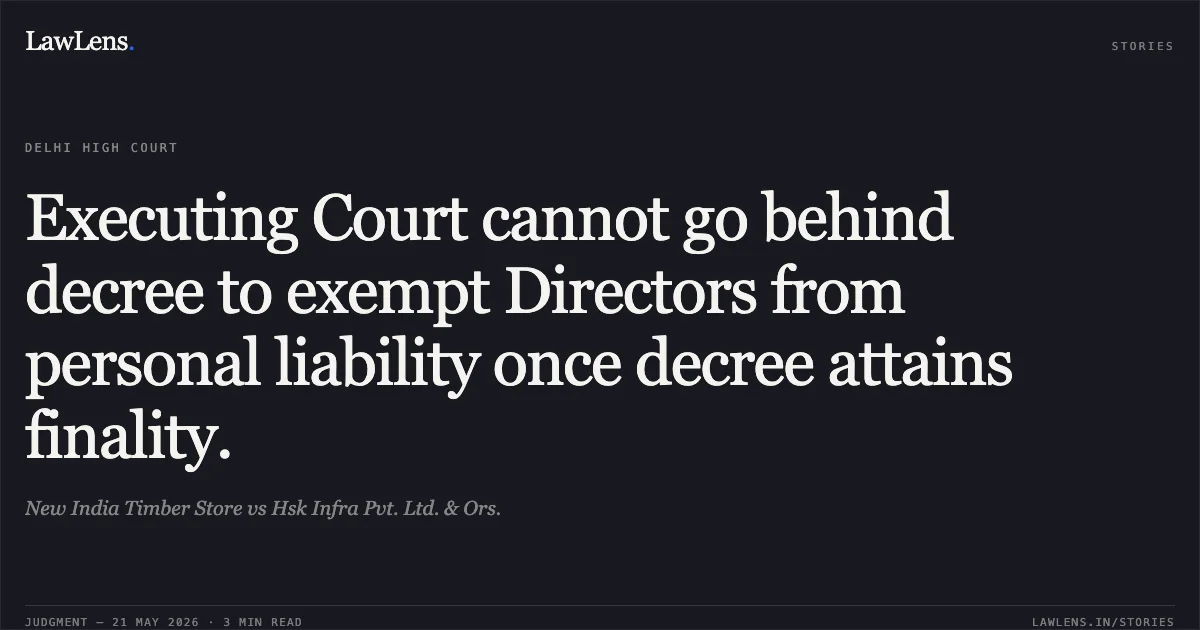
The High Court allowed the appeal and set aside the impugned order dated July 31, 2025
It held that an Executing Court is duty-bound to execute a decree as it exists and cannot exempt certain Judgment Debtors from liability if the original decree—which has attained finality—specifically included them. The personal and inherited properties of Respondents No. 2 3, previously ordered for attachment, remain subject to the execution proceedings to satisfy the decretal amount
Source reference: p. 9 / para. 21Acts & Sections Cited
2 provisions across 1 statute referred to in this judgment. Each provision opens on LawLens.
Code of Civil Procedure, 19082
Original Court PDF
New India Timber StorevsHsk Infra Pvt. Ltd. & Ors.
Click to open original judgment
Original judgment, available to read, download and summarize on LawLens.in