Facts
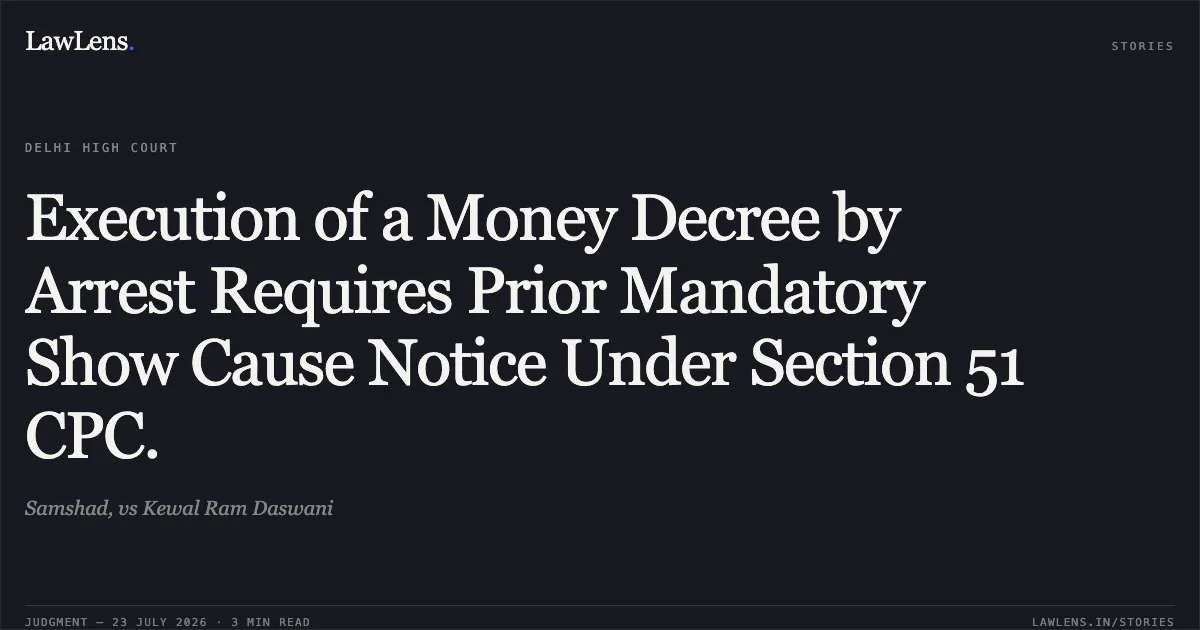
The appellant (judgment-debtor) challenged an order dated 23.12.2025 passed by the Commercial Court, Tis Hazari, Delhi, which issued warrants of arrest against him in an execution petition
Source reference: para 1The Executing Court observed that the appellant’s asset affidavit showed no movable or immovable property, yet a report suggested his residential property had floors on rent
Source reference: para 2Disregarding the appellant's objections, the Executing Court concluded he was intentionally avoiding his liability to pay the decretal amount and issued arrest warrants through the local SHO
Source reference: para 2The appellant contended that the court failed to issue a show-cause notice as mandatorily required under the Code of Civil Procedure (CPC)
Source reference: para 3Issues
1. Whether the Executing Court is mandatorily required to grant an opportunity to show cause to the judgment-debtor before issuing arrest warrants in the execution of a money decree
Source reference: para 3, 112. Whether the failure to follow the procedure prescribed under Section 51 and Order XXI Rules 37 and 40 of the CPC invalidates the warrants of arrest
Source reference: para 10, 13Law Applied
Section 51 of the CPC, which provides that execution by detention in prison shall not be ordered for a money decree unless the judgment-debtor is given an opportunity to show cause
Source reference: para 6Order XXI Rule 37, which mandates the issuance of a notice instead of a warrant, unless there is a risk of absconding
Source reference: para 6Order XXI Rule 40, which prescribes a mandatory inquiry before detention
Source reference: para 7The Supreme Court precedent in Jolly George Varghese v. The Bank of Cochin, which held that simple inability to pay is not grounds for imprisonment under Article 21 of the Constitution and Section 51 of the CPC
Source reference: para 8The principle from Taylor v. Taylor that if a statute prescribes a specific manner for an act, it must be done in that manner or not at all
Source reference: para 10Reasoning
The High Court observed that the Executing Court bypassed the "rigid and mandatory protocol" established for the arrest of a civil debtor
Source reference: para 6Under the proviso to Section 51, the court must be satisfied—after a show-cause notice—that the debtor is likely to abscond, has dishonestly transferred property, or possesses the means to pay but refuses to do so
Source reference: para 6, 9the respondent (decree-holder) admitted that no show-cause notice was issued
Source reference: para 5there was no material to suggest the appellant was likely to abscond, which would have been the only ground to bypass the notice under the proviso to Rule 37(1)
Source reference: para 6, 12since personal liberty is at stake, adherence to the procedure must be "scrupulous"; thus, issuing warrants without an inquiry or a prior show-cause notice violated the appellant's rights under Article 21 and the procedural requirements of the CPC
Source reference: para 6, 10, 11Holding
The Court answered the issues in the affirmative, holding that the Executing Court failed to follow the mandatory due process required by law
The High Court allowed the appeal and set aside the impugned order to the extent of the issuance of arrest warrants
Source reference: para 13, 15However, the respondent was granted liberty to file a fresh application under Order XXI Rule 11A and Rule 37, after which the Executing Court must afford the appellant a proper opportunity to show cause before passing any further orders regarding detention
Source reference: para 14Acts & Sections Cited
2 provisions across 1 statute referred to in this judgment. Each provision opens on LawLens.
Code of Civil Procedure, 19082
Original Court PDF
Samshad,vsKewal Ram Daswani
Click to open original judgment
Original judgment, available to read, download and summarize on LawLens.in