Facts
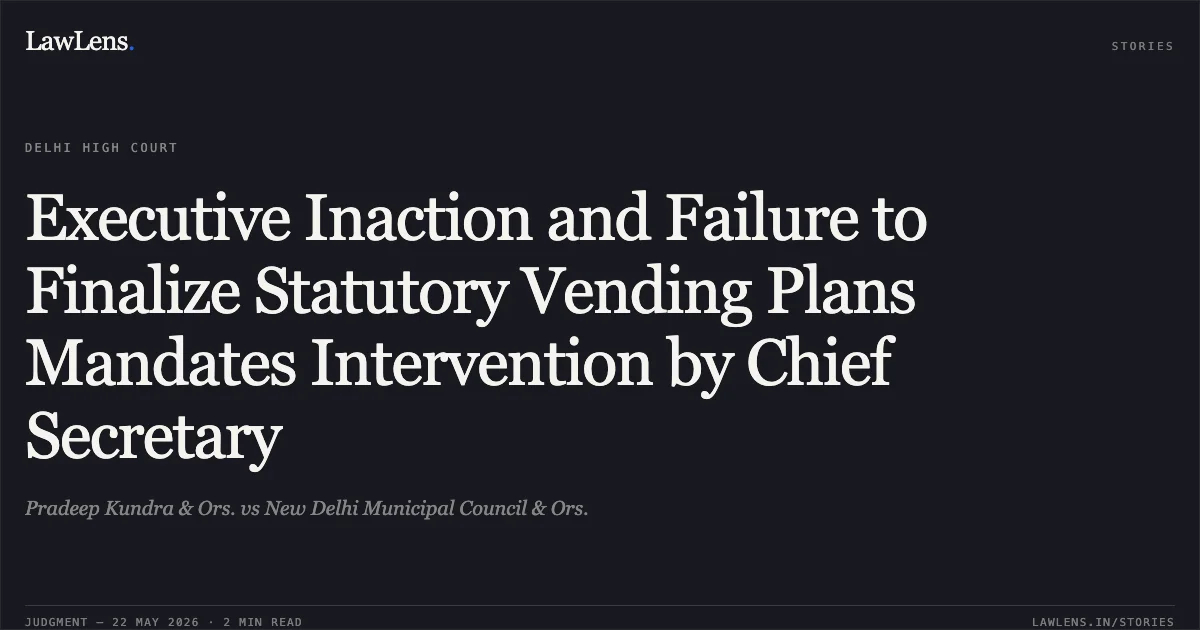
The Delhi High Court addressed a cluster of petitions concerning the regulation of street vending and tehbazari holders in both New Delhi Municipal Council (NDMC) and Municipal Corporation of Delhi (MCD) areas.
Source reference: no citationUnder the Street Vendors Act, 2014, local bodies must prepare vending plans and submit them to the Government of NCT of Delhi (GNCTD) for approval.
Source reference: p. 3, para 5In NDMC areas, a vending plan was submitted on 9th October, 2025, but remained pending.
Source reference: p. 3, para 6Despite areas like Connaught Place and Palika Bazar being declared 'No-vending' zones by the Supreme Court in 2007, unlicensed squatters continue to occupy corridors.
Source reference: p. 3-4, para 8; p. 9, para 27The MCD has yet to finalize its vending plan or address the 13,000+ tehbazari holders who have not participated in surveys.
Source reference: p. 11, para 32-33The court noted a complete lack of administrative progress despite prior judicial directions.
Source reference: p. 5, para 13Issues
1. Whether the GNCTD and local bodies have failed in their statutory duty to notify and implement vending plans under Section 21 of the Street Vendors Act, 2014.
Source reference: p. 6, para 192. Whether the continued occupation of 'no-vending' zones by non-surveyed tehbazari holders/squatters constitutes a failure of administrative enforcement.
Source reference: p. 9, para 263. Whether the current administrative "confusion" and lack of decision-making necessitates high-level intervention by the Chief Secretary.
Source reference: p. 11, para 30-31Law Applied
Street Vendors (Protection of Livelihood and Regulation of Street Vending) Act, 2014, specifically Section 21, which mandates the formulation of a vending plan and the determination of norms by the Government.
Source reference: p. 3, para 5; p. 4, para 12Precedent set by the Supreme Court in Sudhir Madan and Ors. v. MCD and Ors. [2007], which judicially approved the 'No-hawking' and 'No-vending' status of Connaught Place and Rajiv Chowk.
Source reference: p. 3-4, para 8Principles of administrative accountability and the requirement for Town Vending Committees (TVC) to conduct comprehensive surveys.
Source reference: p. 4, para 9Reasoning
The Court observed a "chaotic situation" stemming from an "utter confusion" in decision-making by the NDMC, MCD, and GNCTD.
Source reference: p. 11, para 35-36It criticized the GNCTD's Department of Urban Development for its ignorance, noting it issued letters asking for plans that had already been submitted.
Source reference: p. 6, para 19The NDMC was found to be "shirking responsibility" by shifting the target number of vending sites after the plan was submitted.
Source reference: p. 8-9, para 22-24The court highlighted a legal impasse: thousands of "approved" tehbazari holders refuse to participate in surveys, yet continue to vend in prohibited areas under the guise of old Supreme Court protections, while the authorities remain passive.
Source reference: p. 9, para 25-27In the MCD areas, the failure to even constitute TVC-II or finalize a survey indicated a complete breakdown of the statutory mechanism.
Source reference: p. 11, para 33Holding
The Court held that there is a complete absence of decision-making by the GNCTD and local agencies regarding the rights of vendors versus shopkeepers and pedestrians.
It directed the Chief Secretary of GNCTD to personally intervene, hold a meeting on 2nd June 2026 with the Chairman (NDMC) and Commissioner (MCD), and resolve how the government intends to proceed.
Source reference: p. 12, para 37-40The Chief Secretary was ordered to file a status report and join the next hearing via virtual mode; the matter is listed for further proceedings on 27th July, 2026.
Source reference: p. 11-12, para 31, 38, 39Acts & Sections Cited
1 provisions across 1 statute referred to in this judgment. Each provision opens on LawLens.
Street Vendors (Protection of Livelihood and Regulation of Street Vending) Act, 20141
Original Court PDF
Pradeep Kundra & Ors.vsNew Delhi Municipal Council & Ors.
Click to open original judgment
Original judgment, available to read, download and summarize on LawLens.in