Facts
The petitioner, a Constable in the Central Reserve Police Force (CRPF) since 1992, was granted 15 days of casual leave in July 1995 to attend his sister's wedding.
Source reference: para. 1, 2He failed to rejoin duty on the stipulated date (26.07.1995) due to his wife suffering a tibia fracture, leaving him as the sole caregiver for her, their minor children, and aged parents.
Source reference: para. 3Despite sending telegrams for leave extension, he was declared a deserter and remained absent for 242 days until he reported back on 26.03.1996.
Source reference: para. 8, 22, 24A departmental inquiry was conducted (allegedly in his absence), finding him guilty of misconduct under Section 11(1) of the CRPF Act, 1949.
Source reference: para. 4, 6Consequently, he was removed from service on 30.06.1996.
Source reference: para. 6, 27The petitioner challenged this order primarily on the grounds of disproportionate punishment and failure to consider mitigating humanitarian circumstances.
Source reference: para. 9, 14Issues
1. Whether the unauthorized absence of 242 days by a member of a disciplined force, occasioned by compelling domestic exigencies, justifies the extreme penalty of removal from service.
Source reference: para. 37, 432. Whether the Disciplinary Authority failed to apply the doctrine of proportionality by ignoring mitigating factors and the petitioner's clean prior service record.
Source reference: para. 41, 54Law Applied
Section 11(1) of the Central Reserve Police Force Act, 1949, which provides for punishments for misconduct.
Source reference: para. 6, 16Doctrine of Proportionality, emphasizing that punishment must be commensurate with the delinquency.
Source reference: para. 41Krushnakant B. Parmar v. Union of India, establishing that unauthorized absence is not "wilful" if caused by compelling circumstances beyond an employee's control.
Source reference: para. 46Union of India v. R.K. Sharma and Chairman Cum Managing Director, Coal India Ltd. v. Mukul Kumar Choudhuri, which hold that removal for absence caused by personal distress is shockingly disproportionate and constitutes "legal victimization" if it ignores a clean past record.
Source reference: para. 45, 48, 51, 56Reasoning
The court observed that while discipline is the foundation of a uniformed force, "unauthorized absence" does not automatically equate to "wilful desertion".
Source reference: para. 40, 43, 44The court noted that the respondents did not dispute the receipt of the petitioner's telegrams explaining his wife’s medical emergency.
Source reference: para. 15, 42It found that the Disciplinary Authority acted with "institutional rigidity," focusing solely on the numerical length of the absence (242 days) while failing to evaluate the humanitarian dimension or the petitioner's unblemished service from 1992 to 1995.
Source reference: para. 53, 54, 58The court reasoned that since the petitioner did not seek alternative employment and eventually reported back to the unit, there was no intent to permanently abandon service.
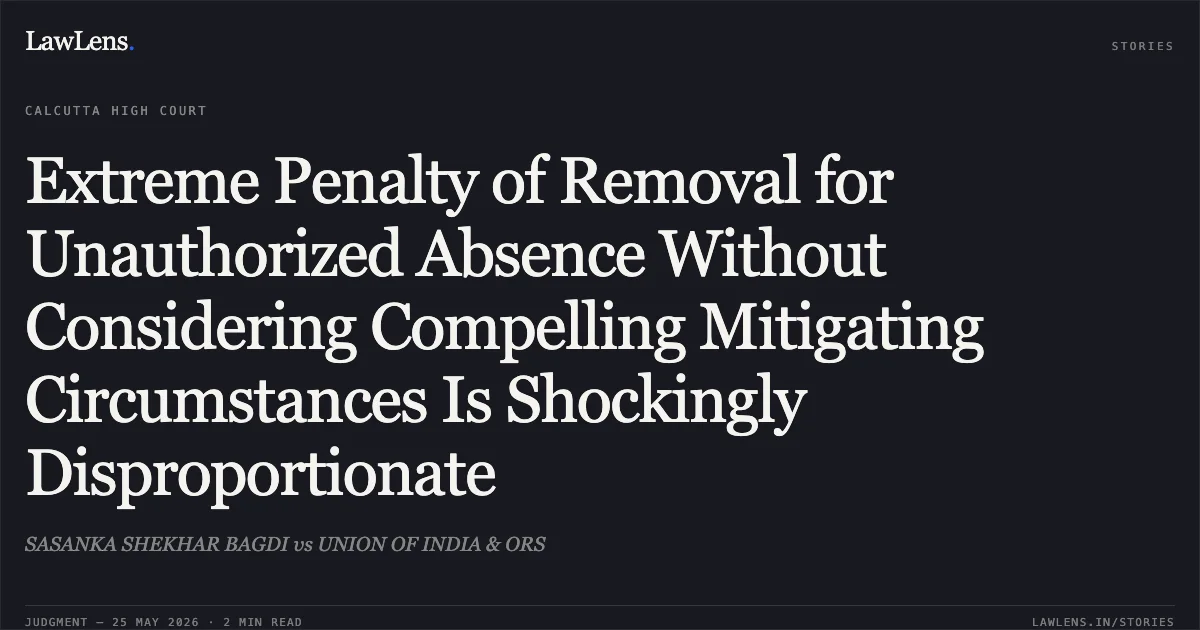
Source reference: para. 44Thus, while the misconduct was proved, the penalty of removal—which "kills a fly with a sledgehammer"—was found to be manifestly excessive and irrational under Article 226 review.
Source reference: para. 48, 55, 57Holding
The court held that while the finding of unauthorized absence was valid, the punishment was shockingly disproportionate.
The Court allowed the writ petition and quashed the order of removal from service dated 30.06.1996, remanding the matter to the Disciplinary Authority to pass a fresh, lesser penalty within 12 weeks.
Source reference: para. 59, 60, 61, 63Acts & Sections Cited
2 provisions across 1 statute referred to in this judgment. Each provision opens on LawLens.
Central Reserve Police Force Act, 19492
Original Court PDF
SASANKA SHEKHAR BAGDIvsUNION OF INDIA & ORS
Click to open original judgment
Original judgment, available to read, download and summarize on LawLens.in