Facts
The petitioners, residents of Gram Panchayat Bani, challenged the draft notification dated 23/24.11.2025 and the final notification dated 25.02.2026 regarding the constitution and declaration of Nagar Panchayat Barsar, District Hamirpur.
Source reference: p.1, p.2This was the second round of litigation; previously, in CWP No. 819 of 2025, the High Court had quashed an earlier notification and directed the Secretary (Urban Development) to pass a reasoned order after considering the petitioners’ objections.
Source reference: para 5The petitioners objected to the inclusion of their rural area in the Nagar Panchayat, arguing that the residents are primarily engaged in animal husbandry and agriculture, are below the poverty line, and cannot bear the financial burdens of an urban local body.
Source reference: para 3Following a personal hearing and a reasoned order dated 09.02.2026 rejecting the objections, the respondents issued the final notification.
Source reference: para 6, 7Issues
1. Whether the impugned notifications were arbitrary and illegal for failing to satisfy the essential ingredients and criteria for a "transitional area" as mandated under Article 243Q of the Constitution of India.
Source reference: para 1, 92. Whether the factors specified in Article 243Q(2), such as population density and non-agricultural employment, must be published in the draft notification for the constitution of a Nagar Panchayat.
Source reference: para 12Law Applied
Article 243Q of the Constitution of India, which mandates the constitution of a Nagar Panchayat for a "transitional area" (rural to urban transition).
Source reference: para 11Article 243Q(2), which empowers the Governor to specify such areas based on population, density, revenue, employment patterns, economic importance, or "such other factors" as deemed fit.
Source reference: para 11The Court also distinguished the precedent of Champa Lal v. State of Rajasthan & Ors. (2018) 16 SCC 356, which held that notifications failing to meet the requirements of Article 243Q(2) are unconstitutional.
Source reference: para 10Reasoning
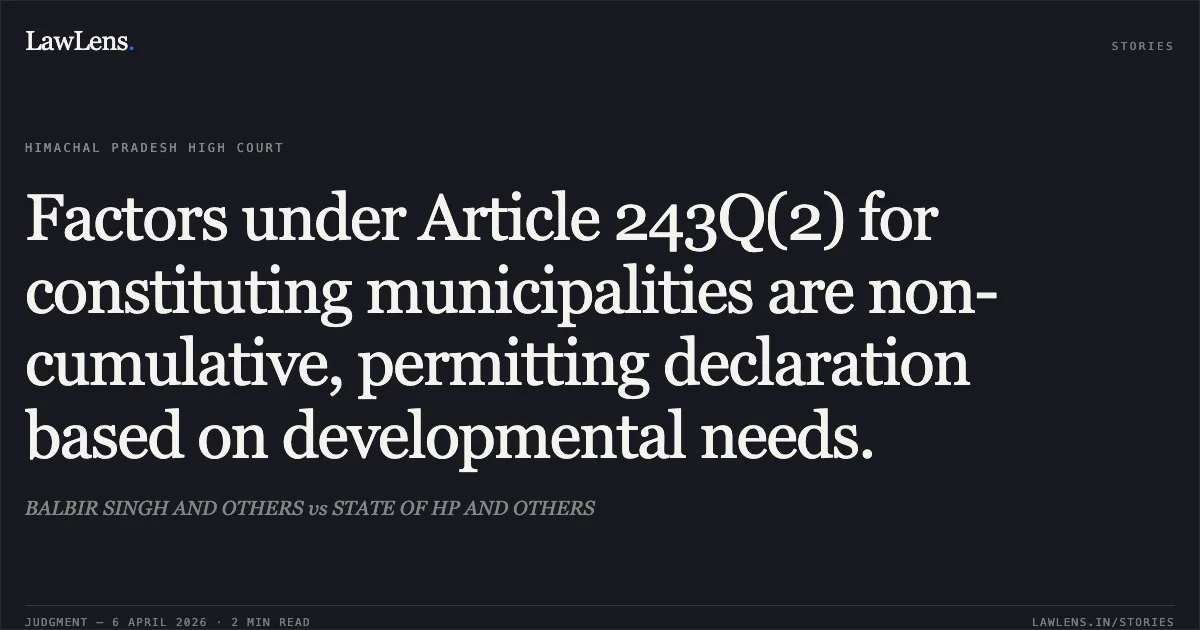
The Court observed that Article 243Q(2) does not mandate the cumulative existence of all listed factors; rather, the inclusion of "such other factors" grants the State broad discretion to declare an area as municipal for the purposes of "better development and well-organized arrangements".
Source reference: para 14The Court noted that the field reports submitted by the SDO and Tehsildar confirmed that the area had a population of 7,132 and generated an annual revenue of ₹19,75,480/-, which exceeded the standard thresholds.
Source reference: para 15, 18Furthermore, the court highlighted the presence of significant urban infrastructure, including a Civil Hospital, Courts, SDM office, banks, schools, hotels, and high tourist footfall due to the Baba Balaknath Ji Temple.
Source reference: para 16The Court reasoned that these factors sufficiently categorized the region as a "transitional area".
Source reference: para 18Unlike the Champa Lal case, where the State failed to specify reasons for the upgrade, the Himachal Pradesh government here had conducted a factual assessment and issued a reasoned order.
Source reference: para 14, 19Holding
The Court held that there was no arbitrariness, illegality, or violation of Articles 14 and 243Q of the Constitution in the constitution of Nagar Panchayat Barsar.
The Court found that the statutory and constitutional requirements were satisfied through the existence of urban institutional infrastructure and sufficient revenue generation.
Source reference: para 18Consequently, the High Court dismissed the petition, upholding the draft notification dated 23/24.11.2025 and the final notification dated 25.02.2026.
Source reference: para 20Original Court PDF
BALBIR SINGH AND OTHERSvsSTATE OF HP AND OTHERS
Click to open original judgment
Original judgment, available to read, download and summarize on LawLens.in