Facts
The plaintiff, a jewellery company, filed a commercial suit for the recovery of Rs. 6,51,28,139.99 for goods allegedly sold and delivered to the defendants
Source reference: para 2, 16The plaintiff asserted that the goods were supplied against eleven delivery challans and that the defendants accepted them without demur but failed to pay the outstanding balance
Source reference: para 4, 15The defendants filed an application for summary judgment under Order XIII-A of the Code of Civil Procedure (CPC), as amended by the Commercial Courts Act, 2015
Source reference: para 1The defendants contended that the goods were never delivered, noting that the invoices lacked countersignatures and that the plaintiff failed to comply with mandatory GST procedures for goods in transit under the CGST Act
Source reference: para 7, 9, 12Furthermore, the defendants relied on a prior balance confirmation email suggesting a significantly lower liability
Source reference: para 11Issues
1. Whether the plaintiff has no real prospect of succeeding on the claim within the meaning of Order XIII-A, Rule 3 of the CPC
Source reference: para 1, 62. Whether the dispute regarding the delivery of goods and the alleged non-compliance with statutory tax procedures constitutes a triable issue
Source reference: para 16, 22Law Applied
The court primarily applied Order XIII-A, Rule 3 of the CPC (as amended), which empowers the court to give a summary judgment if a party has no real prospect of succeeding on or defending a claim and there is no other compelling reason why the claim should not be disposed of before recording oral evidence
Source reference: para 1, 6, 25It further considered Section 24 of the Sale of Goods Act, 1930, regarding the passage of title upon approval or acceptance
Source reference: para 8Additionally, the court examined the procedural requirements under Section 142(12) and Rules 117 and 120 of the Central Goods and Services Tax Act, 2017 (CGST Act), concerning the movement of goods on approval and necessary statutory filings
Source reference: para 9, 10Reasoning
The court held that for the purpose of an application under Order XIII-A, the averments in the plaint must be treated as sacrosanct to determine if a real prospect of success exists
Source reference: para 19The plaintiff’s claim was built on specific delivery challans and ledger entries, which the defendants disputed as fabricated or legally untenable due to a lack of signatures and GST compliance
Source reference: para 15, 22The court reasoned that the defendants' arguments—specifically regarding the statutory presumptions arising from tax law non-compliance—require a "factual enquiry" and "witness action"
Source reference: para 20, 22The judge emphasized that summary judgment is not a substitute for a trial where triable issues of fact exist
Source reference: para 21Because the dispute involves whether goods were actually consumed or accepted on credit, the court determined it could not adjudicate the merits without a full trial
Source reference: para 17, 23Holding
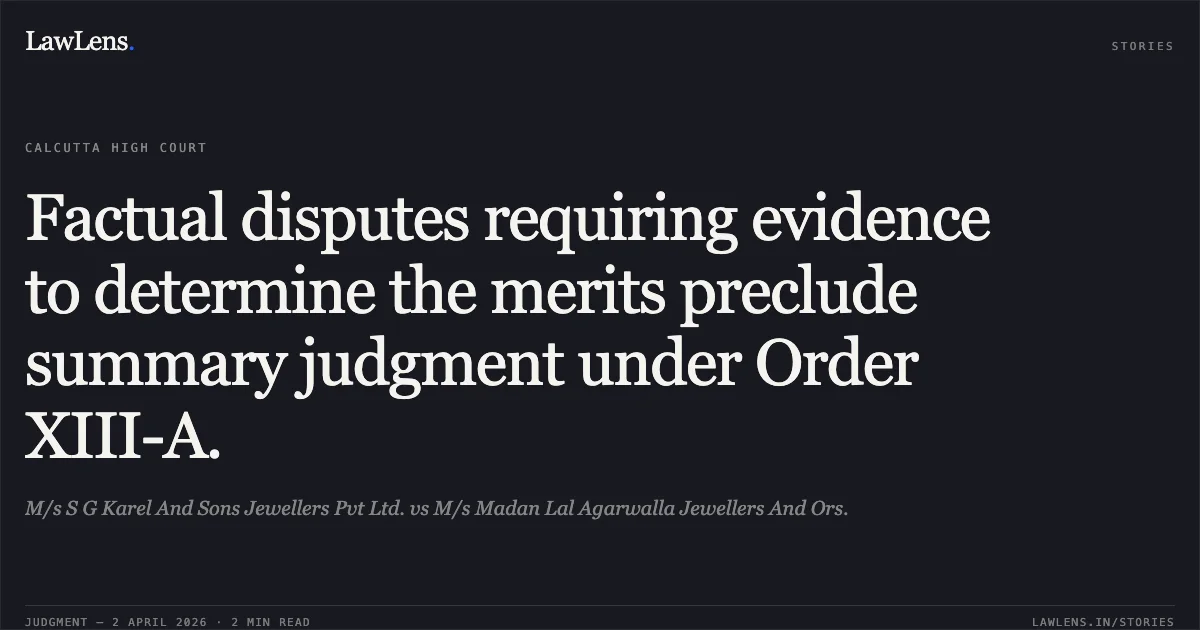
The court concluded that the criteria for summary judgment under Order XIII-A, Rule 3 were not met, as the case involves triable issues that cannot be resolved without a formal fact-finding process
The court reaffirmed that the right to a trial is a vested right of the plaintiff unless the claim is clearly barred by law
Source reference: para 25Consequently, the application for summary judgment was dismissed, and the suit was ordered to proceed to trial
Source reference: para 27, 28Acts & Sections Cited
2 provisions across 2 statutes referred to in this judgment. Each provision opens on LawLens.
Sale of Goods Act, 19301
Central Goods and Services Tax Act, 20171
Original Court PDF
M/s S G Karel And Sons Jewellers Pvt Ltd.vsM/s Madan Lal Agarwalla Jewellers And Ors.
Click to open original judgment
Original judgment, available to read, download and summarize on LawLens.in