Facts
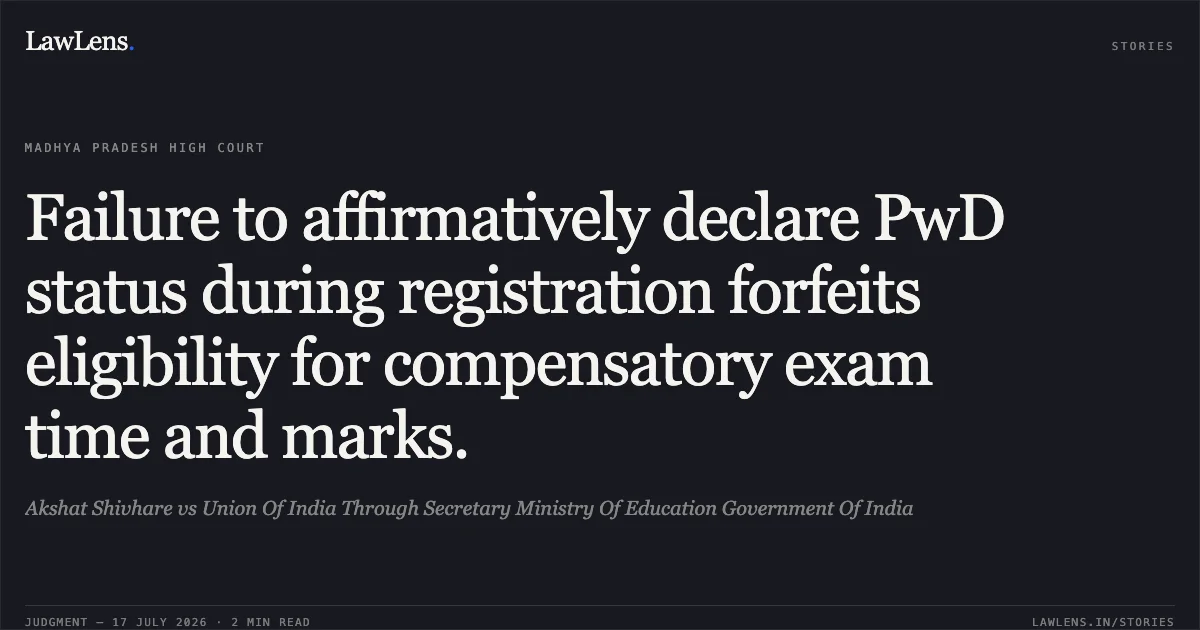
The appellant, a Person with Disability (PwD) suffering from Obsessive Compulsive Disorder (OCD) with more than 40% disability, appeared for the JEE Mains and JEE Advanced 2025 examinations.
Source reference: p.3, para. 4-5He alleged that he was denied compensatory time and accommodations during the exams despite requests to invigilators, leading to a loss of marks in the Chemistry section.
Source reference: p.3, para. 4The appellant challenged the Single Judge’s dismissal of his writ petition, which had found that he failed to select the PwD option or the requirement for a scribe/extra time in his online application form.
Source reference: p.1-2, para. 2The appellant contended he answered "No" to the PwD status questions due to confusion regarding the form's phrasing and his condition.
Source reference: p.3-4, para. 5Issues
1. Whether the appellant, having declared himself as a non-PwD candidate in the application form and failing to submit the requisite certificates, is legally entitled to compensatory marks or alternative admission relief.
Source reference: p.5, para. 82. Whether the court can grant relief based on supernumerary seats or additional attempts after the conclusion of the admission process and counseling.
Source reference: p.4, para. 6; p.5, para. 8Law Applied
Section 2(1) of the Madhya Pradesh Uchcha Nyayalaya (Khand Nyayapeeth Ko Appeal) Adhiniyam, 2005, regarding the maintainability of the writ appeal.
Source reference: p.1, para. 2The JEE Advanced 2025 Information Bulletin and Brochure mandate that candidates with at least 40% disability must submit a specific certificate (Annexure-II) during registration to avail of compensatory time or scribe services.
Source reference: p.5, para. 7Precedents concerning the rights and reasonable accommodations for PwD candidates: Vikas Kumar v. UPSC (2021) 5 SCC 370, Prince Jaibir Singh v. Union of India (2024) 11 SCC 793, and Atul Kumar v. Chairman (JoSAA) 2024 SCC OnLine SC 2684.
Source reference: p.5, para. 6Reasoning
The Court observed that the appellant explicitly answered "No" to both critical questions in the registration form: "Are you a PwD candidate?" and "Do you have disability and having difficulty in writing?".
Source reference: p.5-6, para. 8While the appellant claimed his OCD led to this confusion, the Court noted that the examination brochure clearly prescribed a mandatory procedure—specifically the submission of Annexure-II—to trigger the right to compensatory time.
Source reference: p.5, para. 7, 9Since the appellant failed to declare his status or submit the required format, the invigilators could not be faulted for denying extra time.
Source reference: p.6, para. 9The Court distinguished the cited Supreme Court precedents, finding them inapplicable because the appellant's own failure to follow mandatory registration requirements precluded the claim of a "deprived legal right".
Source reference: p.6, para. 8, 10Holding
The appellant's failure to declare his PwD status in the application form or submit the mandatory certificate formats disentitled him to any relief.
The Court affirmed the Single Judge's order, concluding that it was "too late in a day" to claim such rights after the examinations and counseling were concluded, and dismissed the appeal as devoid of merits.
Source reference: p.5, para. 8; p.6, para. 11Acts & Sections Cited
1 provisions across 1 statute referred to in this judgment. Linked provisions open on LawLens.
M.P. Uchcha Nyayalaya (Khand Nyayapeeth Ko Appeal) Adhiniyam, 20051
Original Court PDF
Akshat ShivharevsUnion Of India Through Secretary Ministry Of Education Government Of India
Click to open original judgment
Original judgment, available to read, download and summarize on LawLens.in