Facts
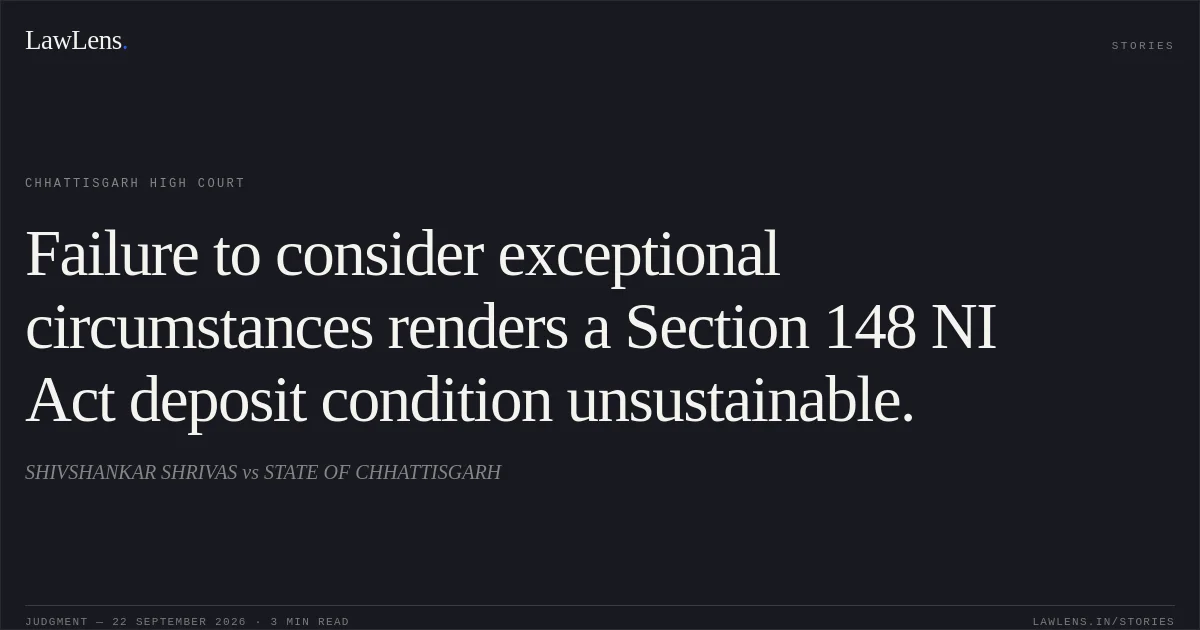
The petitioner was convicted by the Judicial Magistrate First Class, Bilaspur, under Section 138 of the Negotiable Instruments Act, 1881, in N.I.A. Case No. 52/2022. He was sentenced to two years’ simple imprisonment and directed to pay compensation of ₹4,00,000 to the complainant, with a further six months’ simple imprisonment in default of payment
Source reference: para. 2The petitioner preferred an appeal before the Sessions Court and sought suspension of sentence under Section 389 of the Code of Criminal Procedure, 1973/Section 430 of the Bharatiya Nagarik Suraksha Sanhita, 2023. The appellate court suspended the sentence but directed him to deposit 20% of the compensation amount within 60 days
Source reference: paras. 2, 6Before the High Court, the petitioner contended that he was more than 65 years old and had suffered a brain haemorrhage, and therefore the condition requiring deposit of 20% of the compensation ought to be relaxed
Source reference: para. 3The State opposed the petition, relying on Section 148(1) of the Negotiable Instruments Act
Source reference: para. 4Issues
Whether the appellate court was required to consider whether the petitioner’s case constituted an exceptional case warranting suspension of sentence without directing deposit of 20% of the compensation under Section 148(1) of the Negotiable Instruments Act?
Source reference: paras. 6–8Whether the direction to deposit 20% of the compensation was sustainable when the appellate court had not recorded reasons for rejecting suspension of the entire judgment without such a condition?
Source reference: para. 8Law Applied
The Court applied Section 389 of the Code of Criminal Procedure, 1973/Section 430 of the Bharatiya Nagarik Suraksha Sanhita, 2023, concerning suspension of sentence pending appeal, together with Section 148(1) of the Negotiable Instruments Act, which empowers the appellate court, in an appeal against conviction under Section 138, to order deposit of a minimum of 20% of the fine or compensation.
Source reference: no citationRelying on Jamboo Bhandari v. Madhya Pradesh State Industrial Development Corporation Ltd., (2023) 10 SCC 446, the Court held that the requirement of depositing 20% is not inflexible: the appellate court may dispense with it in an exceptional case, but must record reasons for doing so. Conversely, while considering an application for suspension of sentence, the court must examine whether the case warrants suspension without the deposit condition, even where the accused has not expressly sought such an exception
Source reference: para. 7Reasoning
The High Court found that the Sessions Court had imposed the 20% deposit condition while suspending execution of the sentence, but had not considered whether the case was exceptional or recorded reasons for refusing suspension of the entire judgment without that condition
Source reference: paras. 6, 8Under Jamboo Bhandari, the appellate court was required to undertake that consideration when deciding the petitioner’s application under Section 389 CrPC/Section 430 BNSS, particularly because the petitioner had sought suspension of the sentence and judgment without conditions. The absence of such consideration rendered the direction to deposit 20% legally unsustainable, irrespective of whether the appellate court was generally empowered to impose such a condition under Section 148(1) of the Negotiable Instruments Act
Source reference: paras. 7–8Holding
The High Court allowed the petition to the limited extent of setting aside the condition directing the petitioner to deposit 20% of the compensation amount.
The remaining conditions imposed by the appellate court’s order dated 15 July 2026 were maintained
Source reference: para. 9The Court clarified that the complainant/respondent No. 2 remained at liberty to file a separate application under Section 148 of the Negotiable Instruments Act, which the appellate court was directed to consider and decide in accordance with law. The CRMP was accordingly disposed of
Source reference: paras. 9–10Acts & Sections Cited
4 provisions across 3 statutes referred to in this judgment. Each provision opens on LawLens.
Code of Criminal Procedure, 19731
Bharatiya Nagarik Suraksha Sanhita, 20231
Negotiable Instruments Act, 18812
Original Court PDF
SHIVSHANKAR SHRIVASvsSTATE OF CHHATTISGARH
Click to open original judgment
Original judgment, available to read, download and summarize on LawLens.in