Facts
The appellant was arrested on November 7, 2023, for offenses under Sections 124A, 153A, and 120B of the IPC and Sections 18, 20, 38, and 39 of the UAPA
Source reference: para. 5-6The statutory 90-day period for filing a chargesheet under Section 167(2) of the CrPC was set to expire on February 5, 2024
Source reference: para. 6On February 2, 2024, the Special Judge granted a 25-day extension for the investigation upon an application by the Investigating Officer, forwarded by the APP
Source reference: para. 7The appellant was neither produced nor notified of this extension hearing
Source reference: para. 7, 23On February 8, 2024, the appellant applied for default bail, which the trial court rejected on February 20, 2024, citing the prior extension
Source reference: para. 9-10The High Court dismissed the appellant's challenge, holding that the filing of the chargesheet within the extended period rendered the default bail plea infructuous
Source reference: para. 3, 11, 14Issues
1. Whether the order extending the time for investigation was legally valid given the failure to produce the accused or provide notice
Source reference: para. 17, 262. Whether the mechanical grant of extension without recording justifiable reasons violates the fundamental right to liberty under Article 21
Source reference: para. 28-293. Whether the filing of a chargesheet after the expiry of the initial 90-day period, but within an improperly granted extension, defeats the accused's right to default bail
Source reference: para. 35-36Law Applied
Section 167(2) of the CrPC, which mandates the release of an accused on default bail if the investigation is not completed within the prescribed period
Source reference: para. 6, 28Section 43-D(2) of the UAPA, which allows for the extension of detention up to 180 days subject to a report by the Public Prosecutor indicating the progress of the investigation and specific reasons for continued detention
Source reference: para. 11, 30The precedent in Jigar v. State of Gujarat (2023), confirming that the production of the accused (physically or virtually) and notice of the extension application are mandatory requirements of law under Article 21 of the Constitution
Source reference: para. 26, 34Reasoning
The Court observed that the trial court's order dated February 2, 2024, was passed behind the appellant's back, violating the mandatory requirement to procure the presence of the accused during extension proceedings
Source reference: para. 23, 26, 29The Court noted that the "indefeasible right" to default bail is intrinsically linked to Article 21, and failure to notify the accused is a "gross illegality" rather than a mere procedural lapse
Source reference: para. 26the Court found that the Special Judge failed to exercise judicial mind, as the extension orders were granted mechanically based on "bald submissions" by the APP without recording specific reasons or evaluating the progress of the investigation
Source reference: para. 27, 31, 35Since the first extension was invalid, the subsequent custody beyond 90 days was unauthorized, and the appellant had "crystallized" his right to default bail by filing an application before the chargesheet was submitted
Source reference: para. 35-36Holding
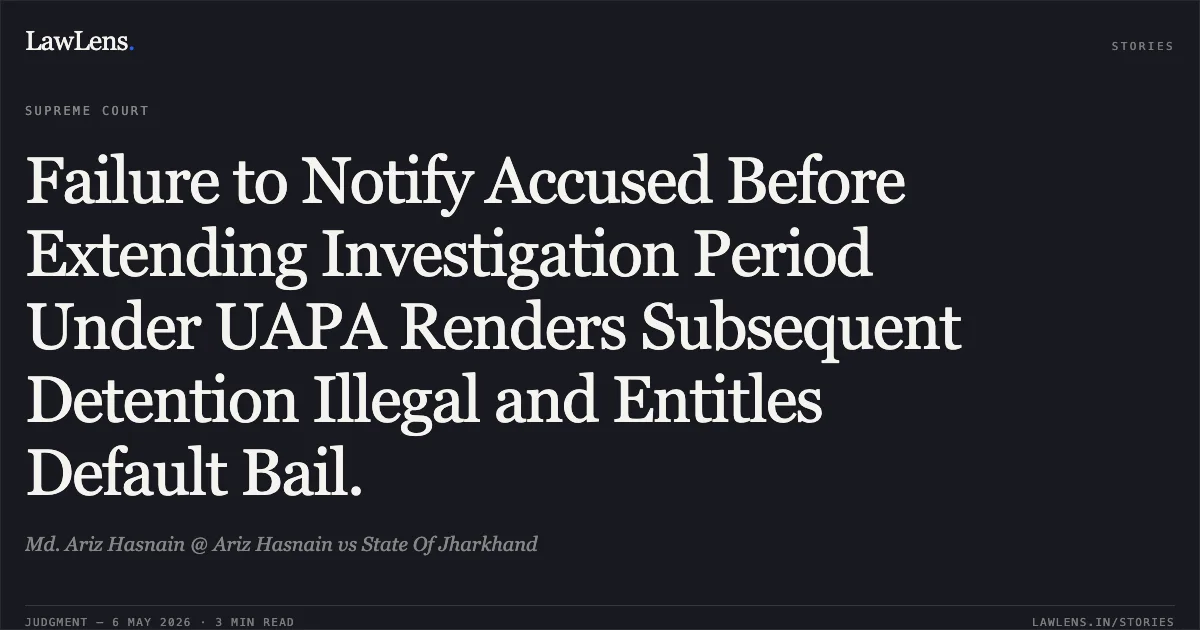
The Supreme Court set aside the High Court and Trial Court orders, holding that the extensions were legally unsustainable due to lack of notice and non-application of mind
The appellant acquired an indefeasible right to bail because the chargesheet was filed after the statutory period had expired and the intervening extension orders were void
Source reference: para. 36The Court ordered the appellant to be released on default bail under Section 167(2) CrPC, subject to conditions imposed by the trial court
Source reference: para. 38-39Acts & Sections Cited
7 provisions across 3 statutes referred to in this judgment. Each provision opens on LawLens.
Unlawful Activities (Prevention) Act, 19675
Code of Criminal Procedure, 19731
Gujarat University of Transplantation Sciences Act, 2015.1
Original Court PDF
Md. Ariz Hasnain @ Ariz HasnainvsState Of Jharkhand
Click to open original judgment
Original judgment, available to read, download and summarize on LawLens.in