Facts
Shambhu Roy claimed that he joined Hooghly Infrastructure Pvt. Ltd. as a badli worker on 25 May 1980 and resigned on 1 February 2014.
Source reference: para. 2–8He sought gratuity, asserting long service and relying on documents including an ESI card and wage slips.
Source reference: para. 2–8The employer disputed his eligibility, including whether he had completed the requisite days of service, and pointed to inconsistencies in his age and service history.
Source reference: para. 2–8The Controlling Authority awarded gratuity of ₹1,72,931 with interest of ₹1,68,608; the appellate authority upheld that decision, drawing an adverse inference from the employer’s failure to produce service records. The employer challenged both orders by writ petition.
Source reference: para. 2–8, 13–14Issues
1. Whether the authorities were justified in finding that Roy had established the service required to qualify for gratuity, notwithstanding his status as a badli worker and the employer’s challenge to proof of 240 days’ work.
Source reference: para. 7–8, 13–152. Whether the authorities’ orders awarding gratuity and interest warranted interference in writ jurisdiction.
Source reference: para. 1, 15–17Law Applied
Section 2A of the Payment of Gratuity Act, 1972, addresses continuous service, and Section 7(3A) provides for interest on delayed payment of gratuity; the Controlling Authority relied on Section 7(3A) in calculating interest.
Source reference: para. 7, 13The employer invoked decisions under Section 25B of the Industrial Disputes Act, 1947, concerning the claimant’s initial burden to prove 240 days’ work, including Range Forest Officer v. S.T. Hadimani and Manager, RBI, Bangalore v. S. Mani; it also relied on a Calcutta High Court Division Bench decision concerning badli workers.
Source reference: para. 7–8The appellate authority relied on Mahant Shri Srinivas Ramanuj Das v. Surjanarayan Das for drawing an adverse inference where a party fails to produce evidence within its possession.
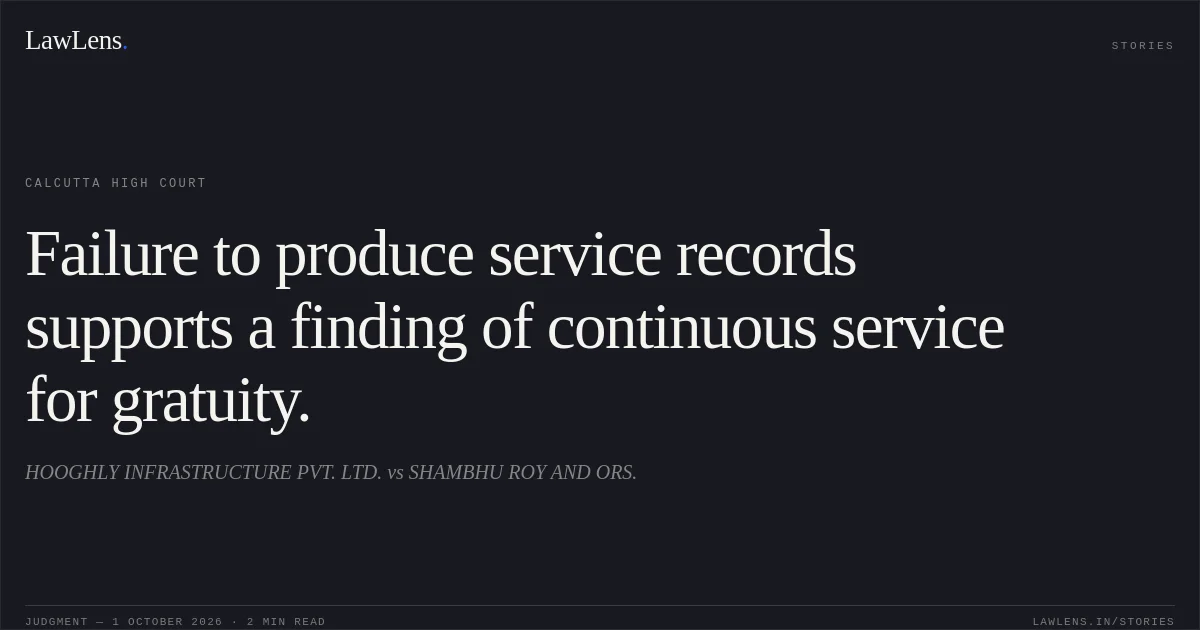
Source reference: para. 14The High Court’s stated basis for decision was that the employee had produced sufficient documents and the employer had failed to produce documents.
Source reference: para. 15–16Reasoning
The Court considered the employee’s documentary evidence alongside the employer’s failure to produce its records and concluded that the authorities had properly found the evidence sufficient to support the gratuity claim.
Source reference: para. 4–8, 14–16It accepted the authorities’ treatment of the employer’s failure to produce records as significant, notwithstanding the employer’s arguments about inconsistencies in Roy’s age and the limits of the available wage and attendance records. Finding the impugned orders consistent with law, the Court saw no basis to interfere.
Source reference: para. 4–8, 14–16Holding
The Court held that the employee had produced sufficient documents and that the authorities’ orders required no interference.
It dismissed the writ petition, disposed of any connected applications, and vacated any interim order.
Source reference: para. 15–19Acts & Sections Cited
4 provisions across 2 statutes referred to in this judgment. Linked provisions open on LawLens.
West Bengal Factories Rules, 19583
Industrial Disputes Act, 19471
Original Court PDF
HOOGHLY INFRASTRUCTURE PVT. LTD.vsSHAMBHU ROY AND ORS.
Click to open original judgment
Original judgment, available to read, download and summarize on LawLens.in