Facts
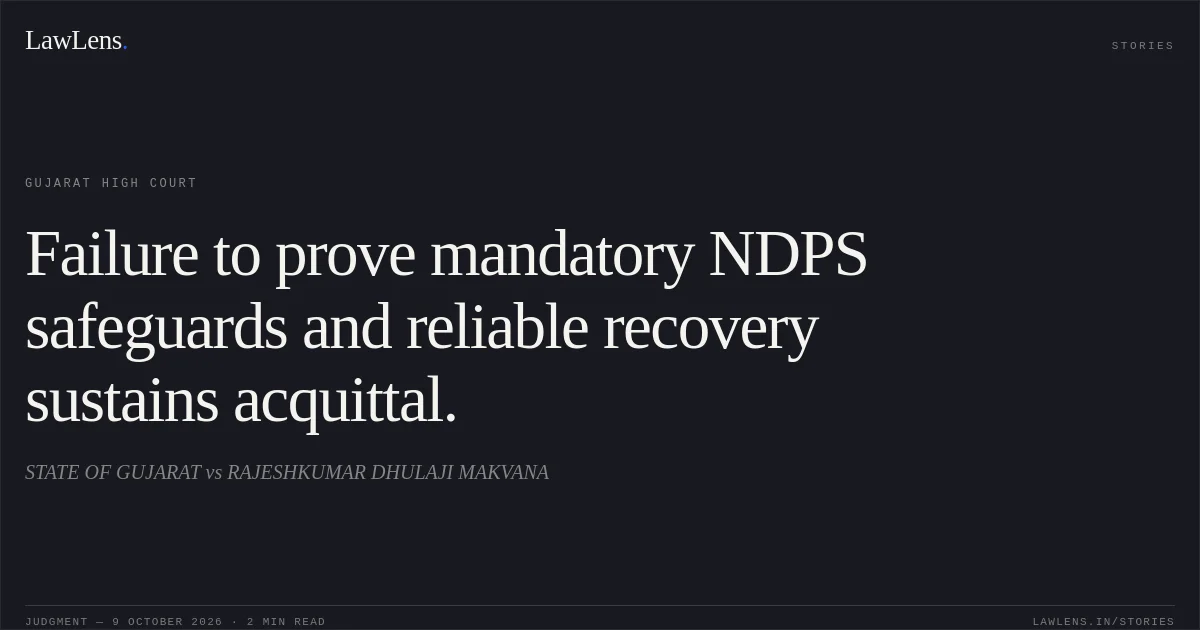
The State appealed against the acquittal of two accused of offences under Sections 8(c), 21 and 29 of the Narcotic Drugs and Psychotropic Substances Act, 1985 (NDPS Act).
Source reference: para. 1–2, 6–7, 9The prosecution alleged that accused No. 1, a police constable, was apprehended carrying 102 grams of brown sugar for delivery to accused No. 2.
Source reference: para. 1–2, 6–7, 9The trial court acquitted both accused, finding the prosecution case unproved. On appeal, the State challenged the assessment of the evidence and the findings concerning compliance with the NDPS Act
Source reference: para. 1–2, 6–7, 9Issues
Whether the trial court was justified in acquitting the accused, including whether its assessment of the evidence disclosed any illegality, irregularity or perversity warranting appellate interference
Source reference: para. 13Whether the prosecution proved the charged offences beyond reasonable doubt, having regard to the alleged procedural non-compliance and evidentiary deficiencies
Source reference: para. 13, 16–19Law Applied
The Court considered Sections 42, 50, 55 and 57 of the NDPS Act, concerning recording and reporting prior information, safeguards for personal searches, custody of seized articles, and reporting of arrests and seizures
Source reference: para. 18–19It relied on Karnail Singh v. State of Haryana, holding that compliance with Section 42 should ordinarily precede search and seizure, although delayed compliance may be accepted where adequately explained by genuine urgency
Source reference: para. 22It also applied Vijaysinh Chandubha Jadeja v. State of Gujarat, under which the person to be searched must be informed of the right under Section 50 to be searched before a Gazetted Officer or Magistrate, and non-compliance may render the recovery suspect
Source reference: para. 23The Court further applied the rule in Tofan Singh v. State of Tamil Nadu that a confessional statement made to an officer invested with powers under Section 53 of the NDPS Act, or a statement under Section 67, cannot be used as a confessional basis for conviction
Source reference: para. 11, 16On appeals against acquittal, Chandrappa v. State of Karnataka and subsequent authorities establish that an appellate court may reappraise the evidence, but must account for the reinforced presumption of innocence; where two reasonable views are possible, the acquittal should not be disturbed
Source reference: para. 31–34Reasoning
The Court found material inconsistencies between the raiding officers’ accounts, a lack of support from the panch witnesses, and discrepancies in the evidence concerning the weighing and custody of the seized substance.
Source reference: para. 16–19, 26, 28–30, 35–36It held that the prosecution had not established compliance with the relevant NDPS safeguards, including Sections 42, 50, 55 and 57.
Source reference: para. 16–19, 26, 28–30, 35–36The case against accused No. 2 rested on the co-accused’s custodial statement, which could not establish her involvement in light of Tofan Singh and the absence of corroborating evidence.
Source reference: para. 16–19, 26, 28–30, 35–36The Court concluded that these deficiencies left reasonable doubt and that the trial court’s acquittal was a reasonable view supported by the record, not a perverse or legally unsustainable one
Source reference: para. 16–19, 26, 28–30, 35–36Holding
The Court held that the prosecution had not proved the charges beyond reasonable doubt and that no basis existed to interfere with the acquittal.
The State’s appeal was dismissed, the trial court’s acquittal was confirmed, the bail bonds were cancelled, and the record and proceedings were directed to be returned to the trial court
Source reference: para. 35–37Acts & Sections Cited
21 provisions across 2 statutes referred to in this judgment. Each provision opens on LawLens.
Narcotic Drugs and Psychotropic Substances Act, 1985
Code of Criminal Procedure, 19735
Original Court PDF
STATE OF GUJARATvsRAJESHKUMAR DHULAJI MAKVANA
Click to open original judgment
Original judgment, available to read, download and summarize on LawLens.in