Facts
The applicant allegedly borrowed Rs. 2,50,000 from the complainant for business purposes and issued a cheque dated 02.05.2005.
Source reference: p. 4The cheque was dishonoured due to "insufficient funds".
Source reference: p. 4Despite a statutory notice, the applicant failed to make payment, leading to a complaint under Section 138 of the Negotiable Instruments (NI) Act.
Source reference: p. 3On 22.03.2007, the JMFC, Mangrol, convicted the applicant, sentencing him to one year of simple imprisonment, a fine of Rs. 5,000, and compensation of Rs. 50,000.
Source reference: p. 3This conviction was upheld by the Additional Sessions Judge, Surat, on 17.02.2011.
Source reference: p. 3The applicant moved the High Court in revision but remained absent during subsequent hearings, prompting the Court to decide the matter on merits based on available records.
Source reference: p. 2Issues
1. Whether the trial and appellate courts erred in convicting the applicant under Section 138 of the NI Act despite his defense that the cheque was issued as security for a smaller loan.
Source reference: p. 5-62. Whether the High Court, in its revisional jurisdiction, should interfere with the concurrent findings of fact recorded by the lower courts.
Source reference: p. 8-9Law Applied
Sections 118 and 139 of the Negotiable Instruments Act, which establish rebuttable presumptions that a cheque is issued for consideration and a legally enforceable debt.
Source reference: p. 5-7Bir Singh v. Mukesh Kumar regarding the validity of a signature on a blank cheque.
Source reference: p. 6Rajesh Jain v. Ajay Singh regarding the burden of proof to rebut statutory presumptions.
Source reference: p. 7Principles of revisional jurisdiction under Sections 397/401 of the CrPC as defined in Amit Kapoor v. Ramesh Chander, which restricts interference unless there is a patent defect, perversity, or error of law.
Source reference: p. 8-9Reasoning
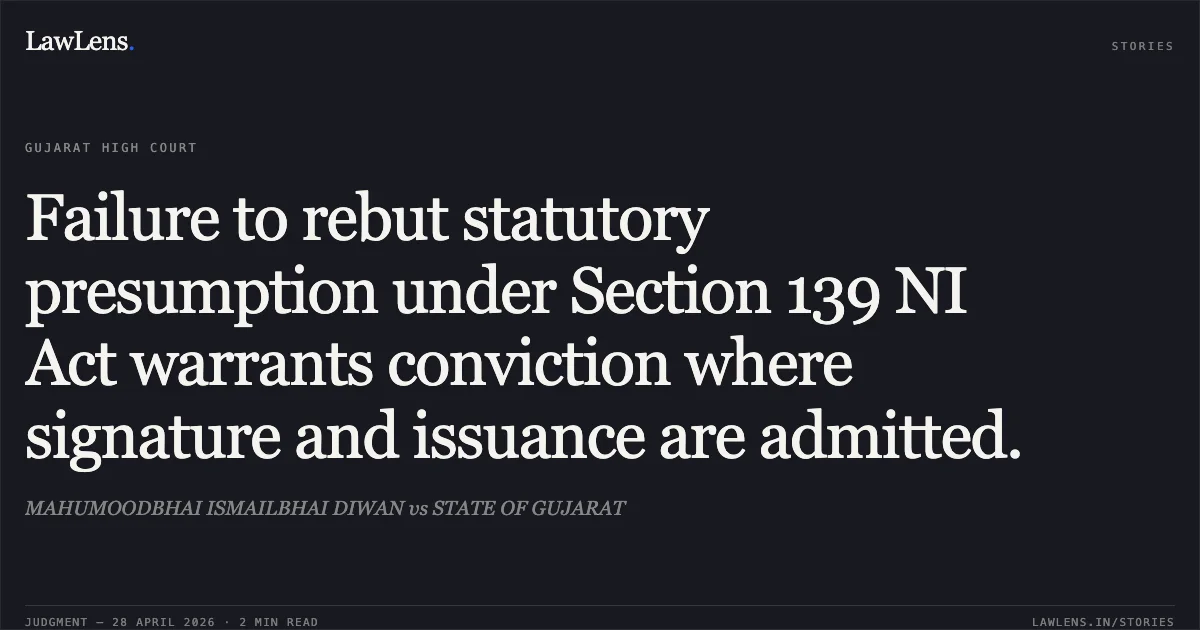
The Court observed that since the applicant admitted his signature on the cheque and the account belonged to him, the statutory presumption under Section 139 of the NI Act was automatically triggered.
Source reference: p. 4-5Under Sections 20 and 87 of the NI Act, even if the body of the cheque was not filled by the accused, the holder had the right to complete the instrument.
Source reference: p. 5The applicant’s defense—that the cheque was a blank security for a Rs. 12,000 loan related to medical expenses—was found unsubstantiated, as witnesses failed to prove the specific "security" arrangement or disprove the existence of a legally enforceable debt.
Source reference: p. 6In its revisional capacity, the Court determined that the lower courts had properly appreciated the evidence on a preponderance of probabilities and that there was no "palpable error" or "arbitrary exercise of discretion" to warrant interference.
Source reference: p. 8-9Holding
The High Court answered both issues in the negative, holding that the applicant failed to rebut the statutory presumptions and that the lower courts' findings were not perverse.
The revision application was dismissed, the interim relief was vacated, and the applicant was ordered to surrender to serve the remaining sentence. The Court further directed the Registry to release any deposited amounts to the complainant after verification.
Source reference: p. 10Acts & Sections Cited
8 provisions across 2 statutes referred to in this judgment. Each provision opens on LawLens.
Code of Criminal Procedure, 19733
Negotiable Instruments Act, 18815
Original Court PDF
MAHUMOODBHAI ISMAILBHAI DIWANvsSTATE OF GUJARAT
Click to open original judgment
Original judgment, available to read, download and summarize on LawLens.in