Facts
On May 25, 2014, a Junior Engineer of the MP Electricity Board reported the theft of 2.5 quintals of aluminum conductor wire (valued at Rs. 2,00,000/-) from a transmission line
Source reference: para 2Following an investigation, the police alleged that the wire was recovered based on disclosure statements made by the five accused persons while they were already in custody for another case
Source reference: para 11The Trial Court (Special Judge, Electricity Act, Anuppur) acquitted the accused on September 17, 2022, citing a lack of evidence
Source reference: para 1The State subsequently filed this appeal along with an application (I.A. No. 681/2023) seeking leave to appeal against the acquittal
Source reference: para 1, 7Issues
1. Whether the prosecution established the identity of the seized material as the stolen property belonging to the Electricity Department
Source reference: para 92. Whether the recovery of the property at the instance of the accused was legally sustainable and credible
Source reference: para 11-123. Whether there exists any patent perversity in the Trial Court's judgment of acquittal warranting interference by the High Court under Section 378 of the CrPC
Source reference: para 13, 19Law Applied
Section 378(3) of the Code of Criminal Procedure, 1973, regarding leave to appeal against acquittal
Source reference: para 1Sections 379 and 427 of the IPC, Section 136 of the Electricity Act, and Section 3(2)(ka) of the Prevention of Damage to Public Property Act, 1984
Source reference: para 1Section 27 of the Indian Evidence Act regarding the admissibility of information leading to discovery
Source reference: para 11Appellate principles established in H.D. Sundara v. State of Karnataka (2023) and Mallappa v. State of Karnataka (2024), which mandate that an acquittal should not be disturbed if the Trial Court’s view is "legally plausible," even if a contrary view is possible
Source reference: para 14, 18Reasoning
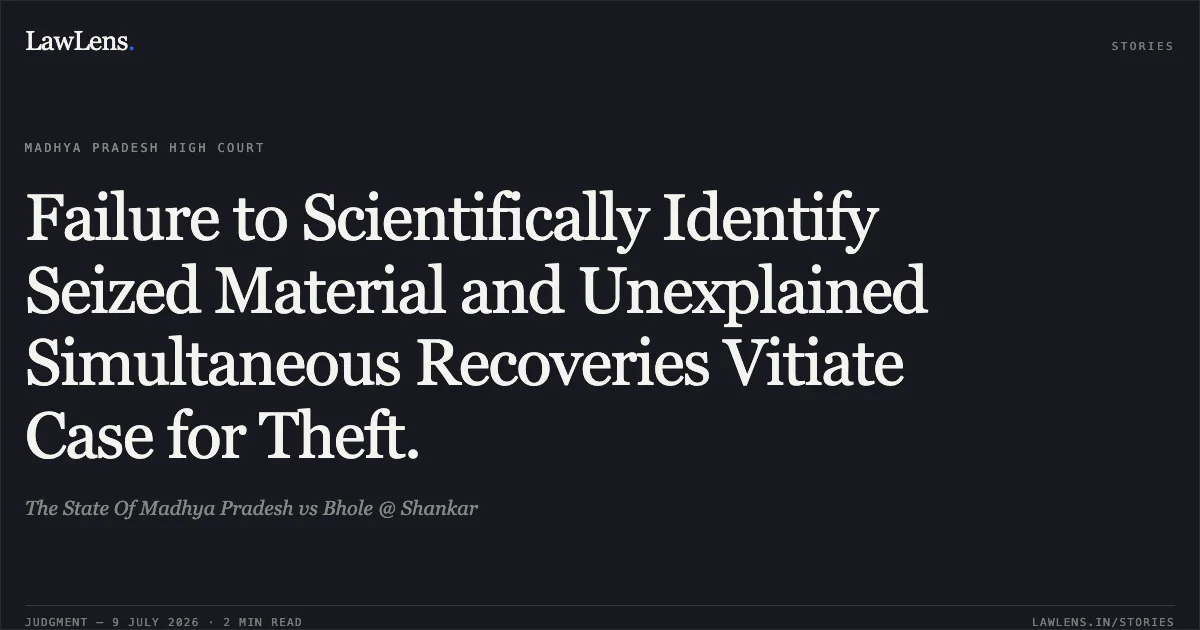
The Court found the prosecution's case fundamentally flawed as it failed to link the seized wire to the crime. Specifically, although a sample of the remaining wire was taken from the spot, no scientific comparison or identification parade was conducted to prove the seized wire was the same as the stolen property
Source reference: para 9Material witnesses, including an Electricity Department employee (PW-5) and independent recovery witnesses (PW-6), turned hostile
Source reference: para 10Furthermore, the Investigating Officer (PW-9) claimed separate recoveries was made from the same location for different accused persons, which the Court deemed a "serious doubt" regarding the genuineness of the proceedings
Source reference: para 11The absence of an official seal on the seizure memos (Ex. P/13 to P/18) further invalidated the authenticity of the recovery
Source reference: para 12The Court held that the Trial Court's decision to grant the benefit of the doubt was a reasonable and plausible view based on the evidentiary gaps
Source reference: para 13, 19Holding
The High Court held that the prosecution failed to prove the charges beyond reasonable doubt and that the Trial Court’s judgment was neither perverse nor manifestly erroneous
The application for leave to appeal (I.A. No. 681/2023) was dismissed. Consequently, the Criminal Appeal was dismissed at the admission stage without notice to the respondents
Source reference: para 20Acts & Sections Cited
6 provisions across 4 statutes referred to in this judgment. Each provision opens on LawLens.
Code of Criminal Procedure, 19731
Indian Penal Code, 18602
Prevention of Damage to Public Property Act, 19841
Electricity Act, 20032
Original Court PDF
The State Of Madhya PradeshvsBhole @ Shankar
Click to open original judgment
Original judgment, available to read, download and summarize on LawLens.in