Facts
The Appellant (S.P. Chandrakar) and Respondent No. 5 (Kishor Bagh) are employees of the District Central Cooperative Bank Ltd (DCCBL), Raipur, governed by the Rules of 1982.
Source reference: p. 2Chandrakar, originally a technical employee (Assistant Engineer), was promoted to the administrative post of Additional Manager on 30.12.2010.
Source reference: p. 3This promotion followed a 2010 circular by the Additional Registrar deleting Rule 5(3)(a), which previously barred technical staff from non-technical posts.
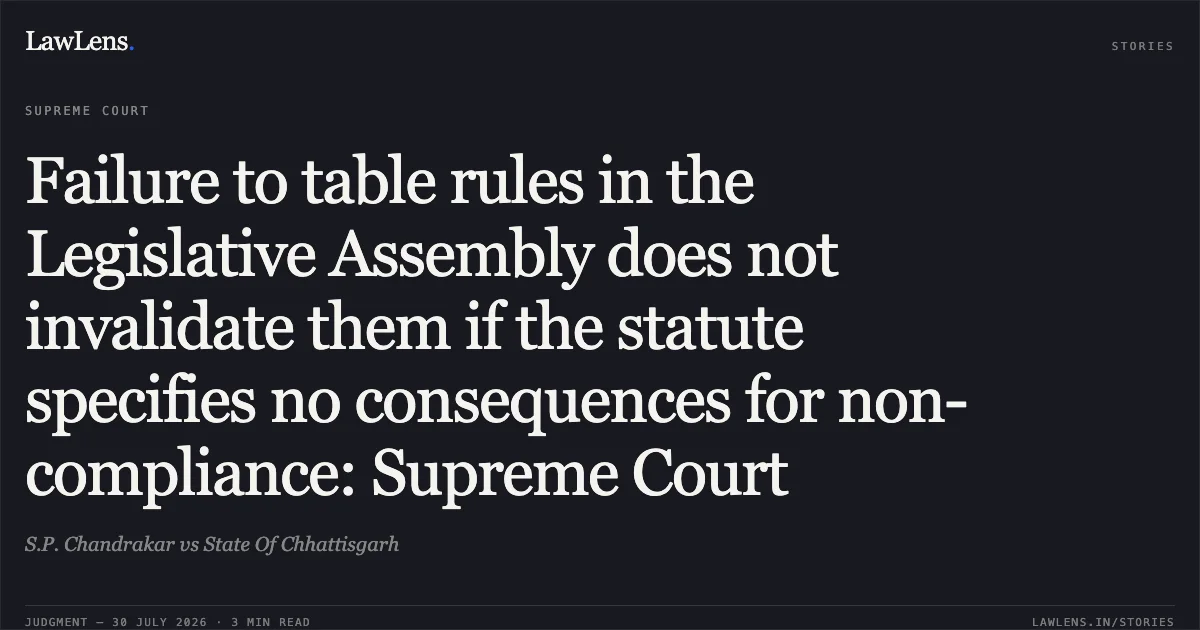
Source reference: p. 5-6Respondent No. 5 challenged the promotion, arguing the Registrar lacked authority to amend statutory rules via executive circular and that the rules were never tabled before the Legislative Assembly as required by Section 95(3) of the Act, 1960.
Source reference: p. 3, 6The High Court upheld the challenge, setting aside the promotion after thirteen years.
Source reference: p. 3-4Issues
1. Whether the Registrar of Cooperative Societies possesses the power to amend or delete the Service Rules under Section 55(1) of the Chhattisgarh Cooperative Societies Act, 1960.
Source reference: p. 72. Whether the requirement to "lay" rules before the Legislative Assembly under Section 95(3) of the Act is mandatory or directory.
Source reference: p. 83. Whether an amendment communicated via an executive circular/instruction is valid if the power to frame such rules is statutorily vested in the issuing authority.
Source reference: p. 12Law Applied
Section 55(1) of the Chhattisgarh Cooperative Societies Act, 1960, which empowers the Registrar to frame rules governing terms of employment.
Source reference: p. 6Section 21 of the General Clauses Act, 1897, establishing that the power to "frame" rules inherently includes the power to add, amend, vary, or rescind them.
Source reference: p. 7The principles in Atlas Cycle Industries Ltd. v. State of Haryana and K.T. Plantation (P) Ltd. v. State of Karnataka, which distinguish between mandatory and directory "shall" based on the presence or absence of consequences for non-compliance.
Source reference: p. 10-11The doctrine from Hukumchand Mills Ltd. v. State of M.P., stating that a wrong reference to power or nomenclature does not vitiate an action if a valid statutory power exists to support it.
Source reference: p. 12-13Reasoning
The Court reasoned that Section 55(1) provides the Registrar with plenary power to determine service conditions; thus, the deletion of Rule 5(3)(a) was within his jurisdiction, regardless of whether the communication was labeled as a "circular".
Source reference: p. 7, 13The Court rejected the High Court’s finding that the Additional Registrar acted without authority, noting the circular explicitly stated it was "Ordered by Registrar".
Source reference: p. 7-8Addressing Section 95(3), the Court held that since the statute prescribes no penalty or consequence for failing to table the rules before the Assembly, the provision is directory, not mandatory.
Source reference: p. 10, 12Consequently, the lack of tabling did not invalidate the amendment.
Source reference: p. 12The Court observed that a promotion undisturbed for thirteen years should not be lightly set aside, especially when founded on a valid exercise of statutory power.
Source reference: p. 13Holding
The Supreme Court allowed the appeal and set aside the High Court judgments.
The Court held that the Registrar had the requisite power to delete the restrictive rule and that the notification was valid despite the procedural omission of legislative tabling.
Source reference: p. 7, 12The Court ordered that the Appellant be restored to his position and status with protected seniority, all consequential promotion benefits, and 50% back wages payable within two months, failing which 6% interest per annum shall apply.
Source reference: p. 14Original Court PDF
S.P. ChandrakarvsState Of Chhattisgarh
Click to open original judgment
Original judgment, available to read, download and summarize on LawLens.in