01Facts
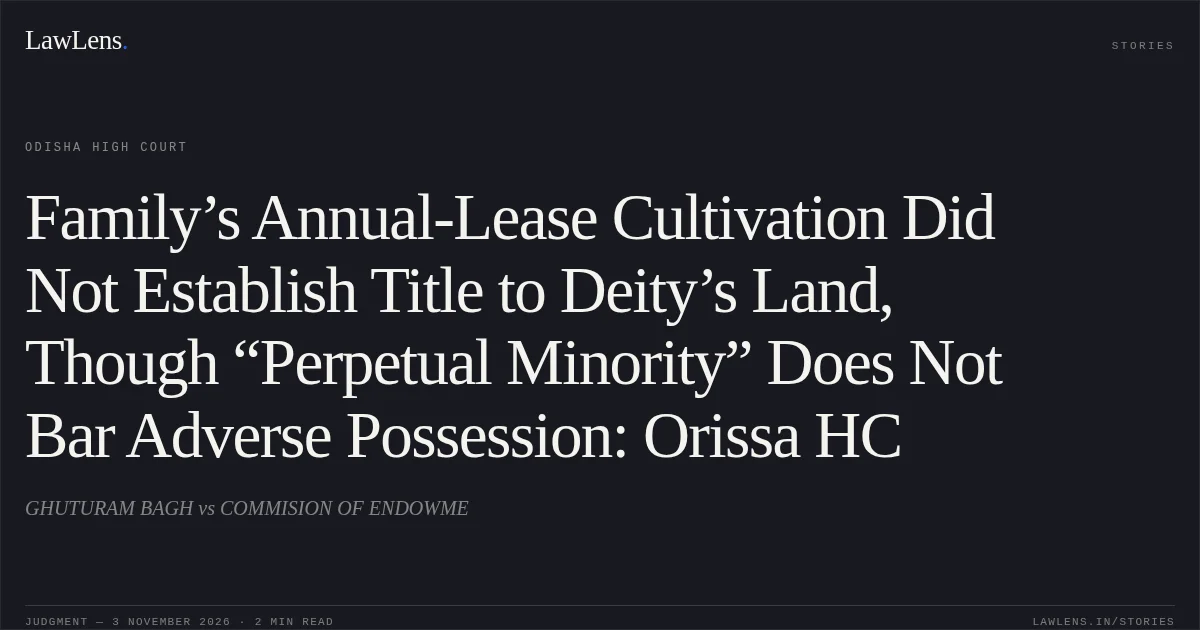
The plaintiff claimed a right of occupancy and title by adverse possession over land belonging to the deity Maa Sureswari Devi, relying on his family’s longstanding cultivation.
¶ 2The trial court dismissed the suit, finding that the land had been cultivated under annual lease arrangements and that the plaintiff had not established adverse possession. The first appellate court affirmed.
¶ 6–10In second appeal, the plaintiff also sought protection of his possession against forcible dispossession.
¶ 1102Issues
i.1. Whether adverse possession can be claimed against property belonging to a deity, notwithstanding the deity’s description as a perpetual minor
¶ 10ii.2. Whether the plaintiff proved possession that was hostile, open, continuous, and maintained for the prescribed period, and whether the claim to confirmation of possession could succeed independently
¶ 10, 1603Law Applied
Under Section 100 of the Code of Civil Procedure, 1908, a second appeal is confined to substantial questions of law; concurrent findings may be reviewed where, for example, the courts below applied the law incorrectly or ignored material evidence (Santosh Hazari v. Purushottam Tiwari; Hero Vinoth v. Seshammal).
¶ 13–15A deity is not exempt from the law of limitation merely because it is regarded as a perpetual minor (M. Siddiq v. Mahant Suresh Das).
¶ 17Adverse possession requires the claimant to plead and prove possession that is open, continuous, and hostile to the true owner, including when and how it became adverse (Karnataka Board of Wakf v. Government of India).
¶ 20Permissive possession does not become adverse by lapse of time alone; a hostile change in its character must be proved (Thakur Kishan Singh v. Arvind Kumar).
¶ 21–22A person in settled possession may be protected against forcible dispossession, but that protection does not establish title (Rame Gowda v. M. Varadappa Naidu).
¶ 29, 32A plaintiff may seek affirmative relief on perfected adverse title, but must prove its factual foundation (Ravinder Kaur Grewal v. Manjit Kaur).
¶ 27Provisions in the judgment · 3 · Linked ones open on LawLens
Code of Civil Procedure, 1908 Section 100Section 109Section 110
04Reasoning
The courts below erred in treating the deity’s perpetual-minor status as an absolute bar to adverse possession. That legal error did not, however, undermine their independent finding that the receipts evidenced annual leases and payment of bhag.
¶ 19, 23–25Such occupation was referable to permission and did not establish when or how possession became hostile to the deity, or that hostile possession continued for the prescribed period.
¶ 23–25, 28The claim to occupancy rights likewise could not be established merely by the duration of cultivation.
¶ 31The court distinguished protection against forcible dispossession from a declaration of title or occupancy rights; the former did not warrant the latter.
¶ 29–3205Holding
The court held that a deity is not beyond the operation of limitation merely because it is a perpetual minor, but the plaintiff failed to prove adverse possession or the independent right claimed.
¶ 18, 28, 33It affirmed the judgments below, clarified that the dismissal was not a decree for eviction and did not authorise dispossession except in accordance with law, and dismissed the second appeal without costs.
¶ 32, 34–36Original Court PDF
GHUTURAM BAGHvsCOMMISION OF ENDOWME
Click to open original judgment
Original judgment, available to read, download and summarize on LawLens.in