01Facts
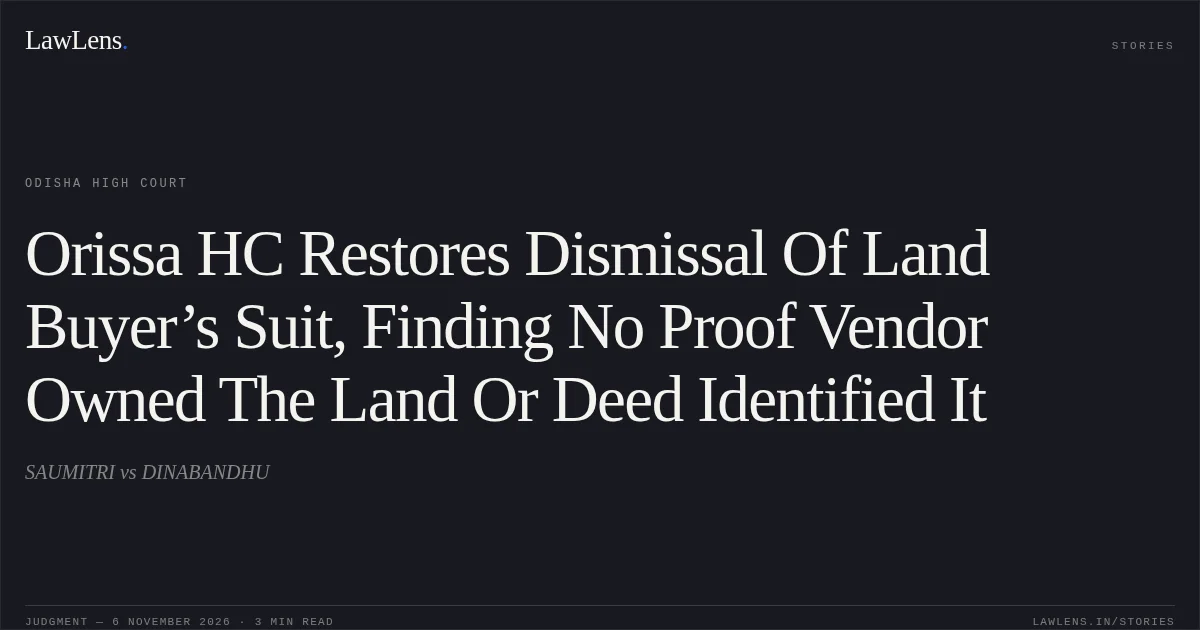
The Plaintiff claimed title to portions of Hamid Settlement Plot Nos. 2607 and 2605 under a registered sale deed dated 8 June 1955 and sought declaration of title and permanent injunction.
The Trial Court dismissed the suit, finding that the Plaintiff had not established his vendor’s title or sufficiently identified the suit land; it also found that the Defendants’ purchase under Ext.H was separate from the suit land and rejected their adverse-possession claim
pp. 15–16The First Appellate Court reversed the dismissal, relying on the sale deed and revenue records. The Defendants appealed under Section 100 CPC
pp. 2, 16–1702Issues
i.1. Whether the First Appellate Court erred in treating the registered sale deed and revenue entries as sufficient to establish the Plaintiff’s title without determining whether his vendor had title
pp. 18, 20–23ii.2. Whether the finding that the Hamid Settlement plots corresponded to the Major Settlement plots, and that the suit land was identifiable, was unsupported by evidence linking the land conveyed to the land claimed
pp. 18, 23–25iii.3. Whether the concurrent finding that the land purchased under Ext.H was distinct from the suit land could, by itself, sustain the Plaintiff’s claim
pp. 18, 25–27iv.4. Whether a permanent injunction could be granted without proof of the Plaintiff’s possession of an identified parcel on the date of suit
pp. 18, 27–2903Law Applied
Section 100 CPC permits interference with factual findings where they rest on no evidence, overlook material evidence, or proceed on an erroneous legal principle; it does not permit mere reappreciation of evidence (*Hero Vinoth (Minor) v. Seshammal*)
p. 18A reversing First Appellate Court must engage with the Trial Court’s reasons and give a reasoned basis for reversing them (*Santosh Hazari v. Purushottam Tiwari*)
p. 19Under Section 8 of the Transfer of Property Act, 1882, a transferor can convey only the interest he is capable of transferring. A plaintiff seeking title must prove it on the strength of their own case; revenue entries do not, by themselves, establish title (*Suraj Bhan v. Financial Commissioner*; *Union of India v. Vasavi Co-operative Housing Society Ltd.*)
pp. 22–23Sections 101–102 of the Indian Evidence Act, 1872 place the burden of proof on the party asserting the fact
p. 23Order VII Rule 3 CPC requires a description sufficient to identify immovable property
p. 23Section 103 CPC permits the High Court to determine a necessary factual issue where the record suffices
p. 29A Section 145 CrPC proceeding does not determine title, though its possession finding may be relevant evidence
p. 29Provisions in the judgment · 4 · Linked ones open on LawLens
Code of Civil Procedure, 1908 Section 100Section 103
Code of Criminal Procedure, 1973 Section 145
Transfer of Property Act, 1882 Section 8
04Reasoning
The First Appellate Court wrongly treated the absence of a challenge to the execution of Ext.1 as dispensing with proof of the vendor’s title; execution of a deed and the transferor’s title are distinct questions
pp. 20–22The revenue records could neither establish Narayan Das’s title in 1955 nor prove that the portions conveyed under Ext.1 were the same land claimed in the suit
pp. 22–23Because Ext.1 conveyed only portions of larger plots, lacked boundary descriptions, and its trace map was not produced, the evidence did not sufficiently identify the suit parcel; the First Appellate Court also failed to address the Trial Court’s contrary finding
pp. 23–25The finding that Ext.H concerned separate land did not affirmatively establish the Plaintiff’s title or identify his land
pp. 25–27Nor was there an independent finding supported by evidence that the Plaintiff possessed an identified parcel when the suit was filed; the Section 145 proceeding did not decide title but remained relevant to possession
pp. 27–29The High Court found the record sufficient to resolve the appeal without remand
p. 2905Holding
The High Court answered the substantial questions in favour of the Appellants, holding that the First Appellate Court’s conclusions on title, identification, and possession were legally unsustainable
p. 23, 25, 27, 29It allowed the Second Appeal, set aside the First Appellate Court’s judgment and decree, restored the Trial Court’s dismissal of the suit, and directed the parties to bear their own costs
p. 30Original Court PDF
SAUMITRIvsDINABANDHU
Click to open original judgment
Original judgment, available to read, download and summarize on LawLens.in