Facts
The petitioner, a Special Assistant to the Chairman of the J&K Legislative Council, was accused in 2006 of submitting a fake matriculation certificate to misrepresent his date of birth (DOB) as 1975 instead of 1973
Source reference: para. 03An initial enquiry committee recommended his reversion, but the competent authority (the Chairman) took a lenient view, issuing a formal warning on 20.03.2007 and directing the petitioner to produce the correct certificate for record correction
Source reference: para. 04, 14Subsequently, the J&K Government issued Circular No. 14 GAD/2007 granting general amnesty to employees who corrected manipulated DOB records by 30.05.2007
Source reference: para. 05, 16Despite the initial matter being closed, the respondents initiated a fresh regular enquiry in 2011 on the same allegations, leading to an order dated 15.09.2011 forfeiting two annual increments
Source reference: para. 07, 11During the pendency of the challenge against this order, the respondents constituted a third enquiry committee via communication dated 03.04.2013
Source reference: para. 09Issues
1. Whether the disciplinary authority has the power to re-open or review a decided enquiry and impose a fresh punishment on the same allegations in the absence of an express statutory provision for review?
Source reference: para. 17, 192. Whether the initiation of a third enquiry on the same facts during the pendency of a writ petition is legally sustainable?
Source reference: para. 173. Whether the procedural requirements of Rule 33 of the J&K Civil Services (Classification, Control and Appeal) Rules, 1956, were satisfied during the second enquiry?
Source reference: para. 24Law Applied
The court primarily applied the J&K Civil Services (Classification, Control and Appeal) Rules, 1956, specifically Rule 33, which mandates a formal procedure (including a memo of charges) for imposing major penalties
Source reference: para. 07, 18The court relied on the established principle that a quasi-judicial authority (which a disciplinary authority is) lacks the inherent power to review its own decision unless such power is expressly granted by statute or rules
Source reference: para. 19It cited State of Haryana v. Roshan Lal Sharma (1970), which held that the exoneration or dropping of charges is a quasi-judicial act that cannot be varied at will
Source reference: para. 20it applied the ratio from Dr. P. Kumari v. State of Punjab (1981), asserting that an employee cannot be punished twice for the same lapse
Source reference: para. 22Reasoning
The court reasoned that when the Chairman decided to issue a "warning" in 2007 instead of a major penalty, that decision attained finality
Source reference: para. 18Since the 1956 Rules do not vest the disciplinary authority with the power of review, a successor in office cannot re-open the case simply because they disagree with a predecessor's "lenient view"
Source reference: para. 19, 23The court observed that the second enquiry was procedurally flawed as no memo of charges was framed or served upon the petitioner, violating the principles of natural justice and Rule 33
Source reference: para. 24Additionally, the petitioner was protected by the 2007 Amnesty Circular as he had corrected his records before the deadline
Source reference: para. 16The court found that subjecting an employee to repeated enquiries for the same allegations is legally untenable and smacks of mala fides
Source reference: para. 09, 23Holding
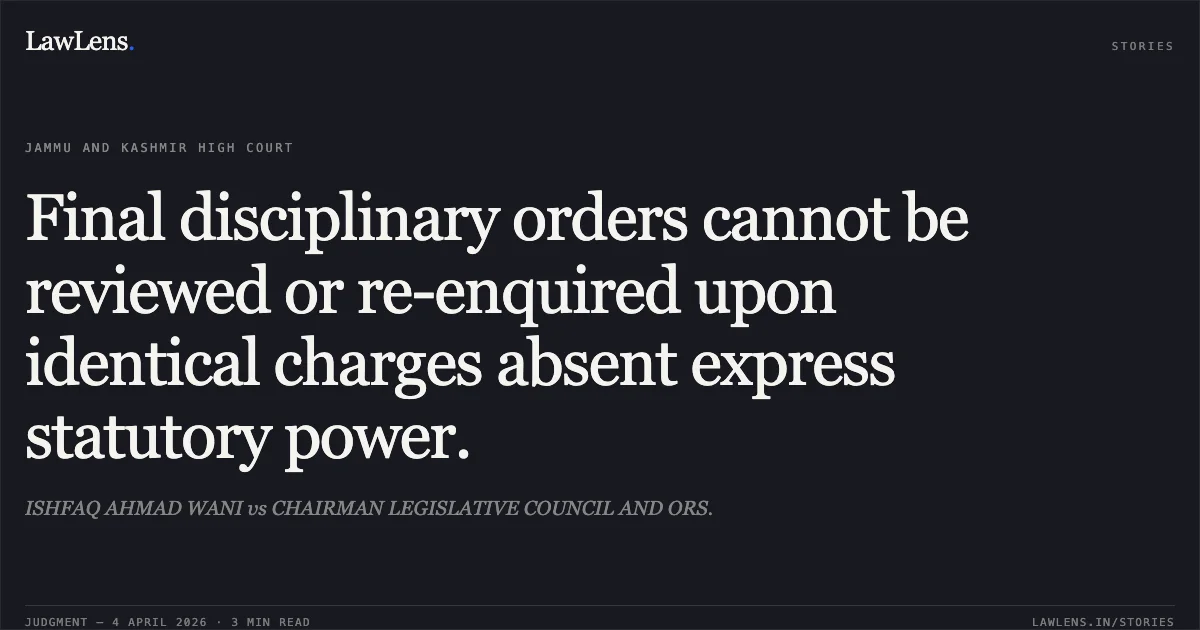
The High Court allowed both writ petitions. It quashed the order dated 15.09.2011, which forfeited the petitioner's increments, and quashed the communication dated 03.04.2013, which sought to initiate a third enquiry
The court held that once a disciplinary authority takes a final decision on an enquiry report, that decision cannot be reviewed or re-opened under the J&K Civil Services (CCA) Rules, 1956, regardless of whether the initial decision was perceived as erroneous or unjust
Source reference: para. 20, 23All subsequent proceedings based on the same allegations were declared void
Source reference: para. 25Acts & Sections Cited
4 provisions across 1 statute referred to in this judgment. Each provision opens on LawLens.
Indian Penal Code, 18604
Original Court PDF
ISHFAQ AHMAD WANIvsCHAIRMAN LEGISLATIVE COUNCIL AND ORS.
Click to open original judgment
Original judgment, available to read, download and summarize on LawLens.in