01Facts
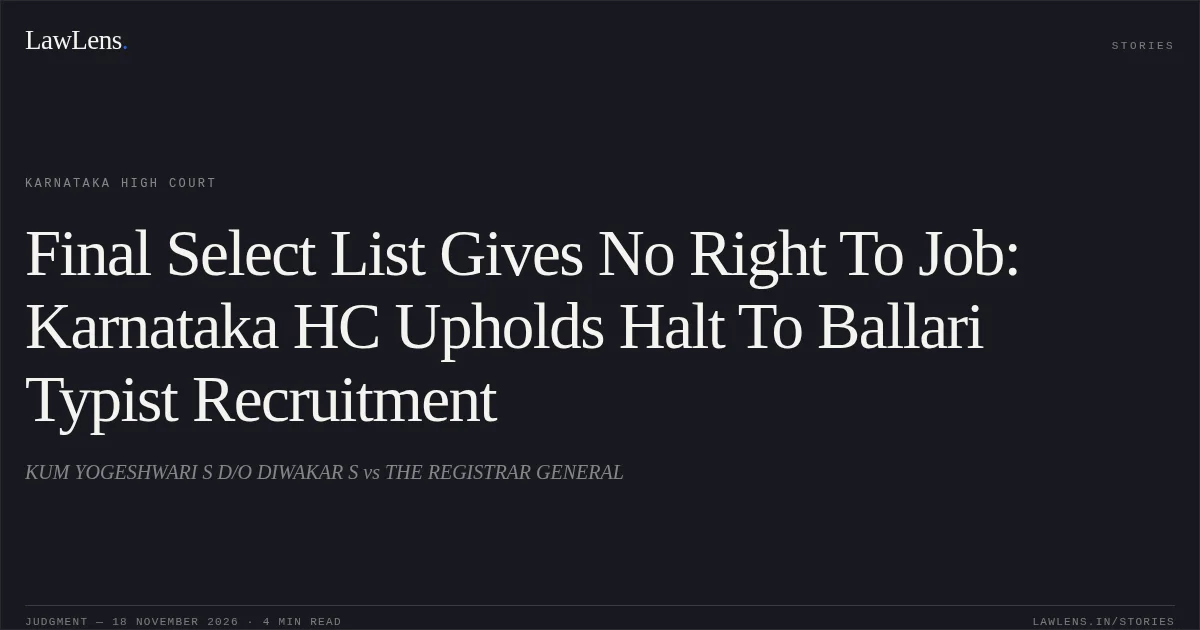
The Principal District and Sessions Judge, Ballari (Respondent No. 2), issued a notification inviting applications for the post of Typist-cum-Copyist. The appellant applied, participated in the selection process, and was included in the select list.
¶ 3 · ¶ 7An intimation for viva voce was issued to the appellant.
¶ 3 · ¶ 7The entire selection was then shelved. The appellant and others challenged this before the learned Single Judge, contending that the selection could not be abandoned midstream because selected candidates had acquired a right to appointment.
¶ 3Respondent No. 2 maintained that the non-continuation was an administrative decision taken for manifold reasons, and that this decision had been placed before and accepted by the Single Judge.
¶ 5The appellant's counsel contended that the only reason for cancellation was an alleged obfuscation in the qualifying examination, which could not justify cancelling the process.
¶ 4The appellant's prayers before the Division Bench sought to set aside the Single Judge's order, and to direct Respondent No. 2 to complete the selection under Rule 4(1)(h) of the Subordinate Courts (Ministerial and Other Posts) (Recruitment) (Amendment) Rules, 2007, and to complete recruitment within a time-bound period.
p. 2The learned Single Judge held that a candidate in the select list gets no indefeasible right to appointment.
¶ 102Issues
i.1. Whether a candidate whose name figures in the final select list, and who has been called for viva voce, acquires an indefeasible right to be appointed, such that the selection process cannot be discontinued.
¶ 3 · ¶ 7 · ¶ 9ii.2. Whether the High Court, under Article 226 of the Constitution, can direct the respondents to continue the recruitment process and fill the subsisting vacancies.
¶ 8iii.3. Whether the order of the learned Single Judge suffers from perversity warranting interference in intra-court appeal.
¶ 1203Law Applied
Article 226 of the Constitution is the source of writ jurisdiction, and directions to continue a selection or fill vacancies fall within the administrative domain, which the Court will not enter.
¶ 8Shankarsan Dash v. Union of India, (1991) 3 SCC 47 (Constitution Bench) holds that a notification is merely an invitation to apply, that selected candidates acquire no right to appointment, and that the State is under no legal duty to fill vacancies unless the recruitment rules so provide.
¶ 10, quoting ¶7 · ¶8 (discussing State of Haryana v. Subash Chander Marwaha, Neelima Shangla, and Jatinder Kumar)Under Shankarsan Dash, the State must act bona fide and for appropriate reasons, and must respect comparative merit if it fills any vacancy.
¶ 10, quoting ¶7 · ¶8Tej Prakash Pathak v. High Court of Rajasthan, (2025) 2 SCC 1 applies the doctrine of legitimate expectation subject to the overriding public interest.
¶ 9 (¶¶25–27)Tej Prakash Pathak holds that a candidate in the final select list gets no indefeasible right to appointment even where vacancies exist, but that the State cannot arbitrarily deny appointment, and bears the burden of justifying non-appointment when challenged.
¶ 9 (¶64)A candidate does not acquire a right by mere inclusion in a select list, citing the statutory framework in Shankarsan Dash.
¶ 10Provisions in the judgment · 1 · Linked ones open on LawLens
KARNATAKA HIGH COURT ACT, 1961 Section 4
04Reasoning
The Court accepted as admitted that the appellant was included in the final select list and that viva voce intimation had issued.
¶ 7The Court held that this status does not create an indefeasible right to appointment, following Tej Prakash Pathak (¶64) and Shankarsan Dash, and rejected the contention that the appellant's inclusion and interview conferred such a right.
¶ 9The Court refused to direct continuation of the recruitment or filling of vacancies, treating this as a matter of administrative discretion and noting that the existence of vacancies alone does not justify judicial directions.
¶ 8The Court accepted the administrative decision not to continue the process as placed before the Single Judge.
¶ 5The judgment does not separately examine whether the State discharged the burden of justifying non-appointment under the arbitrariness caveat in Tej Prakash Pathak (¶64), or whether the reason for cancellation (alleged irregularity in the qualifying examination) was bona fide; the rejection rests on the absence of any indefeasible right and on the limited scope of Article 226 review.
¶ 9 · ¶ 8Finding no perversity in the Single Judge's reasoning, which had followed the same authorities, the Court declined to entertain the appeal as of course.
¶ 11 · ¶ 1205Holding
A candidate whose name appears in the final select list, even after the interview stage, does not acquire an indefeasible right to appointment.
¶ 9 (applying Tej Prakash Pathak, ¶64 and Shankarsan Dash, ¶¶7–8, 10)The High Court will not direct continuation of a recruitment process or the filling of vacancies under Article 226, as this lies within the administrative domain.
¶ 8The Single Judge's order dated 26.02.2026 in W.P. No. 105585 of 2024 is upheld, no perversity having been found.
¶ 11 · ¶ 12The writ appeal is dismissed and the prayers for setting aside the order and for mandamus directing completion of the selection are rejected.
¶ 13Original Court PDF
KUM YOGESHWARI S D/O DIWAKAR SvsTHE REGISTRAR GENERAL
Click to open original judgment
Original judgment, available to read, download and summarize on LawLens.in