01Facts
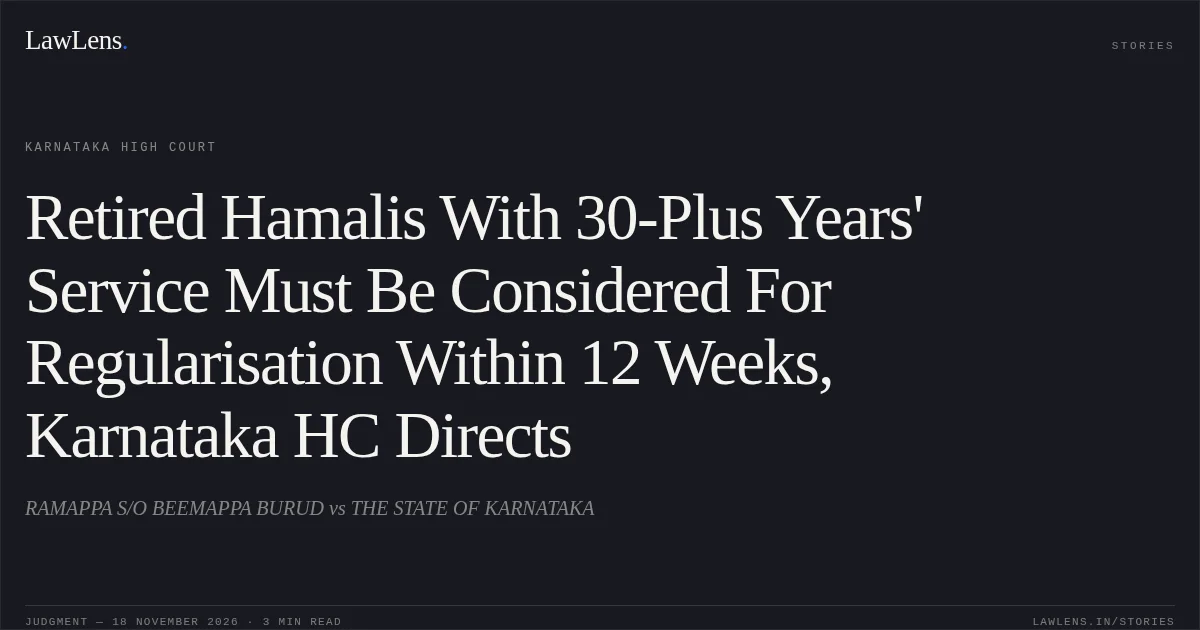
The petitioners, both Hamalis (Group-D), sought a writ of mandamus directing the State to regularize their services in line with an order dated 20.02.2025 and to release consequential benefits, wages under the Minimum Wages Act, and arrears.
¶ 1, 3Petitioner No. 1 was appointed on 25.11.1992 and Petitioner No. 2 on 19.11.1994.
¶ 3, 7Petitioner No. 1 retired on superannuation after more than 30 years of service.
¶ 4Certain other Hamalis approached the Karnataka Administrative Tribunal, Belagavi, claiming 30 years of daily-wage service. The Tribunal directed regularization of those who had served 30 years, and Respondent No. 3 implemented this by order dated 20.02.2025.
¶ 3The petitioners contended that they were entitled to the same treatment on the principle of parity.
¶ 3, 4The State Government Pleader contended that the petitioners had been discontinued and later taken back only pursuant to Labour Court orders granting reinstatement and continuity of service, so the petitioners' authorities were inapplicable.
¶ 5The Court rejected this submission as one "noted only to be rejected".
¶ 702Issues
i.1. Whether daily-wage/Group-D employees with more than 30 years of service, who were reinstated pursuant to Labour Court orders, are entitled to be considered for regularization on the principle of parity with employees regularized pursuant to a Tribunal direction.
¶ 4, 5, 8ii.2. Whether the petitioners' superannuation (in the case of Petitioner No. 1) disentitles them from consideration of regularization.
¶ 8 (quoting Geeta Ramappa Terdal, DB, paras 8.3, 16, 19–20)iii.3. Whether the State's contention that the petitioners' reinstatement under Labour Court orders takes them outside the Umadevi framework is sustainable.
¶ 5, 703Law Applied
The Court relied on the Division Bench decision in Geeta Ramappa Terdal v. Commissioner, City Municipality (W.A. No. 100680/2025, decided 16.10.2026), which in turn traced the law from the Constitution Bench in State of Karnataka v. Umadevi (3).
¶ 8Umadevi (para. 53) bars regularization of backdoor entrants but permits a one-time regularization of irregular appointees in duly sanctioned posts who have served ten years or more without court or tribunal protection.
¶ 8 (DB paras 8.1–8.3, 9.1)The Division Bench further relied on Amarendra Kumar Mohapatra, Sheo Narain Nagar, Narendra Kumar Tiwari, Prem Singh, Chander Mohan Negi, Jaggo, Sukhendu Bhattacharjee (2026 SCC OnLine SC 909), and Bhikhani Devi (2026 SCC OnLine SC 1055).
¶ 8 (DB paras 9.2–9.8, 10–19)Umadevi cannot be used as a blanket shield against regularization of long-serving employees; nomenclature is not determinative; the State as model employer must act fairly; Article 14 requires equal treatment of identically situated employees; and retirement does not extinguish a claim for consideration of regularization.
¶ 8 (DB paras 15–16, 19–20)The principle of parity of treatment.
¶ 804Reasoning
The Court held that the State's reinstatement argument did not remove the petitioners from the ambit of the governing principles, and it rejected that argument without elaboration.
¶ 7The Court found that the petitioners had more than 30 years of service and that the State had already regularized other employees in the same category. On that basis, the Court held that the petitioners were entitled to consideration on the principle of parity of treatment.
¶ 8The Court relied on the Division Bench's observation that superannuation does not extinguish a claim for consideration of regularization, which addressed Petitioner No. 1's retirement.
¶ 8 (DB paras 16, 20–23)The order does not record a finding on whether the petitioners satisfy the Umadevi conditions, namely sanctioned posts, possession of minimum qualifications, and absence of protection of court or tribunal orders for ten years or more. The Labour Court reinstatement, which the State relied on, bears directly on the last condition, but the Court did not analyse it.
¶ 8The Court did not decide the prayer for minimum-wage arrears and consequential benefits, which it neither addressed nor granted.
¶ 1, 8, 905Holding
The Court held that the petitioners, having completed more than 30 years of service, are entitled to have their claim for regularization considered on the principle of parity of treatment.
¶ 8The writ petition is allowed. The Court issued a mandamus directing Respondents to consider the petitioners' regularization as Group-D employees, as done for others, within 12 weeks from receipt of the order.
¶ 9(i)–(ii)The Court did not direct regularization itself, nor did it grant the wage, arrears, or other consequential relief sought in prayer (b). The holding is one of mandatory consideration, not a substantive grant of regularization, and it rests on parity rather than on a determination of the Umadevi eligibility conditions.
¶ 8, 9Original Court PDF
RAMAPPA S/O BEEMAPPA BURUDvsTHE STATE OF KARNATAKA
Click to open original judgment
Original judgment, available to read, download and summarize on LawLens.in