Facts
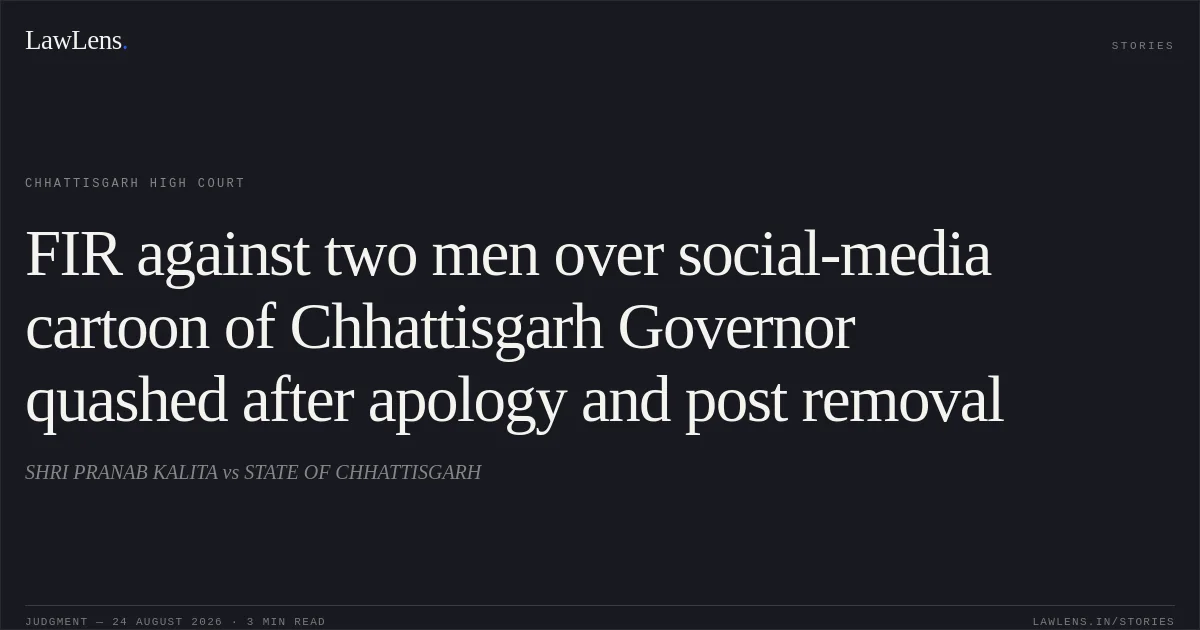
The petitioners invoked Section 528 of the Bharatiya Nagarik Suraksha Sanhita, 2023, seeking quashing of FIR No. 232/2026 dated 19.04.2026 registered at Civil Lines Police Station, Raipur, under Sections 352, 353(1) and 353(2) of the Bharatiya Nyaya Sanhita, 2023 and Section 66 of the Information Technology Act, 2000.
Source reference: para. 3The allegations arose from the petitioners’ sharing of a cartoon-style Facebook post, originally uploaded by a co-accused, concerning the Governor of Chhattisgarh, along with an Assamese-language caption.
Source reference: para. 3During the pendency of the petition, investigation was completed and a charge-sheet was filed before the Chief Judicial Magistrate, Raipur; the petitioners subsequently sought to challenge the charge-sheet as well.
Source reference: paras. 4–5During the hearing, the petitioners tendered an unconditional apology, undertook to remove the objectionable material, refrain from repeating such conduct, publish the apology with comparable prominence, and take steps for withdrawal or closure of a counter-case lodged in Assam.
Source reference: paras. 6–10The State Government and respondent No. 2 consented to settlement subject to compliance with the stipulated conditions.
Source reference: paras. 7, 9, 11–12Issues
1. Whether the High Court should exercise its inherent jurisdiction under Section 528 of the BNSS, 2023 to quash the FIR and consequential charge-sheet arising from the petitioners’ re-publication of the social-media post, in light of the subsequent settlement and the State’s consent.
Source reference: paras. 11–152. Whether continuation of the criminal proceedings, despite the unconditional apology, removal of the objectionable material and undertakings furnished by the petitioners, would amount to an abuse of the process of law.
Source reference: paras. 12–153. Whether quashing could be made subject to compliance with the settlement conditions, including publication of the apology, permanent removal of the material and steps concerning the counter-case in Assam.
Source reference: paras. 9–10, 17Law Applied
The Court applied Section 528 of the Bharatiya Nagarik Suraksha Sanhita, 2023, which preserves the High Court’s inherent jurisdiction to make orders necessary to give effect to any order under the BNSS, prevent abuse of the process of court, or secure the ends of justice.
Source reference: paras. 3, 13, 15It held that this extraordinary power cannot be exercised merely because the parties have compromised, particularly in cases involving non-compoundable offences; the Court must consider the nature and gravity of the offence, its societal impact and the circumstances of the settlement.
Source reference: para. 13For this principle, it relied on State of Madhya Pradesh v. Laxmi Narayan, (2019) 5 SCC 688, which requires careful scrutiny of such settlements and prohibits quashing where the offence is heinous, serious or opposed to public interest.
Source reference: para. 14The Court also considered the offences alleged under Sections 352, 353(1) and 353(2) of the BNS, 2023 and Section 66 of the Information Technology Act, 2000, together with the constitutional context of freedom of speech and expression under Article 19(1)(a).
Source reference: para. 3Reasoning
The Court found that the allegations concerned the publication or re-publication of a social-media post and did not involve physical violence, physical assault or other heinous criminal conduct directly attributable to the petitioners.
Source reference: para. 11Although the offences were not being quashed merely on the basis of a private compromise, the circumstances were materially altered because the State Government itself consented to settlement at the governmental level, respondent No. 2 agreed to bring the proceedings to an end, and the petitioners tendered unconditional apologies and gave undertakings to remove the material and not repeat the conduct.
Source reference: paras. 11–12Applying the principles in Laxmi Narayan, the Court held that the settlement, accompanied by stringent corrective conditions, was not contrary to public interest or the administration of criminal justice.
Source reference: para. 14It therefore concluded that continuation of the prosecution would serve no useful purpose and would amount to an abuse of the process of law.
Source reference: para. 15Holding
The High Court allowed the petition and quashed FIR No. 232/2026 dated 19.04.2026, registered at Civil Lines Police Station, Raipur, together with all consequential proceedings, including Charge-sheet No. 345/2026, insofar as they related to the petitioners.
The relief was expressly made subject to the petitioners’ compliance with the settlement conditions: tendering an unconditional apology before the Court, publishing the apology on the same Facebook account with equivalent prominence, permanently removing the objectionable material from platforms under their control, filing an undertaking not to repeat the conduct, and taking appropriate steps for withdrawal or closure of the counter-case in Assam.
Source reference: para. 17The petition and all pending applications were accordingly disposed of.
Source reference: para. 18Acts & Sections Cited
5 provisions across 3 statutes referred to in this judgment. Linked provisions open on LawLens.
Bharatiya Nyaya Sanhita, 20232
Information Technology Act, 20001
Bharatiya Nagarik Suraksha Sanhita, 20232
Original Court PDF
SHRI PRANAB KALITAvsSTATE OF CHHATTISGARH
Click to open original judgment
Original judgment, available to read, download and summarize on LawLens.in