01Facts
The petitioner challenged FIR No. 0394 of 2026 dated 17.11.2026 at P.S. Haldwani, District Nainital, registered under Sections 120-B, 34, 384, 387, 389 and 420 IPC.
¶ 1The complainant alleged that she had approached the petitioner in 2015 for financial help over legal difficulties. The petitioner and co-accused allegedly formed an organised group that extorted money by threatening false rape and other criminal cases and by threatening to circulate the complainant's photographs and videos. Properties were allegedly registered in the complainant's and her family members' names through coercion, and repeated threats and demands followed.
¶ 2The petitioner contended that she is a woman; the FIR was lodged after an unexplained delay of 11 years; no individual role, overt act or specific transaction was attributed to her; the allegations are general; cheating is not made out; and the ingredients of Sections 384, 387 and 389 IPC are not specifically alleged.
¶ 3The petitioner offered to undergo a narco test, sought a narco test of the complainant (Application No. 2/2026), and asserted that she had lodged a counter-FIR on 19.11.2026 alleging molestation of her daughter by the complainant.
¶ 4The State and the caveator opposed the petition, describing the offences as serious and the petitioner as a habitual offender involved in multiple sextortion cases, and argued that the High Court should not send her for a narco test.
¶ 502Issues
i.1. Whether the High Court should exercise its powers under Article 226 of the Constitution to quash FIR No. 0394 of 2026 at the initial stage.
¶ 6 · ¶ 8ii.2. Whether the impugned FIR is vitiated as a counterblast to the petitioner's later FIR dated 19.11.2026.
¶ 4 · ¶ 6iii.3. Whether the FIR discloses a prima facie cognizable offence against the petitioner despite the alleged absence of a specific role or overt act.
¶ 3 · ¶ 8iv.4. Whether the alleged 11-year delay in lodging the FIR warrants quashing.
¶ 3v.5. Whether the High Court should direct a narco test of the petitioner or the complainant in these proceedings.
¶ 3 · ¶ 5 · ¶ 603Law Applied
The offences alleged in the FIR are Sections 120-B, 34, 384, 387, 389 and 420 IPC.
¶ 1The principles laid down in Neeharika Infrastructure Pvt. Ltd. v. State of Maharashtra, (2021) 19 SCC 401 apply. Quashing is to be exercised sparingly and only in rare cases; the court cannot examine the reliability or genuineness of the FIR allegations; criminal proceedings should not be scuttled at the initial stage; quashing is an exception; the courts should not usurp the police's investigative function; and, on a quashing petition, the court only considers whether the FIR discloses a cognizable offence and must leave investigation to the police.
¶ 7The same principles govern interim orders. An interim stay of investigation or a "no coercive steps" order should be passed with circumspection and only with brief reasons.
¶ 7A quashing petition under Article 226 is not a forum to adjudicate the veracity of the prosecution case, which is to be established through investigation in accordance with due process of law.
¶ 8Provisions in the judgment · 8 · Linked ones open on LawLens
Indian Penal Code, 1860 Section 34Section 384Section 387Section 389Section 420
Code of Criminal Procedure, 1973 Section 482Section 438Section 173
04Reasoning
The Court held that the allegations are "very grave in nature" and that it would not be proper to exercise Article 226 jurisdiction at this stage.
¶ 6The Court rejected the counterblast argument because the impugned FIR was registered on 17.11.2026, before the petitioner's FIR of 19.11.2026, and concerned incidents alleged to have occurred long before either FIR.
¶ 6The Court treated the offer of a narco test as a contention to be raised before the competent trial court, not in writ proceedings.
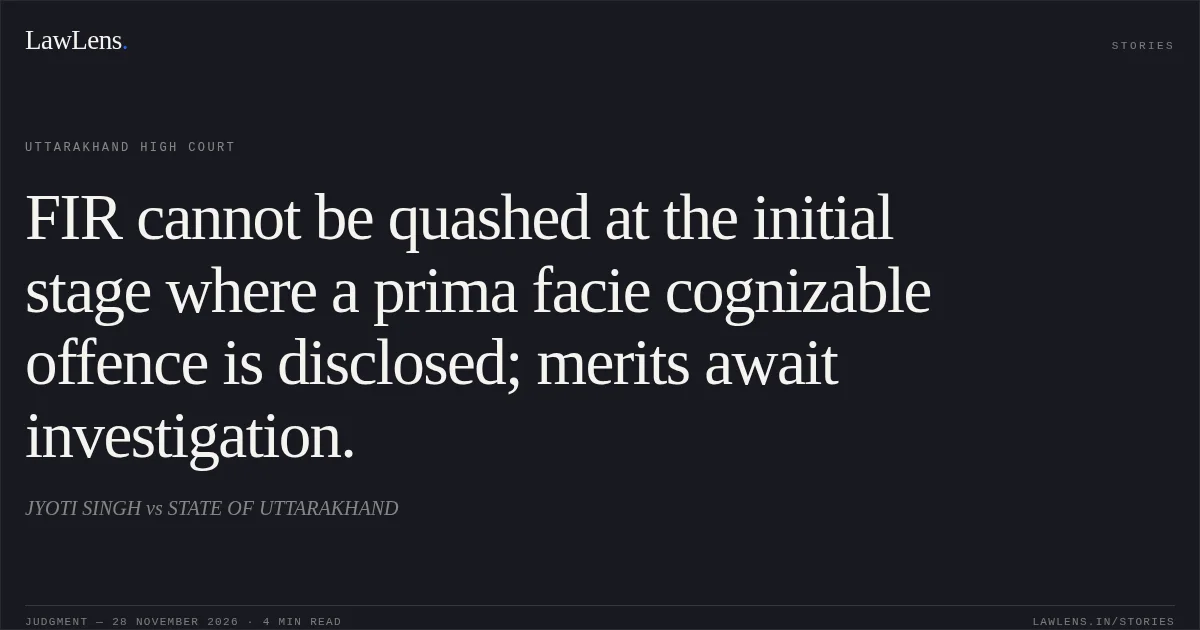
¶ 6Applying Neeharika, the Court found that a prima facie case was disclosed and that the veracity of the allegations could not be examined at that stage; that was a matter for investigation.
¶ 8The Court did not expressly discuss the 11-year delay or the absence of a specific attributed role, and it did not rely on the State's assertion that the petitioner is a habitual offender.
¶ 5–8The reasoning rests on the prima facie disclosure of cognizable offences and on the bar against examining merits at the quashing stage.
¶ 7–805Holding
A prima facie case is made out against the petitioner and, following Neeharika, the High Court cannot enter into the merits of the FIR at this stage.
¶ 8The writ petition was dismissed. The contentions on narco testing are left to be raised before the concerned court. Pending applications were disposed of. Counsel for the petitioner was directed to file a vakalatnama within 24 hours. No interim protection against arrest or "no coercive steps" order was granted, and the investigation is to proceed in accordance with law.
¶ 10 · ¶ 6 · ¶ 11 · ¶ 9 · ¶ 7–8, 10Original Court PDF
JYOTI SINGHvsSTATE OF UTTARAKHAND
Click to open original judgment
Original judgment, available to read, download and summarize on LawLens.in