Facts
The appeal under Section 173 of the Motor Vehicles Act, 1988, was filed by Shriram General Insurance Company against the award dated 10 March 2023 in Claim Case No. 13/2020.
Source reference: para. 1The Claims Tribunal had awarded ₹76,35,985 to the claimants—namely, the deceased’s father and four siblings—and fastened liability upon the Insurance Company to satisfy the award.
Source reference: para. 1The deceased, Ramesh Kumar, aged approximately 24 years, was an unmarried Government employee serving as a Constable in the 22nd Battalion and earning ₹30,395 per month.
Source reference: para. 7The Insurance Company challenged the Tribunal’s refusal to attribute contributory negligence to the deceased, its failure to deduct income tax, and its deduction of only one-fourth towards personal expenses.
Source reference: paras. 2–3The claimants defended the award and additionally sought enhancement under the conventional heads, including funeral expenses.
Source reference: para. 4Issues
Whether the deceased was guilty of contributory negligence in the head-on collision and whether any deduction should consequently be made from the compensation?
Source reference: paras. 2, 4, 6Whether income tax was required to be deducted from the deceased’s annual income after addition of future prospects?
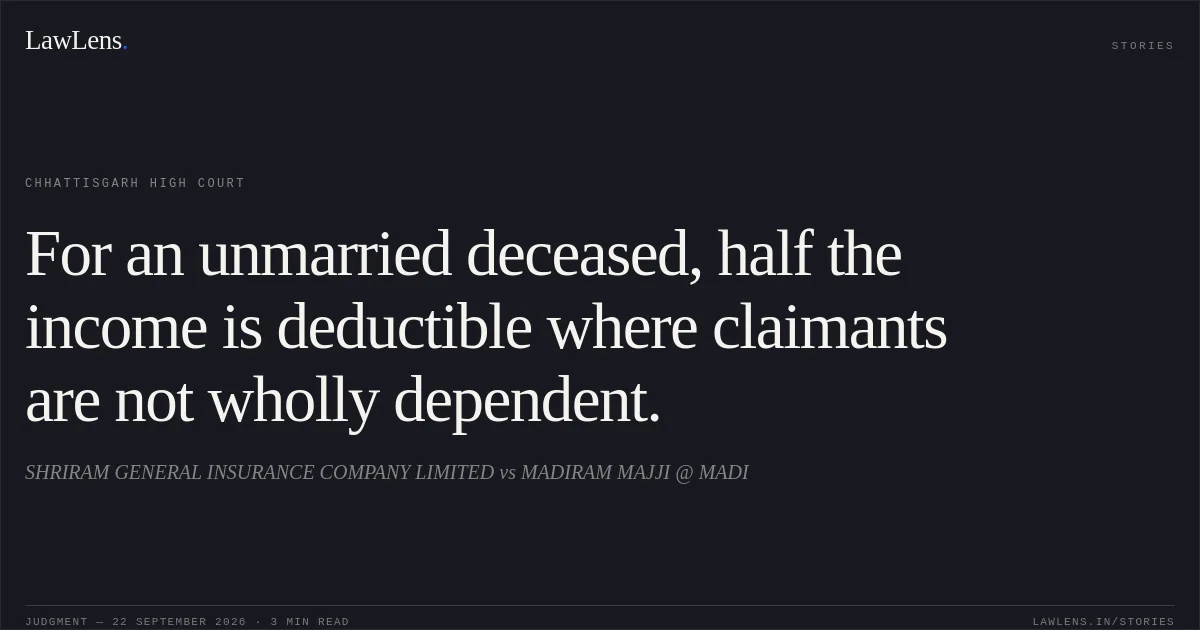
Source reference: paras. 2, 11–13Whether one-half, rather than one-fourth, of the deceased’s income ought to be deducted towards personal and living expenses, considering that he was unmarried and that the claimants’ dependency was not absolute?
Source reference: paras. 3, 9Whether the amounts awarded under the conventional heads, including loss of estate and funeral expenses, required modification in accordance with applicable Supreme Court precedent?
Source reference: paras. 4, 10, 14Law Applied
Section 173 of the Motor Vehicles Act, 1988, permits an aggrieved party to appeal against an award of the Claims Tribunal.
Source reference: para. 1The burden of establishing contributory negligence rests on the party asserting it; a mere allegation of a head-on collision is insufficient without cogent evidence demonstrating negligence by the deceased.
Source reference: para. 6For computation of compensation, the principles in National Insurance Co. Ltd. v. Pranay Sethi, Sarla Verma v. Delhi Transport Corporation, and Magma General Insurance Co. Ltd. v. Nanu Ram govern future prospects, deductions for personal expenses, multiplier selection, and consortium.
Source reference: para. 14A salaried deceased below 40 years is entitled to 50% addition towards future prospects where the applicable employment conditions justify such addition.
Source reference: paras. 8, 11In the case of an unmarried deceased, ordinarily one-half may be deducted towards personal expenses, subject to the number and status of dependants; the actual dependency circumstances must be considered.
Source reference: para. 9Income tax payable on the deceased’s income is deductible in determining the net annual income available for loss-of-dependency compensation.
Source reference: paras. 11–13Reasoning
The Court upheld the finding that the deceased was not contributorily negligent because the claimants’ eyewitness, Ramesh Diwan, consistently attributed rash and negligent driving to the truck driver, and his evidence was corroborated by the charge-sheet.
Source reference: para. 6The Insurance Company did not examine the truck driver, owner, or any rebuttal witness, and therefore failed to produce reliable evidence establishing negligence by the deceased.
Source reference: para. 6The Court accepted the deceased’s monthly income of ₹30,395 and the addition of 50% future prospects, producing an annual income of ₹5,47,110.
Source reference: paras. 7–8, 11Applying the income-tax slabs for Assessment Year 2021–22, it deducted ₹21,922 as tax, resulting in a net annual income of ₹5,25,188.
Source reference: paras. 12–13Since the deceased was unmarried, his father owned approximately five acres of agricultural land, the deceased contributed only ₹5,000–₹6,000 monthly to the household, and the siblings could become financially independent, the Court modified the deduction for personal expenses from one-fourth to one-half.
Source reference: para. 9Applying a multiplier of 18, the loss of dependency was calculated at ₹47,26,692.
Source reference: paras. 10, 14The Court retained consortium of ₹2,20,000 for five claimants and fixed loss of estate and funeral expenses at ₹16,500 each.
Source reference: paras. 10, 14Holding
The Court rejected the Insurance Company’s plea of contributory negligence and affirmed that no deduction was warranted on that account.
It nevertheless allowed the appeal partly by deducting income tax, increasing the deduction towards the deceased’s personal expenses from one-fourth to one-half, and modifying the conventional heads.
Source reference: paras. 14–16The total compensation was consequently reduced from ₹76,35,985 to ₹49,79,692, while the remaining conditions of the Tribunal’s award were left undisturbed.
Source reference: paras. 14–16The Registry was directed to communicate the modified award amount to the claimants in Hindi Devanagari, with assistance from paralegal workers where necessary.
Source reference: para. 17Acts & Sections Cited
1 provisions across 1 statute referred to in this judgment. Each provision opens on LawLens.
Motor Vehicles Act, 19881
Original Court PDF
SHRIRAM GENERAL INSURANCE COMPANY LIMITEDvsMADIRAM MAJJI @ MADI
Click to open original judgment
Original judgment, available to read, download and summarize on LawLens.in