Facts
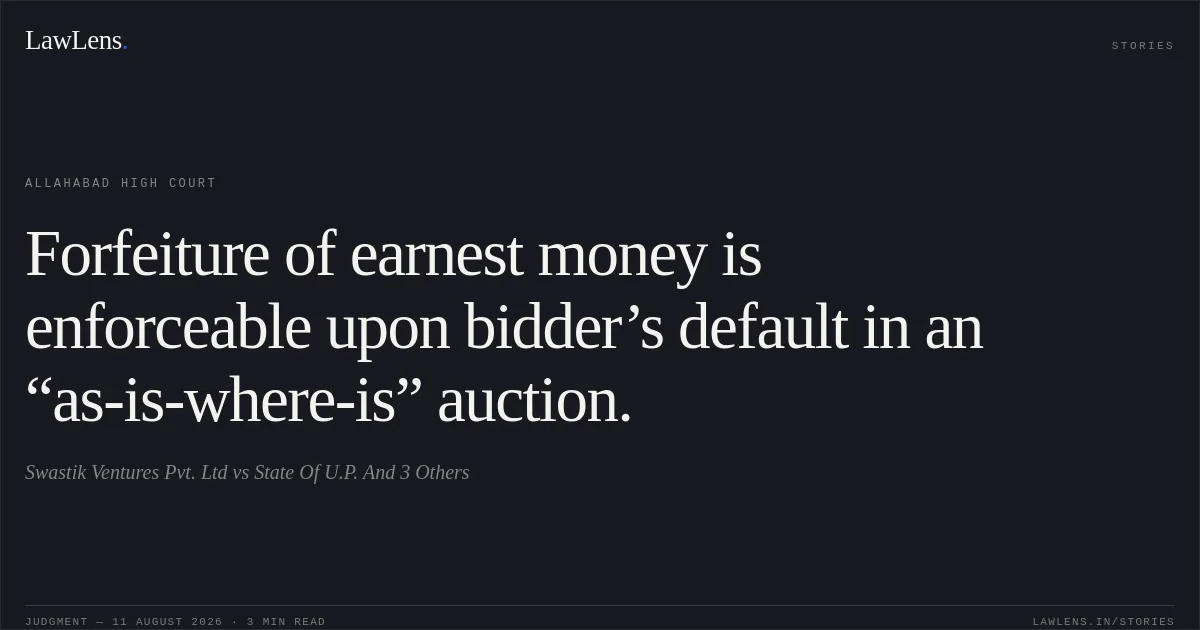
The Gorakhpur Development Authority (“GDA”) auctioned two commercial plots in Budh Vihar Part-A on an “as is where is” basis.
Source reference: paras. 3–6The petitioner participated in the e-auction, deposited registration amounts totalling ₹1,02,73,114, and was declared the highest bidder for both plots.
Source reference: paras. 3–6Allotment letters dated 27 October 2025 required payment of 40% of the bid amounts within one month, failing which the registration amount could be forfeited.
Source reference: paras. 3–6The petitioner did not make the stipulated payment despite reminders dated 18 December 2025, 20 February 2026 and 17 March 2026.
Source reference: paras. 6–7The GDA cancelled the allotments and forfeited the registration amounts by orders dated 2 April 2026.
Source reference: paras. 2, 7–8Issues
Whether the writ petition was maintainable despite the arbitration clause contained in the e-auction conditions?
Source reference: paras. 12–14Whether the petitioner’s failure to deposit 40% of the bid amount justified cancellation of the allotments and forfeiture of the registration amounts?
Source reference: paras. 12, 15–24Whether the forfeiture constituted a penalty or liquidated damages attracting Section 74 of the Indian Contract Act, 1872, thereby entitling the petitioner to a refund?
Source reference: paras. 12, 25–35Whether the petitioner’s failure to challenge the forfeiture clause itself defeated its claim for refund?
Source reference: paras. 12, 22, 36–37Law Applied
The Court applied the principle that an alternative arbitration remedy does not invariably bar a writ petition, particularly where pleadings have been exchanged and the objection is not pursued.
Source reference: paras. 13–14Contractual terms must be read as a whole and harmoniously to ascertain their true meaning, as recognised in BPL Ltd. v. Morgan Securities & Credit Pvt. Ltd.
Source reference: para. 21An “as is where is” condition places the responsibility upon the bidder to inspect the property and ascertain its location, condition and commercial impediments; the principles of caveat emptor therefore apply.
Source reference: paras. 16–17Registration money paid as earnest money to secure performance may ordinarily be forfeited upon the purchaser’s default, consistent with Shree Hanuman Cotton Mills v. Tata Aircraft Ltd. and K.R. Suresh v. R. Poornima.
Source reference: paras. 29, 33Section 74 applies to stipulated compensation or penalties, but the Court held that forfeiture of genuine earnest money in the present commercial transaction was not penal in nature.
Source reference: paras. 25–35The Court further relied on BPL Ltd. for the principle that a party who enters a commercial arrangement with full knowledge of its terms cannot later avoid its consequences as unconscionable or arbitrary without specifically challenging the relevant contractual clause.
Source reference: paras. 34–37Reasoning
The Court held that the arbitration objection did not warrant dismissal because the respondents did not press it during arguments and the pleadings had already been exchanged.
Source reference: paras. 13–14On merits, the e-auction expressly operated on an “as is where is” basis.
Source reference: paras. 16–19The flyover had allegedly been sanctioned in 2022 and was stated by the GDA to have existed or been under construction before the 2025 auction.
Source reference: paras. 16–19The petitioner produced no material showing that it had inspected the plots or that the flyover was constructed only after the auction; consequently, the alleged diminution in commercial viability could not be treated as a breach by the GDA.
Source reference: paras. 16–19The petitioner’s breach occurred when it failed to deposit 40% of the bid amount by the stipulated deadline and continued to abstain despite three reminders.
Source reference: para. 19Although the Court observed that the wording of the forfeiture clause did not clearly authorise forfeiture merely upon non-payment of the initial 40%, the petitioner had unequivocally stated that it did not wish to proceed with the allotments and sought only refund.
Source reference: paras. 21–24Thus, forfeiture was ultimately justified because the petitioner had withdrawn from the transaction and had no intention of paying the bid amounts or developing the plots.
Source reference: paras. 21–24The registration deposit was treated as earnest money securing performance, not as a penalty; Section 74 was therefore held inapplicable.
Source reference: paras. 25–37Further, because the petitioner had not challenged the validity or unconscionability of the forfeiture clause, its refund claim could not succeed.
Source reference: paras. 25–37Holding
The Court answered the maintainability issue in the petitioner’s favour but rejected the petition on merits.
It held that the forfeiture was justified, that Section 74 of the Indian Contract Act did not apply to the forfeiture of the earnest/registration money, and that the absence of any challenge to the forfeiture clause was fatal to the refund claim.
Source reference: paras. 38–41The writ petition was accordingly dismissed, and no order was made as to costs.
Source reference: para. 42Acts & Sections Cited
1 provisions across 1 statute referred to in this judgment. Each provision opens on LawLens.
Indian Contract Act, 18721
Original Court PDF
Swastik Ventures Pvt. LtdvsState Of U.P. And 3 Others
Click to open original judgment
Original judgment, available to read, download and summarize on LawLens.in