01Facts
The petitioner challenged criminal proceedings arising from Crime No. 77 of 2011, registered for offences under Sections 409, 420, 461, 468, 471 and 120B read with Section 34 of the IPC.
p. 3The judgment records that the police filed a ‘B’ report, a protest petition followed, and the regular Magistrate took cognizance on 4 May 2023.
p. 3It further records that, in the intervening period, the petitioner was elected to the Karnataka Legislative Assembly.
p. 3The petitioner’s sole submission was that cognizance should have been taken by the Special Court constituted for cases against sitting and former MPs and MLAs, rather than by the regular Magistrate.
p. 4The judgment’s account dates the complaint to 10 April 2021 but the ‘B’ report to 16 March 2020, an apparent chronological inconsistency.
p. 302Issues
i.Whether the regular Magistrate had jurisdiction to take cognizance of the case against the petitioner, or whether cognizance lay with the Special Court for cases against MPs and MLAs.
pp. 4–5ii.Whether the proceedings before the regular Magistrate should be quashed and the matter remitted to the Special Court.
pp. 7–1003Law Applied
Section 482 of the Code of Criminal Procedure empowers the High Court to intervene to secure the ends of justice, including where proceedings disclose a jurisdictional error.
p. 2 · pp. 5–6The Court relied on Government Order No. LA 10 LCE 2018 dated 8 February 2018, which established a Special Court for criminal cases against elected MPs and MLAs in Karnataka.
p. 5Following Dr. K. Sudhakar v. State of Karnataka, W.P. No. 18116 of 2024, decided 27 November 2024, and Dr. Y. Ramappa v. State of Karnataka, Criminal Petition No. 1510 of 2024, decided 29 June 2026, the Court held that the designated Special Court is competent to take cognizance of and try such cases, irrespective of whether the alleged offence occurred before or after the accused became a legislator; the purpose is to secure expeditious disposal.
pp. 5–9Provisions in the judgment · 10 · Linked ones open on LawLens
Code of Criminal Procedure, 1973 Section 482Section 190
Indian Penal Code, 1860 Section 34Section 409Section 420Section 461Section 468Section 471Section 511
Representation of the People Act, 1951 Section 123
04Reasoning
The petitioner was a sitting MLA when the petition was considered, and the challenged cognizance order had been made by a regular Magistrate.
pp. 3–4, 6Applying its precedents, the Court treated the Special Court’s jurisdiction as extending to cases involving legislators regardless of their status at the time of the alleged offence.
pp. 6–10Because the regular Magistrate was not the competent court to take cognizance, the error was jurisdictional.
pp. 6–10The Court therefore held that the cognizance order and ensuing proceedings could not stand, while clarifying that the complaint and investigation did not thereby disappear and that the Special Court could regulate the matter’s further procedure.
pp. 6–1005Holding
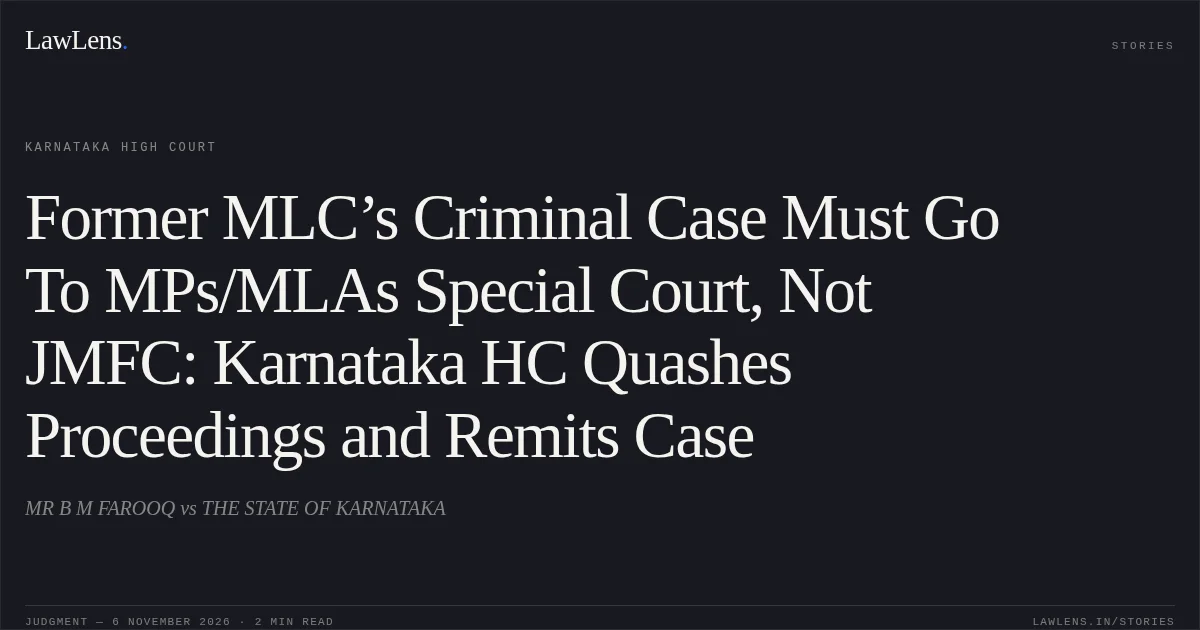
The High Court allowed the petition and quashed the proceedings in Crime No. 77 of 2011 pending before the Principal Civil Judge and JMFC, C.N. Halli.
p. 10It remitted the matter to the Special Court for cases against sitting and former MPs and MLAs triable by Magistrates in Karnataka, leaving that court to pass necessary orders and regulate the proceedings in accordance with law.
p. 10Original Court PDF
MR B M FAROOQvsTHE STATE OF KARNATAKA
Click to open original judgment
Original judgment, available to read, download and summarize on LawLens.in