Facts
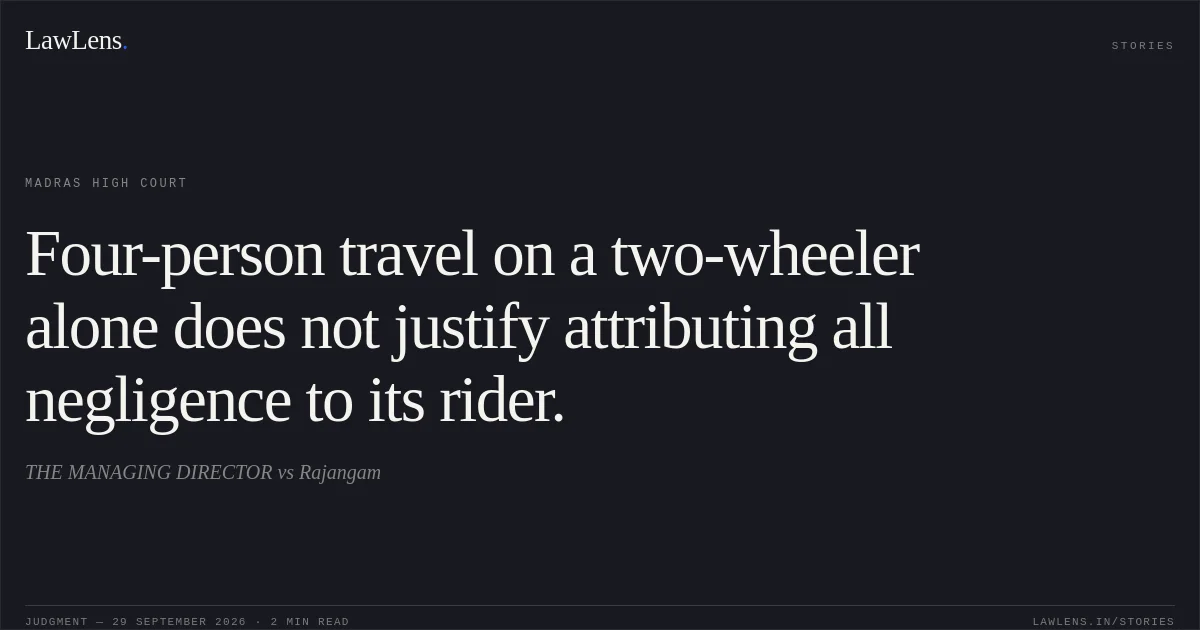
On 4 June 2017, a bus belonging to the appellant Transport Corporation collided with a two-wheeler carrying four persons on the Palani–Dindigul Main Road; the accident resulted in deaths, including those of Sholamalai and Nagendran.
Source reference: para. 2.1–2.3Their legal representatives brought separate compensation claims, which were tried together.
Source reference: para. 2.1–2.3The Tribunal attributed 80% negligence to the bus driver and 20% contributory negligence to the two-wheeler rider, and awarded compensation in both claims with interest at 7.5% per annum.
Source reference: para. 3.1–3.2The Corporation appealed under Section 173 of the Motor Vehicles Act, principally challenging the apportionment of negligence and also disputing the assessment of income.
Source reference: para. 4.1–4.2Issues
Whether the Tribunal was justified in attributing 80% negligence to the bus driver and 20% contributory negligence to the two-wheeler rider, notwithstanding that four persons were travelling on the two-wheeler.
Source reference: para. 7.1Whether the Tribunal’s assessment of compensation disclosed an error warranting appellate interference.
Source reference: para. 9.1Law Applied
The appeals were brought under Section 173 of the Motor Vehicles Act, which provides for an appeal against an award of a Motor Accident Claims Tribunal.
Source reference: no citationIn assessing negligence, the court treated the number of persons travelling on the two-wheeler as a relevant circumstance, but held that this fact alone did not establish that the rider was solely responsible for the accident; negligence was to be apportioned in light of the evidence concerning how the accident occurred.
Source reference: para. 8.1–8.5The court cited no precedent and stated no separate statutory test for appellate review of the compensation calculation.
Source reference: para. 9.1Reasoning
The Tribunal had considered the evidence, including the testimony of P.W.3 and R.W.1 and the documentary record, and had already accounted for the four occupants by assigning 20% contributory negligence to the rider.
Source reference: para. 8.1–8.6The Corporation produced no material showing that the accident was wholly attributable to the rider or that the Tribunal’s apportionment was perverse; the fact of overloading, by itself, did not displace the finding that the bus driver was also substantially negligent.
Source reference: para. 8.1–8.6On quantum, the Corporation demonstrated no specific error in the income assessment, multiplier, or computation warranting interference.
Source reference: para. 9.1Holding
The High Court answered the negligence issue in favour of the claimants and found no demonstrated error in the compensation awards.
It dismissed both appeals and confirmed the Tribunal’s common award dated 21 June 2022.
Source reference: para. 10.1–10.3The Corporation was directed to deposit the respective awards, accrued interest, and costs, if not already deposited, within eight weeks; the claimants may withdraw the amounts according to the Tribunal’s apportionment, and the interest rate remains unchanged.
Source reference: para. 10.1–10.3No costs were awarded.
Source reference: para. 10.1–10.3Acts & Sections Cited
1 provisions across 1 statute referred to in this judgment. Each provision opens on LawLens.
Motor Vehicles Act, 19881
Original Court PDF
THE MANAGING DIRECTORvsRajangam
Click to open original judgment
Original judgment, available to read, download and summarize on LawLens.in