Facts
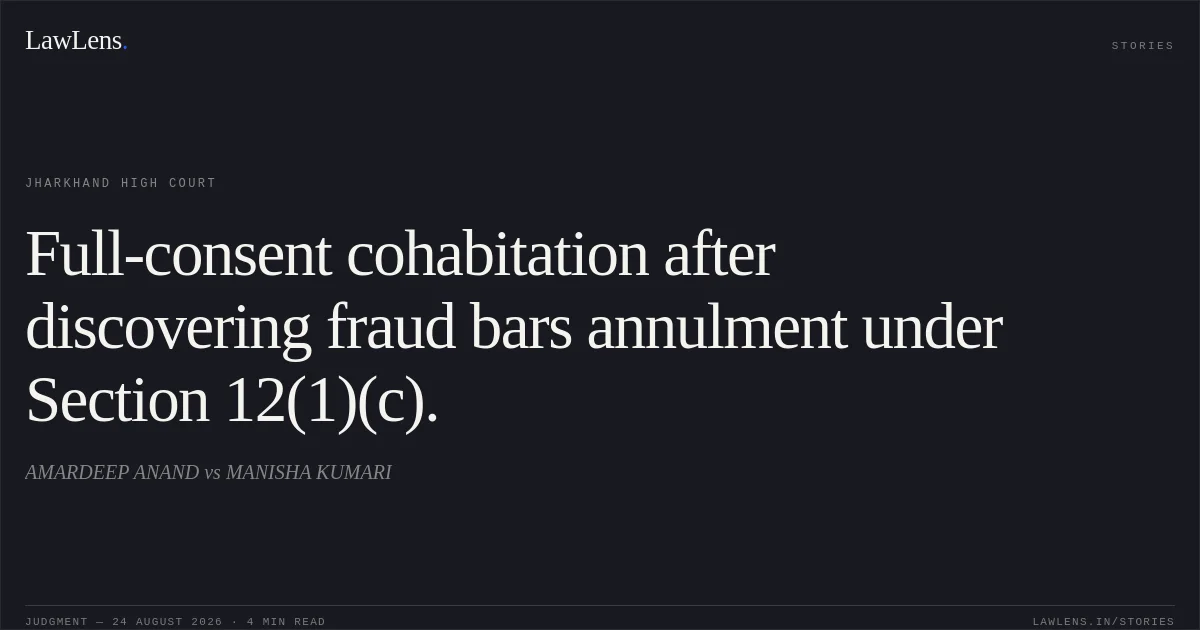
The appellant-husband challenged the judgment dated 26 June 2025 and decree dated 7 July 2025 by which the Additional Family Court-I, Ranchi dismissed his petition under Section 12(1)(c) of the Hindu Marriage Act, 1955 seeking annulment of the marriage.
Source reference: paras. 3–5; pp. 1–5The parties married on 22 November 2017.
Source reference: paras. 3–5; pp. 1–5The husband alleged that the wife and her family had concealed her prior surgery, ovarian and fallopian-tube complications, severe anaemia, and chronic autoimmune disease, and that his consent to marriage was therefore obtained by fraud.
Source reference: paras. 3–5; pp. 1–5He claimed that he became aware of the concealed medical records only in October–November 2022, after which the wife left for her parental home.
Source reference: para. 4; pp. 3–5Although the wife entered appearance, she neither filed a written statement nor participated in reconciliation proceedings and was debarred from filing her written statement.
Source reference: para. 6; p. 5The husband examined himself and one supporting witness, but no doctor was examined and the medical documents were photocopies marked only for identification.
Source reference: para. 19; pp. 7–10The Family Court found that the husband had been aware of the wife’s medical condition since at least 2018, continued to live with her and participate in her treatment until 2022, and consequently dismissed the petition under Section 12(2)(a).
Source reference: paras. 34–41; pp. 14–17Issues
Whether the alleged concealment of the respondent-wife’s medical history and illness amounted to fraud concerning a material fact or circumstance under Section 12(1)(c) of the Hindu Marriage Act, 1955, thereby vitiating the appellant-husband’s consent to the marriage.
Source reference: paras. 17, 28–31; pp. 12–14Whether the petition for annulment was barred under Section 12(2)(a) because the appellant had discovered, or was aware of, the alleged fraud and thereafter continued to live with the respondent as her husband.
Source reference: paras. 28, 38–40; pp. 13–16Whether the Family Court’s appreciation of the evidence and dismissal of the petition was perverse and warranted appellate interference under Section 19(1) of the Family Courts Act, 1984.
Source reference: paras. 9–13, 22–25, 41–43; pp. 6, 11–17Law Applied
Section 12(1)(c) of the Hindu Marriage Act permits annulment where the petitioner’s consent was obtained by force or by fraud as to the nature of the ceremony or any material fact or circumstance concerning the respondent; however, the provision does not encompass every misrepresentation or concealment and is not to be applied by importing the contractual definition of fraud under the Contract Act.
Source reference: paras. 28–30; pp. 13–14Under Section 12(2)(a), a petition based on fraud cannot be entertained if it is filed more than one year after discovery of the fraud or if, after discovery, the petitioner continued to live with the other party with full consent.
Source reference: para. 28; p. 13On perversity, the Court relied on Arulvelu v. State, (2009) 10 SCC 206, holding that a finding is perverse where it ignores or excludes relevant evidence, considers irrelevant material, or is so irrational that no reasonable judicial mind could reach it.
Source reference: paras. 22–24; pp. 11–13It further relied on Damodar Lal v. Sohan Devi, (2016) 14 SCC 197, for the principle that a mere different appreciation of evidence or inadequacy of evidence does not constitute perversity.
Source reference: para. 25; p. 13Reasoning
The High Court held that the Family Court’s conclusion was supported by the appellant’s own evidence.
Source reference: paras. 34–35; pp. 14–15The appellant stated both that he personally took the respondent to CMC Vellore for treatment and that her mother and brother had taken her there despite excluding him, creating a material contradiction.
Source reference: paras. 34–35; pp. 14–15His evidence and the medical records showed that he was aware of her serious health condition from 2018, not for the first time in November 2022.
Source reference: paras. 35, 38–40; pp. 15–16He thereafter continued to reside with her and actively financed and participated in her medical treatment until 2022, satisfying the statutory bar under Section 12(2)(a)(ii).
Source reference: paras. 35, 38–40; pp. 15–16Further, no medical expert established that the alleged prior surgery was connected with the later autoimmune condition, infertility, or any incurable disease, and the appellant’s medical documents were not properly proved beyond being marked for identification.
Source reference: paras. 19(ii), 36–37; pp. 9–10, 15–16In these circumstances, the alleged concealment was not proved in the manner required for relief under Section 12(1)(c), and the Family Court’s findings were neither unsupported by evidence nor irrational.
Source reference: paras. 41–42; p. 17The appellate challenge therefore did not meet the high threshold of perversity.
Source reference: paras. 41–42; p. 17Holding
The High Court answered the issues against the appellant.
It held that the appellant failed to establish that his consent to the marriage had been obtained by fraud relating to a material fact under Section 12(1)(c), and that, in any event, his continued cohabitation with the respondent after knowledge of her medical condition attracted the bar under Section 12(2)(a)(ii).
Source reference: paras. 39–42; pp. 16–17The Family Court’s judgment dated 26 June 2025 and decree dated 7 July 2025 were affirmed, the appeal was dismissed, and any pending interlocutory applications were disposed of.
Source reference: paras. 43–45; p. 17Acts & Sections Cited
5 provisions across 3 statutes referred to in this judgment. Each provision opens on LawLens.
Family Courts Act, 19841
Hindu Marriage Act, 19553
Indian Contract Act, 18721
Original Court PDF
AMARDEEP ANANDvsMANISHA KUMARI
Click to open original judgment
Original judgment, available to read, download and summarize on LawLens.in