01Facts
The petitioners sought quashing of proceedings in Special Case No. 1 of 2017, arising from Ashoknagar Police Station Case No. 998 of 2016, registered under Section 498A of the IPC and Section 3(1)(r) of the Scheduled Castes and Scheduled Tribes (Prevention of Atrocities) Act, 1989 (“SC/ST Act”) and pending before the Special Court at Barasat.
¶ 1The de facto complainant was the wife of the younger brother of Petitioner No. 1; the parties allegedly resided separately and had a dispute concerning land and possession.
¶ 2–9, 22–23The petitioners alleged that the criminal case was a counterblast to their complaints concerning obstruction of a common passage, assault, and property-related disputes.
¶ 6–9The complainant alleged that, since her marriage, the petitioners had subjected her to physical and mental cruelty and that Petitioner No. 2 had humiliated and abused her by referring to her Scheduled Caste status.
¶ 10The initial investigation resulted in a final report treating the case as false.
¶ 11On the complainant’s application under Section 173(8) of the CrPC, the Special Court directed investigation by an officer other than the earlier Investigating Officer and the SDPO, Habra, after more than six years.
¶ 12The subsequent investigation culminated in Charge Sheet No. 258 of 2024 dated 21 May 2024, leading to the present revisional application.
¶ 1302Issues
i.Whether the criminal proceedings under Section 498A IPC and Section 3(1)(r) of the SC/ST Act were liable to be quashed on the ground that the allegations were general, arose from a private property dispute, and constituted an abuse of the process of law.
¶ 19–23, 30–32ii.Whether the allegations and materials in the FIR, charge-sheet, and case diary disclosed the essential ingredients of an offence under Section 3(1)(r) of the SC/ST Act, particularly intentional insult or intimidation on account of caste in a place within public view.
¶ 19–21, 26–30iii.Whether the direction for further investigation under Section 173(8) CrPC, issued after submission of the earlier final report, was legally impermissible as amounting to re-investigation.
¶ 1203Law Applied
Section 498A IPC criminalises cruelty by a husband or his relative, meaning wilful conduct likely to drive the woman to suicide or cause grave injury or danger to her life, limb, or health, or harassment connected with an unlawful demand for property or valuable security.
¶ 24Section 3(1)(r) of the SC/ST Act requires intentional insult or intimidation of a member of a Scheduled Caste or Scheduled Tribe with intent to humiliate that person in a place within public view.
¶ 19–20, 26In Hitesh Verma v. State of Uttarakhand, the Supreme Court distinguished a “public place” from a “place within public view” and held that allegations confined within a private residence, in the absence of members of the public, do not satisfy that ingredient.
¶ 26Ramesh Chandra Vaishya v. State of Uttar Pradesh requires the caste-related utterances and the circumstances of the alleged insult to be identifiable from the FIR or, at least, the charge-sheet; a general allegation of caste abuse is insufficient.
¶ 28The principles in Bhajan Lal, Kahkashan Kausar, Dara Lakshmi Narayana, and Randheer Singh support quashing where allegations are vague, omnibus, unsupported by specific acts, or where criminal proceedings are used to give a civil dispute a criminal colour.
¶ 17–18, 25, 29Under Ramawatar v. State of Madhya Pradesh, proceedings under the SC/ST Act may also be quashed where the dispute is essentially private or civil, the offence was not committed on account of caste, or continuation of the prosecution would amount to abuse of process.
¶ 27Provisions in the judgment · 12 · Linked ones open on LawLens
Indian Penal Code, 1860 Section 323Section 341Section 506
Scheduled Castes and the Scheduled Tribes (Prevention of Atrocities) Act, 1989 Section 3Section 18
Code of Criminal Procedure, 1973 Section 107Section 144Section 173Section 438Section 482
04Reasoning
The Court noted that the parties lived separately and that the materials disclosed a family and property dispute accompanied by cross-cases.
¶ 22–23The allegations supporting Section 498A IPC were found to be general in nature, without sufficiently particularised acts of cruelty attributable to the petitioners.
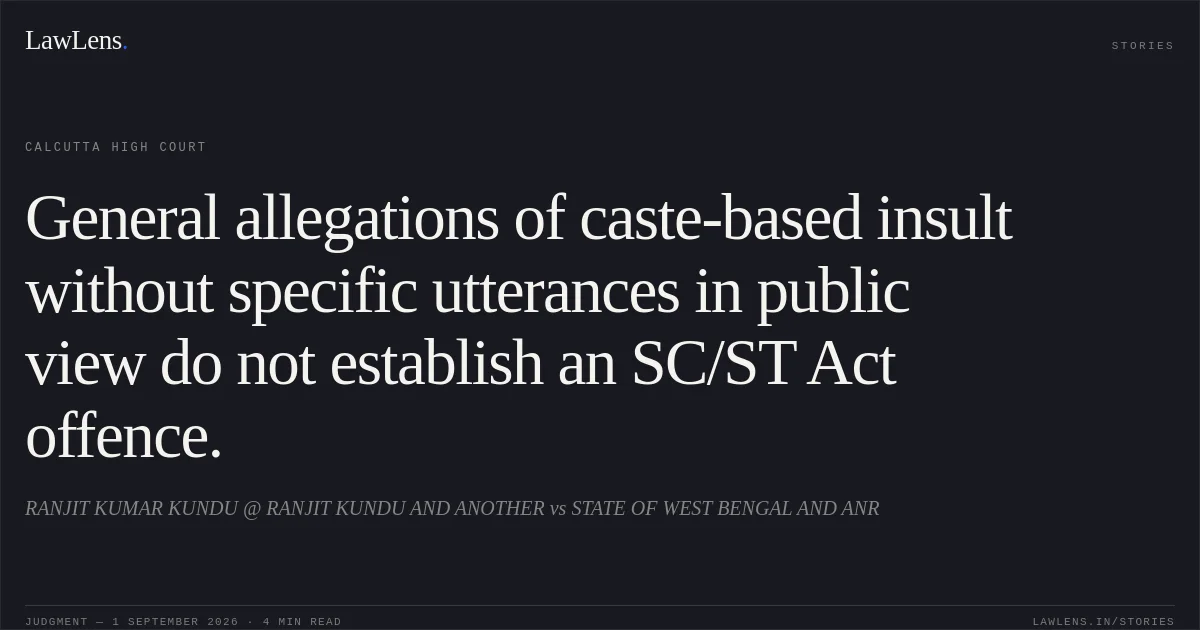
¶ 23Although the complainant alleged caste-based humiliation, the Court found no supporting material or witness statement in the FIR or charge-sheet sufficient to establish the specific caste-related words, the intention to humiliate on account of caste, or that the alleged incident occurred in a place within public view.
¶ 30Applying Hitesh Verma and Ramesh Chandra Vaishya, the Court held that the essential ingredients of Section 3(1)(r) were not prima facie demonstrated.
¶ 30Nevertheless, the Court did not accept the petitioners’ challenge to the proceedings or grant quashing relief; it held that the order under revision required no interference.
¶ 3105Holding
The Court declined to quash the criminal proceedings in Special Case No. 1 of 2017 and dismissed CRR 2852 of 2024.
¶ 32All connected applications were disposed of, any interim order was vacated, and a copy of the judgment was directed to be sent to the Trial Court for necessary compliance.
¶ 33–35Original Court PDF
RANJIT KUMAR KUNDU @ RANJIT KUNDU AND ANOTHERvsSTATE OF WEST BENGAL AND ANR
Click to open original judgment
Original judgment, available to read, download and summarize on LawLens.in