Facts
Anuradha Devi alleged that she married Dipu Mishra in 2007 and thereafter lived with her husband and in-laws at Village Nawadih. She alleged that her husband and in-laws subjected her to mental and physical cruelty, demanded ₹1 lakh as dowry, abused and assaulted her upon her refusal, and, on 21 February 2016, forcibly took her jewellery valued at approximately ₹70,000 and ousted her from the matrimonial home.
Source reference: paras. 4, p. 2On the basis of her written report, Bhojpur Mahila P.S. Case No. 33 of 2018 was registered for offences under Sections 498-A, 379, 506 read with Section 34 of the IPC and Sections 3 and 4 of the Dowry Prohibition Act against the husband and his relatives.
Source reference: para. 5, p. 2The Sub-Divisional Judicial Magistrate, Bhojpur at Arrah, took cognizance of the IPC offences and issued summons by order dated 12 July 2018 in Trial No. 4474 of 2018.
Source reference: para. 3, p. 1Rajaram Mishra, the father-in-law, and Pavitra Devi, the mother-in-law, challenged the cognizance order. During the pendency of the petition, Pavitra Devi died, rendering the proceedings infructuous as against her; the petition therefore survived only against Rajaram Mishra.
Source reference: paras. 1–2, p. 1Issues
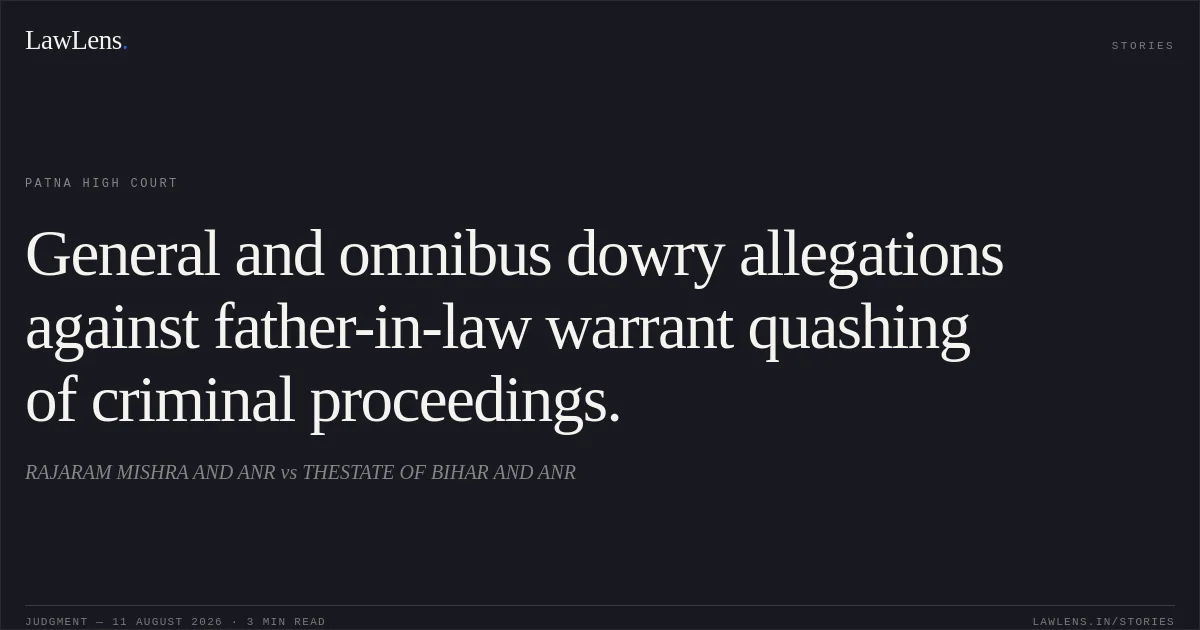
Whether the criminal proceedings and cognizance order against Rajaram Mishra, the father-in-law, should be quashed where the allegations of dowry demand and cruelty were general and omnibus and did not specify his individual role?
Source reference: paras. 6, 9, pp. 2, 9Whether continuation of the prosecution against the petitioner would amount to an abuse of the process of law warranting exercise of the High Court’s inherent jurisdiction?
Source reference: paras. 7–9, pp. 3–9Law Applied
The Court considered the offences under Sections 498-A, 379 and 506 read with Section 34 of the IPC, as well as Sections 3 and 4 of the Dowry Prohibition Act, alleged in the FIR.
Source reference: paras. 3, 5, pp. 1–2In exercising its quashing jurisdiction under Section 482 of the Code of Criminal Procedure, the Court applied the principle that criminal proceedings may be quashed where the allegations, even if accepted in their entirety, do not prima facie constitute an offence, or where they are absurd, manifestly frivolous, malicious, or constitute an abuse of process, as recognised in State of Haryana v. Bhajan Lal, 1992 Supp (1) SCC 335.
Source reference: para. 8, pp. 6–9Relying on Kahkashan Kausar alias Sonam v. State of Bihar, (2022) 6 SCC 599, Preeti Gupta v. State of Jharkhand, (2010) 7 SCC 667, and Neelu Chopra v. Bharti, (2009) 10 SCC 184, the Court reiterated that general and omnibus allegations against the husband’s relatives, without specific particulars of their individual conduct, should be scrutinised carefully and may justify quashing.
Source reference: para. 8, pp. 3–6The Court also referred to Abhishek v. State of Madhya Pradesh, 2023 SCC OnLine SC 1083, and the principles stated in Mahmood Ali v. State of U.P., Criminal Appeal No. 2341 of 2023, concerning careful examination of the FIR and surrounding circumstances in cases alleged to be vexatious or motivated.
Source reference: paras. 7–8, pp. 3–6Reasoning
The Court found that the principal allegations of cruelty and dowry-related harassment were directed generally against the husband and his family members, without setting out any specific act or distinct role attributable to Rajaram Mishra.
Source reference: paras. 6, 9, pp. 2, 9It noted that the FIR indicated that the informant had primarily lived with her husband and that the allegations against the father-in-law were general and omnibus. The Court further observed that the alleged cruelty appeared substantially connected with the fact that the informant had given birth only to female children, while the dowry allegation appeared to have been added in a general manner to aggravate the matrimonial dispute.
Source reference: paras. 6, 9, pp. 2, 9Applying the principles against prosecuting relatives solely on the basis of vague allegations, the Court held that the materials did not disclose a sufficiently specific prima facie case against the petitioner and that continuing the prosecution would amount to an abuse of the process of law.
Source reference: paras. 8–9, pp. 3–9Holding
The High Court allowed the petition as against Rajaram Mishra and quashed and set aside the cognizance order dated 12 July 2018 in Trial No. 4474 of 2018 arising out of Bhojpur Mahila P.S. Case No. 33 of 2018, insofar as it concerned him.
The proceedings against Pavitra Devi had already become infructuous due to her death during the pendency of the petition.
Source reference: para. 1, p. 1The Court directed that a copy of the judgment be communicated to the trial court forthwith.
Source reference: paras. 10–11, p. 9Acts & Sections Cited
8 provisions across 3 statutes referred to in this judgment. Each provision opens on LawLens.
Indian Penal Code, 18603
Code of Criminal Procedure, 19733
Original Court PDF
RAJARAM MISHRA AND ANRvsTHESTATE OF BIHAR AND ANR
Click to open original judgment
Original judgment, available to read, download and summarize on LawLens.in