Facts
Uma Bai, wife of appellant Manoj Bind, died after consuming insecticide in November 2016.
Source reference: no citationThe prosecution alleged that the appellants harassed her for giving birth to daughters and that Manoj also beat her.
Source reference: no citationThe Sessions Court convicted all three appellants under Sections 306/34 IPC and sentenced them to seven years’ rigorous imprisonment.
Source reference: no citationManoj died during the appeal, which abated against him; Chhotelal Bind and Sudama Bai continued the appeal.
Source reference: para. 2–6The High Court reviewed the prosecution evidence, including testimony alleging harassment but generally lacking specific instances attributed to the surviving appellants.
Source reference: para. 10–13, 18–21Issues
1. Whether the evidence established that Chhotelal Bind and Sudama Bai abetted Uma Bai’s suicide within the meaning of Sections 306 and 107 IPC.
Source reference: para. 24–262. Whether the surviving appellants’ convictions under Section 306/34 IPC could be sustained on the basis of general allegations of harassment and the circumstances surrounding the suicide.
Source reference: para. 24–26Law Applied
Section 306 IPC punishes abetment of suicide; under Section 107 IPC, abetment requires instigation, conspiracy, or intentional aid.
Source reference: para. 23–25A conviction under Section 306 requires the accused’s intention and involvement in aiding or instigating suicide, with a live and proximate nexus between the accused’s conduct and the suicide (Gurcharan Singh v. State of Punjab, 2017 (1) SCC 433).
Source reference: para. 23–25Section 113-A of the Evidence Act permits—but does not require—the court to presume abetment where its statutory preconditions, including suicide within seven years of marriage and cruelty, are established; the court must consider all the circumstances (Hansraj v. State of Haryana, 2004 (12) SCC 257).
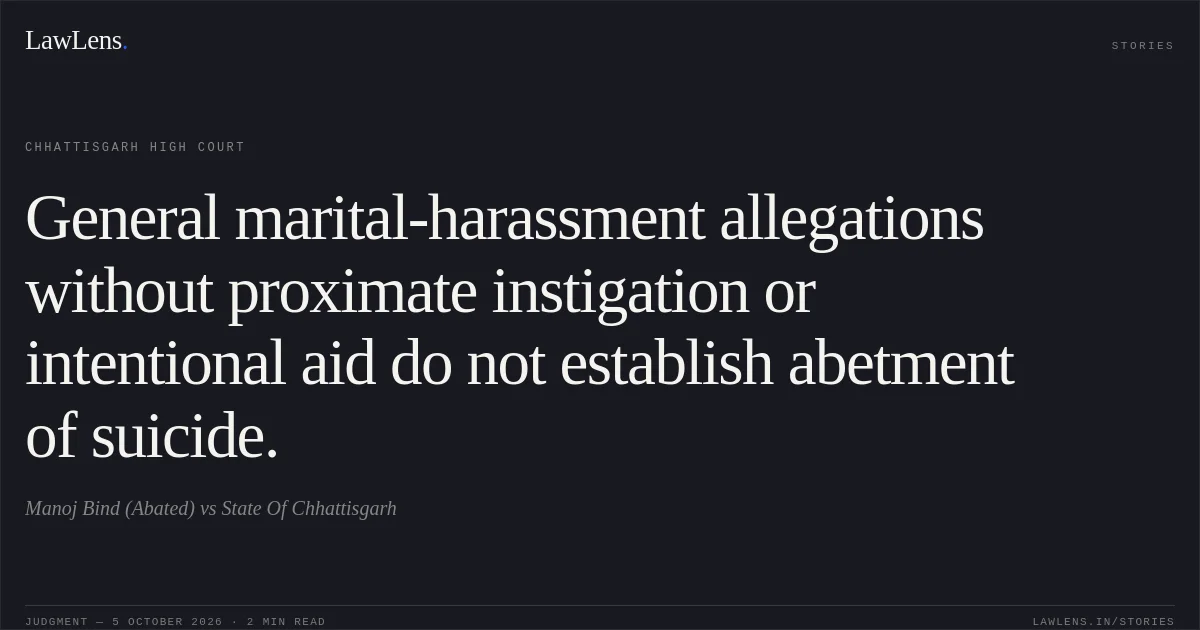
Source reference: para. 22General matrimonial discord or cruelty, without the requisite connection to the suicide and proof of abetment, is insufficient to sustain a conviction under Section 306 IPC.
Source reference: para. 22–23, 26Reasoning
The Court considered the evidence at its highest and found that it showed, at most, allegations of harassment because Uma Bai had given birth to daughters.
Source reference: para. 21, 24–26The allegations against Chhotelal and Sudama Bai were general and omnibus, with no specific act of instigation, conspiracy, or intentional aid attributed to them.
Source reference: para. 21, 24–26The Court found no sufficiently proximate causal link between their conduct and the suicide; statements that Uma Bai was unhappy or did not wish to live did not, without evidence of abetment, establish the offence.
Source reference: para. 21, 24–26The lack of prior complaints or a community meeting was also noted among the circumstances.
Source reference: para. 21, 24–26Holding
The Court held that the prosecution had not proved the essential ingredients of abetment under Section 107 IPC and that the conviction under Section 306 IPC could not be sustained beyond reasonable doubt.
It allowed the appeal of Chhotelal Bind and Sudama Bai, set aside their convictions and sentences, and acquitted them.
Source reference: para. 27–29Their bail bonds were to continue for six months under Section 481 BNSS, 2023.
Source reference: para. 27–29The appeal against Manoj Bind had already abated following his death.
Source reference: para. 6, 27–29Acts & Sections Cited
8 provisions across 3 statutes referred to in this judgment. Each provision opens on LawLens.
Code of Criminal Procedure, 19734
Indian Penal Code, 18603
Bharatiya Nagarik Suraksha Sanhita, 20231
Original Court PDF
Manoj Bind (Abated)vsState Of Chhattisgarh
Click to open original judgment
Original judgment, available to read, download and summarize on LawLens.in