Facts
The appellant, the victim’s grandfather, was prosecuted for allegedly taking his ten- or eleven-year-old granddaughter to his house on the pretext of buying sweets and subjecting her to sexual assault, including kissing her, removing her clothes and licking her genital area. The victim allegedly escaped, took shelter in a nearby house, and disclosed the incident to her parents shortly thereafter
Source reference: paras. 3, 16–17A written complaint was submitted on 05.07.2020, resulting in registration of Mahila P.S. Case No. 35 of 2020 under provisions of the IPC and the POCSO Act
Source reference: para. 4After investigation, the appellant was charged under Sections 341, 342, 354, 354(B) and 506 IPC and Sections 4, 8 and 10 POCSO Act; he pleaded not guilty and alleged false implication arising from a family land dispute
Source reference: para. 6The trial court convicted him under Sections 8 and 10 POCSO Act and imposed concurrent sentences of five years’ rigorous imprisonment with a total fine of ₹50,000. The present appeal challenged the conviction and sentence.
Source reference: para. 2Issues
1. Whether the testimony of the victim, read with her statement under Section 164 CrPC and the evidence concerning her conduct immediately after the incident, was sufficient to establish sexual assault by the appellant despite minor discrepancies and the absence of eyewitnesses?
Source reference: paras. 17–18.32. Whether the two-day delay in lodging the FIR, in a case involving alleged sexual assault by a close family member, materially undermined the prosecution case?
Source reference: paras. 19–19.13. Whether the prosecution established that the victim was a “child” under the POCSO Act, notwithstanding the absence of a formal age-determination inquiry under Section 94 of the Juvenile Justice Act, 2015?
Source reference: paras. 22–264. Whether the appellant’s defence of false implication due to a family partition or land dispute created a reasonable doubt regarding the prosecution case?
Source reference: paras. 20–21.15. Whether the alleged discrepancy between the handwriting on the written complaint and the victim’s exercise book rendered the FIR and the prosecution case unreliable?
Source reference: paras. 27–27.1Law Applied
The Court applied Sections 8, 9 and 10 of the Protection of Children from Sexual Offences Act, 2012: sexual assault is punishable under Section 8, while sexual assault committed in aggravated circumstances, including by a relative or a person in a position of trust, attracts Section 10. Section 34 POCSO requires the Special Court to determine whether a person is a child where that question arises
Source reference: para. 23Section 94 of the Juvenile Justice (Care and Protection of Children) Act, 2015 governs age determination where the person’s status as a child requires inquiry
Source reference: paras. 23, 25The Court relied on Raushan Kumar v. State of Bihar, concerning the limits of age determination based on medical or radiological material, and Sushil Kumar Tiwari v. Hare Ram Sah, 2025 INSC 1061, for the principle that where minority is consistently established by unrebutted oral and documentary evidence and is not challenged at trial, the protective provisions of child-protection legislation should not be defeated by insisting upon an excessively rigid age determination
Source reference: paras. 22–25The Court also applied the POCSO statutory presumptions regarding the commission of the offence and culpable mental state after foundational facts were established
Source reference: para. 28The victim’s testimony, if credible and consistent on material particulars, could independently sustain conviction; corroboration was not indispensable
Source reference: paras. 17–18.3Reasoning
The Court found the victim’s testimony materially consistent with the FIR and her Section 164 CrPC statement regarding the appellant’s identity, the inducement to accompany him, the location, and the sexual assault
Source reference: paras. 17–18The evidence of PW-5, PW-7 and PW-8 corroborated her immediate post-occurrence conduct: she reached their house in a distressed and crying condition soon after escaping, notwithstanding discrepancies concerning the precise extent of her disclosure
Source reference: para. 18.1The two-day delay was not considered fatal because the accused was the victim’s grandfather and the alleged offence occurred within a close family setting; further, the delay was not specifically put to the victim or her parents in cross-examination
Source reference: para. 19.1On age, the Court held that the victim’s statements that she was approximately ten to eleven years old, the parents’ evidence, the trial court’s assessment, and the medical findings indicating physical immaturity established that she was below eighteen; the appellant had not disputed her age during trial or in his Section 313 statement
Source reference: paras. 25–26The old partition-related documents did not demonstrate a continuing motive for false implication, particularly since the family continued to reside together and the alleged dispute dated back several years
Source reference: paras. 20–21.1The handwriting objection also failed because the proposed comparison was not feasible, handwriting may change with age, and the victim’s deposition remained consistent with the written complaint and Section 164 statement
Source reference: para. 27.1Having found the foundational facts proved, the Court held that the POCSO presumptions operated against the appellant and that he failed to rebut them
Source reference: para. 28Holding
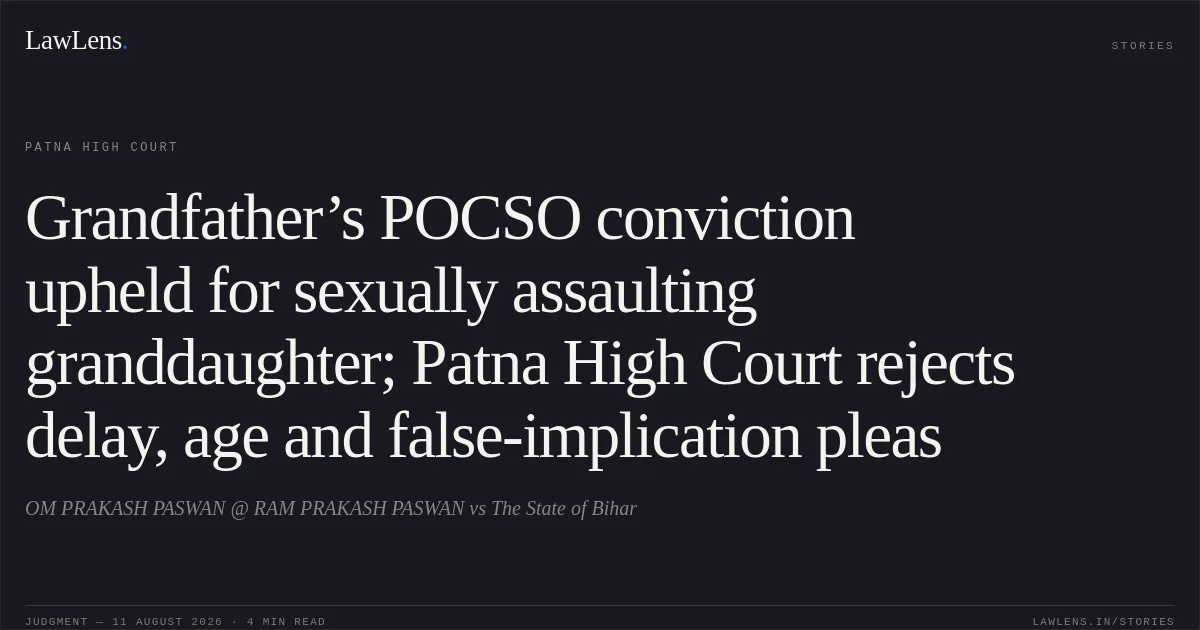
The High Court held that the prosecution proved beyond reasonable doubt that the appellant committed aggravated sexual assault upon his minor granddaughter, attracting Sections 8 and 10 of the POCSO Act
The Court rejected the challenges based on the victim’s credibility, delay in lodging the FIR, alleged land dispute, handwriting discrepancy and the absence of a formal age inquiry.
Source reference: paras. 29–30It found the trial court’s conviction and sentence legal and well-founded, dismissed the appeal, and directed transmission of the trial records and judgment to the trial court for compliance
Source reference: paras. 29–30Acts & Sections Cited
16 provisions across 4 statutes referred to in this judgment. Each provision opens on LawLens.
Protection of Children from Sexual Offences Act, 20127
Indian Penal Code, 18604
Code of Criminal Procedure, 19732
Juvenile Justice (Care and Protection of Children) Act, 2015.3
Original Court PDF
OM PRAKASH PASWAN @ RAM PRAKASH PASWANvsThe State of Bihar
Click to open original judgment
Original judgment, available to read, download and summarize on LawLens.in