01Facts
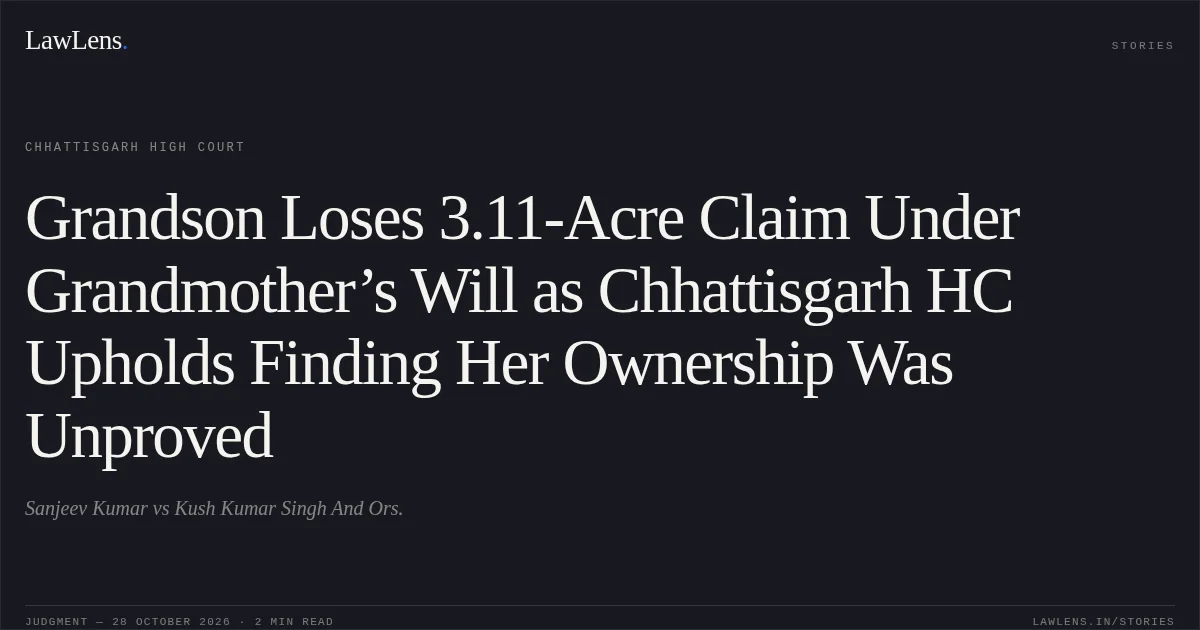
The plaintiff claimed the suit land, Khasra No. 446/8, measuring 3.11 acres, had fallen to his grandmother Radhabai’s share in a 1981 partition and that she bequeathed it to him by a registered Will dated 23 May 2000.
¶ 5–7, 13–16The Trial Court decreed his suit for declaration of title, injunction and possession.
¶ 5–7, 13–16The First Appellate Court reversed, finding that Radhabai’s ownership was not established and that the Will was not reliable.
¶ 5–7, 13–16The plaintiff appealed under Section 100 CPC.
¶ 5–7, 13–1602Issues
i.Whether the First Appellate Court erred in holding that Radhabai was not competent to bequeath the suit property to the plaintiff by the registered Will dated 23 May 2000.
¶ 16ii.Whether the First Appellate Court’s finding that the Will was not duly proved and valid was perverse.
¶ 1603Law Applied
Under Section 63 of the Indian Succession Act, 1925, read with Section 68 of the Indian Evidence Act, 1872, execution and attestation of a Will must be proved in accordance with the statutory requirements; where legitimate suspicious circumstances arise, the propounder must satisfactorily dispel them.
¶ 28, 31, 34–35Revenue entries are primarily fiscal and do not, by themselves, create or extinguish title.
¶ 28, 31, 34–35Under Section 100 CPC, the High Court may not reappreciate facts merely because another view is possible; interference is warranted where the findings involve a substantial error of law, perversity, disregard of material evidence or a comparable infirmity.
¶ 28, 31, 34–35The Court referred to Shivakumar v. Sharanabasappa, (2021) 11 SCC 277, on proof of Wills and suspicious circumstances, and Nazir Mohamed v. J. Kamala, (2020) 19 SCC 57, on the limits of second-appellate jurisdiction.
¶ 28, 31, 34–35Provisions in the judgment · 2 · Linked ones open on LawLens
Code of Civil Procedure, 1908 Section 100
Indian Succession Act, 1925 Section 63
04Reasoning
The absence of Radhabai’s name from the revenue records did not, by itself, establish that she lacked title.
¶ 29–37However, the plaintiff had to prove that she held an interest in the property she purported to bequeath.
¶ 29–37The 1981 partition was admitted, the land was recorded in the names of the two sons, and the evidence did not clearly establish that the suit property had fallen to Radhabai’s share.
¶ 29–37The First Appellate Court also considered the contradiction between the plaintiff’s evidence that he was absent when the Will was executed and the attesting witness’s evidence that he was present, alongside evidence concerning the purchase of the stamp paper.
¶ 29–37The High Court held that the First Appellate Court had assessed the evidence cumulatively and given cogent reasons; its findings were not perverse or affected by a substantial error of law.
¶ 29–3705Holding
The Court answered both substantial questions of law against the plaintiff, finding no ground for interference under Section 100 CPC.
¶ 37–39The second appeal was dismissed, the First Appellate Court’s judgment and decree affirmed, and the parties directed to bear their own costs.
¶ 37–39Original Court PDF
Sanjeev KumarvsKush Kumar Singh And Ors.
Click to open original judgment
Original judgment, available to read, download and summarize on LawLens.in