Facts
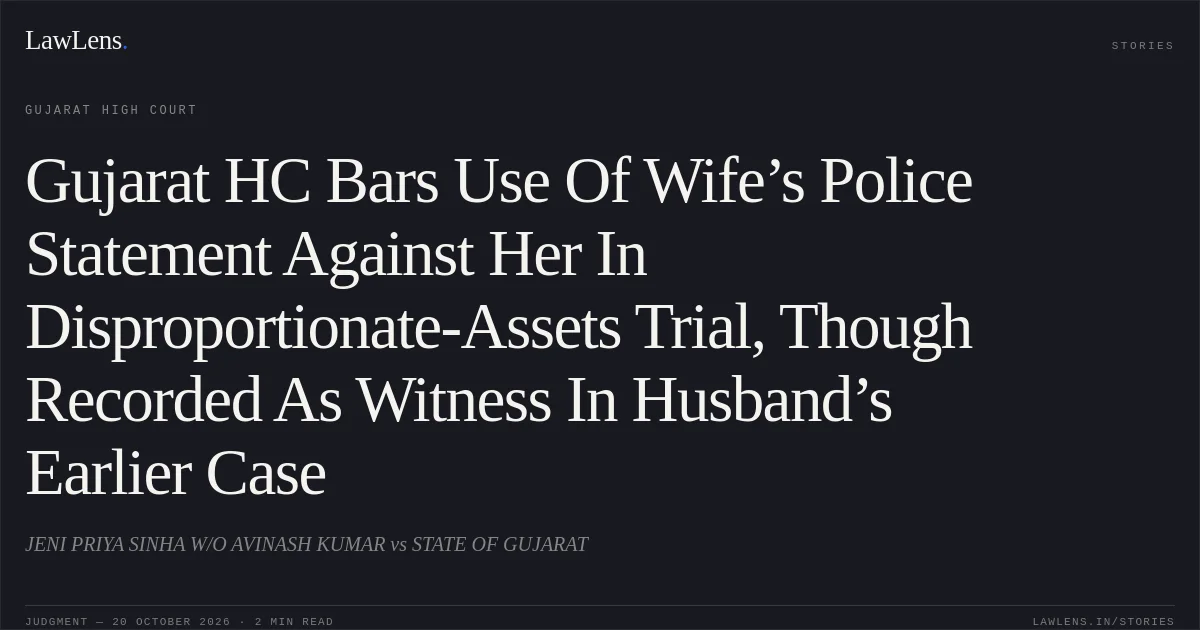
The petitioner was recorded as a witness during an ACB search of her residence on 14 March 2017, in proceedings concerning a bribery allegation against her husband.
Source reference: p. 2–4The CBI later registered a separate disproportionate-assets case in which the petitioner was also charged.
Source reference: p. 2–4During the evidence of the ACB officer in that trial, the prosecution had the petitioner’s earlier police statement exhibited.
Source reference: p. 2–4The trial court permitted this, reasoning that the statement was not inculpatory.
Source reference: p. 2–4The petitioner challenged that ruling, seeking removal of the relevant portions of the officer’s deposition.
Source reference: p. 2–4Issues
1. Whether the petitioner’s statement, recorded by police under Section 161 Cr.P.C. in earlier proceedings in which she was a witness, could be exhibited in the subsequent CBI trial in which she was an accused
Source reference: p. 6–72. Whether the statement could be admitted on the basis that it was exculpatory or could be used under Section 157 of the Evidence Act
Source reference: p. 3–4, 9–10Law Applied
Sections 161 and 162 Cr.P.C. govern statements made to police during investigation.
Source reference: p. 7–10Section 161(2) requires a person questioned to answer truthfully, except where the answer may expose that person to a criminal charge, penalty or forfeiture; Section 162 generally bars the use of a written police statement at an inquiry or trial concerning the offence under investigation, subject to the statutory use for contradiction and related re-examination.
Source reference: p. 7–10The court treated Section 162 as controlling over the general corroboration provision in Section 157 of the Evidence Act, and held that a police statement is not substantive evidence and cannot be introduced against an accused merely because it is characterised as exculpatory.
Source reference: p. 7–10Reasoning
The petitioner’s statement was recorded by police during an investigation in which she was a witness, but it was later tendered through the investigating officer in a separate CBI trial in which she was an accused.
Source reference: p. 6–10The court held that the statement remained a police statement governed by Sections 161 and 162 Cr.P.C.; its use was not made permissible by the fact that the petitioner had not been an accused when it was recorded, or by the prosecution’s description of it as exculpatory.
Source reference: p. 6–10Nor could Section 157 Evidence Act be relied on to corroborate it, because Section 162 restricted the use of such statements.
Source reference: p. 6–10The statement therefore could not be used as evidence through the officer in the later trial.
Source reference: p. 6–10Holding
The High Court held that the trial court’s order permitting the petitioner’s statement to be exhibited could not be sustained.
It allowed the petition and made the Rule absolute.
Source reference: p. 10Acts & Sections Cited
9 provisions across 3 statutes referred to in this judgment. Each provision opens on LawLens.
Code of Criminal Procedure, 19734
Indian Penal Code, 18603
Prevention of Corruption Act, 19882
Original Court PDF
JENI PRIYA SINHA W/O AVINASH KUMARvsSTATE OF GUJARAT
Click to open original judgment
Original judgment, available to read, download and summarize on LawLens.in