Facts
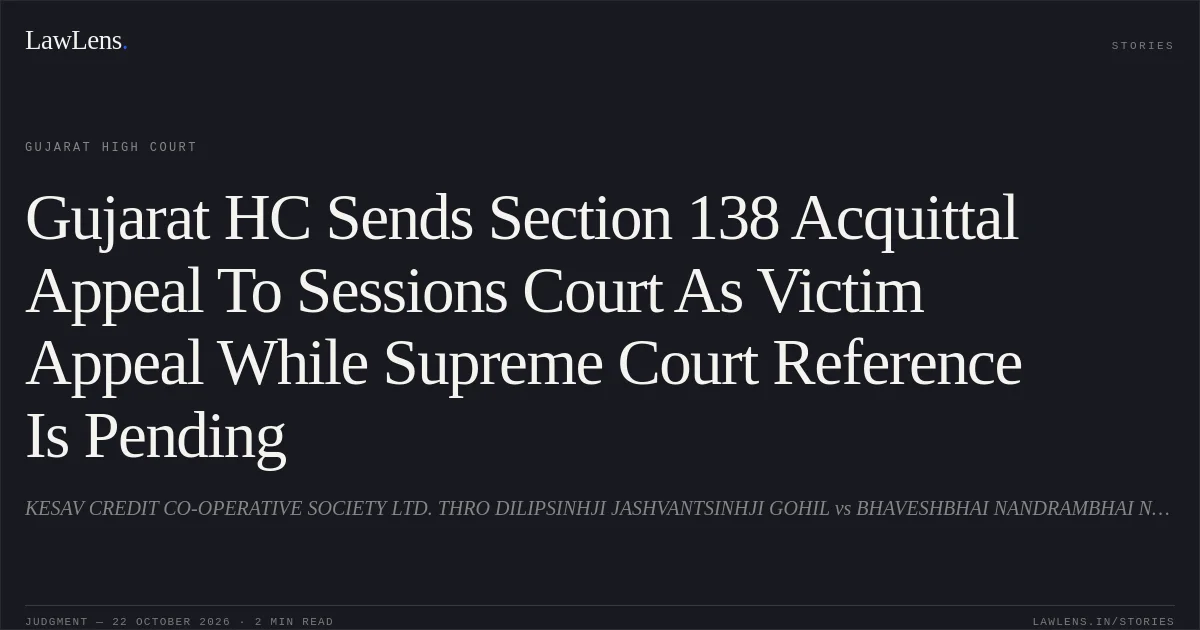
The original complainant appealed under Section 419 of the Bharatiya Nagarik Suraksha Sanhita, 2023, against the Magistrate’s order acquitting the respondent-accused, dated 2 May 2024.
Source reference: para. 1The appellant submitted that, in light of Celestium Financial v. A. Gnanasekaran, a complainant in a Section 138 Negotiable Instruments Act case is a victim and must pursue an appeal before the Sessions Court under the proviso to Section 372 CrPC, corresponding to Section 413 BNSS.
Source reference: paras. 3–5The Additional Public Prosecutor noted that the issue was pending consideration by a larger Bench of the Supreme Court in M/s. Everest Automobiles v. M/s. Rajit Enterprises.
Source reference: para. 6Issues
Whether the complainant’s appeal against acquittal should be transferred to the Sessions Court for treatment as a victim’s appeal under the proviso to Section 372 CrPC/Section 413 BNSS.
Source reference: paras. 3–5, 8Whether the appeal should be decided on its merits while the Supreme Court’s larger-Bench consideration of the relevant question remained pending.
Source reference: paras. 6, 8–9Law Applied
Section 372 CrPC and its corresponding provision, Section 413 BNSS, permit a victim to appeal against acquittal to the court to which an appeal ordinarily lies from the trial court’s order.
Source reference: no citationIn Celestium Financial v. A. Gnanasekaran, reported at 2025 (3) GLH 747, the Supreme Court held that a complainant/payee in a Section 138 Negotiable Instruments Act proceeding is also the victim of the alleged offence and may appeal against acquittal under the victim-appeal proviso, without proceeding under Section 378 CrPC.
Source reference: para. 7The Court also relied on Shivsinh Ganpatsinh Solanki v. State of Gujarat and Thakar Hariprasad Dalsukhram v. State of Gujarat, reported at 2026 SCC OnLine Guj 569, concerning the appropriate appellate forum.
Source reference: paras. 4, 8The judgment noted that the issue was pending larger-Bench consideration in M/s. Everest Automobiles v. M/s. Rajit Enterprises.
Source reference: para. 6Reasoning
Applying the cited authorities, the Court accepted that the complainant’s appeal was to be treated as a victim’s appeal before the Sessions Court, the court immediately superior to the Magistrate.
Source reference: paras. 4–5, 8Although the State pointed out that the Supreme Court had referred the issue for authoritative determination, the High Court did not decide the merits or resolve the broader question; it directed transfer and left the appeal to proceed in the Sessions Court.
Source reference: paras. 6, 8–9Holding
The High Court disposed of the appeal by directing the Registry to transfer the appeal and the entire record to the concerned Sessions Court, where it is to be treated and numbered as an appeal under the proviso to Section 372 CrPC/Section 413 BNSS and notice issued to the parties.
The Sessions Court was requested to endeavour to decide the matter expeditiously. The High Court expressly stated that it had not considered the merits.
Source reference: para. 9Acts & Sections Cited
9 provisions across 3 statutes referred to in this judgment. Each provision opens on LawLens.
Bharatiya Nagarik Suraksha Sanhita, 20232
Negotiable Instruments Act, 18812
Code of Criminal Procedure, 19735
Original Court PDF
KESAV CREDIT CO-OPERATIVE SOCIETY LTD. THRO DILIPSINHJI JASHVANTSINHJI GOHILvsBHAVESHBHAI NANDRAMBHAI NIMAVAT
Click to open original judgment
Original judgment, available to read, download and summarize on LawLens.in