Facts
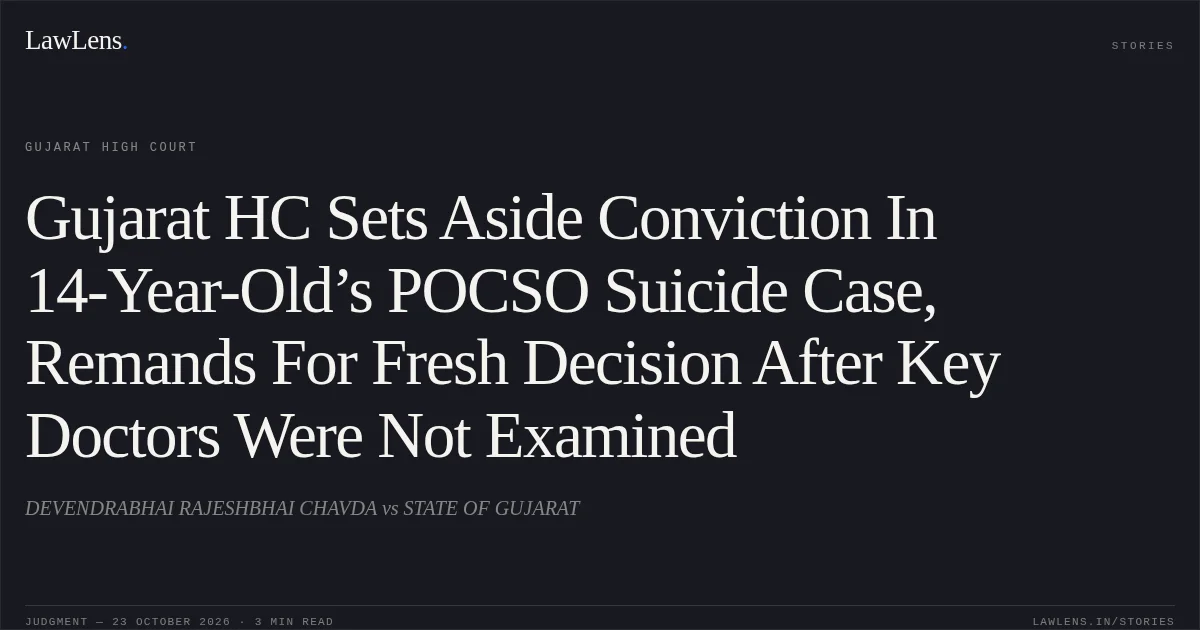
The appellant was convicted by the Special POCSO Court of offences under Sections 305, 354(a) and 506 of the Indian Penal Code and Sections 17 and 18 of the POCSO Act, based principally on two dying declarations.
Source reference: para. 2–4The victim, aged 14, had set herself ablaze on 25 January 2021 and died of her injuries on 4 February 2021.
Source reference: para. 4, 21At trial, the prosecution did not call the doctor who treated the victim and recorded her initial history, or the Medical Officer who endorsed her fitness to give the dying declarations; the victim’s indoor medical papers were also not produced.
Source reference: para. 4, 9The appellant appealed against the conviction and sought suspension of sentence.
Source reference: para. 1–2Issues
1. Whether the conviction, based on the dying declarations, could stand when the treating doctor and the doctor who endorsed the victim’s fitness to make them were not examined and the medical papers were not produced.
Source reference: para. 9, 11, 162. Whether the appellate court should set aside the conviction and remit the case for a fresh decision, given the trial court’s failure to secure material evidence.
Source reference: para. 15–17Law Applied
The Court relied on Section 311 of the Code of Criminal Procedure and Section 165 of the Indian Evidence Act, which empower—and, where necessary for a just decision, require—the trial court to summon material witnesses, recall witnesses, ask questions and obtain relevant evidence rather than act as a passive recorder.
Source reference: para. 12–16It relied on Nallapati Sivaiah v. Sub Divisional Officer, Guntur, A.P., AIR 2008 SC 19, for the principle that a dying declaration must be scrutinised for reliability and that the declarant’s fitness to make it must be proved; a doctor’s endorsement or a Magistrate’s recording of the declaration does not, by itself, establish its truthfulness.
Source reference: para. 10It also relied on Anees v. State Govt. of NCT, AIR 2024 SC 2297, Varsha Garg v. State of Madhya Pradesh, AIR 2022 SC 3707, and Dhanraj v. State of Rajasthan, 2026 INSC 958, for the trial court’s active truth-seeking role and duty to ensure material evidence is brought on record.
Source reference: para. 12–15Reasoning
The Court noted that the conviction rested on the two dying declarations, while the prosecution had omitted evidence bearing directly on their reliability: the treating doctor’s account of the victim’s initial history, medical evidence concerning her fitness to make the declarations, and the indoor medical papers.
Source reference: para. 9, 11The trial court had not used its powers under Section 311 CrPC or Section 165 of the Evidence Act to obtain that material, despite its importance to a just determination.
Source reference: para. 16The Court therefore held that the omissions amounted to a failure to ensure a fair and complete trial, but did not decide the merits of the allegations or the evidentiary weight of the declarations.
Source reference: para. 16, 18Holding
The High Court allowed the appeal, quashed and set aside the conviction and sentence, and remanded the case to the trial court for a fresh decision after affording both sides an opportunity to be heard and without being influenced by the High Court’s order.
The Court directed the trial court to dispose of the case within six months of receiving the order.
Source reference: para. 19The Court expressly left the merits undecided.
Source reference: para. 18The application for suspension of sentence was disposed of as no longer surviving following disposal of the appeal.
Source reference: para. 20Acts & Sections Cited
9 provisions across 5 statutes referred to in this judgment. Each provision opens on LawLens.
Bharatiya Nagarik Suraksha Sanhita, 20232
Indian Penal Code, 18602
Protection of Children from Sexual Offences Act, 20122
Code of Criminal Procedure, 19732
Bharatiya Sakshya Adhiniyam, 20231
Original Court PDF
DEVENDRABHAI RAJESHBHAI CHAVDAvsSTATE OF GUJARAT
Click to open original judgment
Original judgment, available to read, download and summarize on LawLens.in