Facts
On 11 October 2011, the deceased, aged 34 years, was travelling in a tempo near VIP Ghat, Haridwar, when a truck allegedly driven rashly and negligently by Rajendra Singh collided with the tempo. The deceased sustained fatal injuries.
Source reference: pp. 2–4His widow, two minor children and two parents instituted a claim petition under the Motor Vehicles Act before the MACT, Rohini Courts.
Source reference: pp. 2–4The deceased was employed as an Assistant Manager with M/s Satyam Auto Components and was drawing a salary reflected in the employment records and salary slip.
Source reference: pp. 2–4The Tribunal awarded compensation of ₹58,12,600 with interest at 7.5% per annum.
Source reference: pp. 2–4Both parties appealed: the claimants sought enhancement of income and compensation, while the Insurance Company challenged the assessment of income, the addition towards future prospects, and the failure to deduct for alleged composite negligence.
Source reference: pp. 2–3Issues
Whether the deceased’s salary should include the various allowances and employment-related benefits reflected in his salary slip, and whether income tax was required to be deducted from the assessed annual income?
Source reference: pp. 3–6Whether the deceased was entitled to a 50% addition towards future prospects, or only a 40% addition because he was employed on probation and had no proved entitlement to increments?
Source reference: pp. 6–10Whether the compensation should be reduced on account of alleged composite negligence arising from the head-on collision between the truck and the tempo?
Source reference: pp. 10–11Whether the deductions towards personal and living expenses and the amounts awarded under consortium, loss of estate and funeral expenses required modification?
Source reference: pp. 10–12Law Applied
The Court applied the principles governing computation of compensation under Sections 166 and 168 of the Motor Vehicles Act, 1988.
Source reference: pp. 4–6Relying on National Insurance Co. Ltd. v. Indira Srivastava, Meenakshi v. Oriental Insurance Co. Ltd., Manorma Sinha v. Divisional Manager, Oriental Insurance Ltd., and E. Neeta Devi v. Ashwani Kumar, it held that income is not confined to take-home salary and that fixed allowances and benefits accruing to the family may be included in the multiplicand.
Source reference: pp. 4–6Under National Insurance Co. Ltd. v. Pranay Sethi, 50% future prospects applies to a person below 40 years in permanent employment, whereas 40% applies to a self-employed person or one on a fixed salary; actual income is to be assessed after deduction of income tax.
Source reference: pp. 6–10The Court also applied Pranay Sethi and United India Insurance Co. Ltd. v. Satinder Kaur for conventional heads such as consortium, funeral expenses and loss of estate.
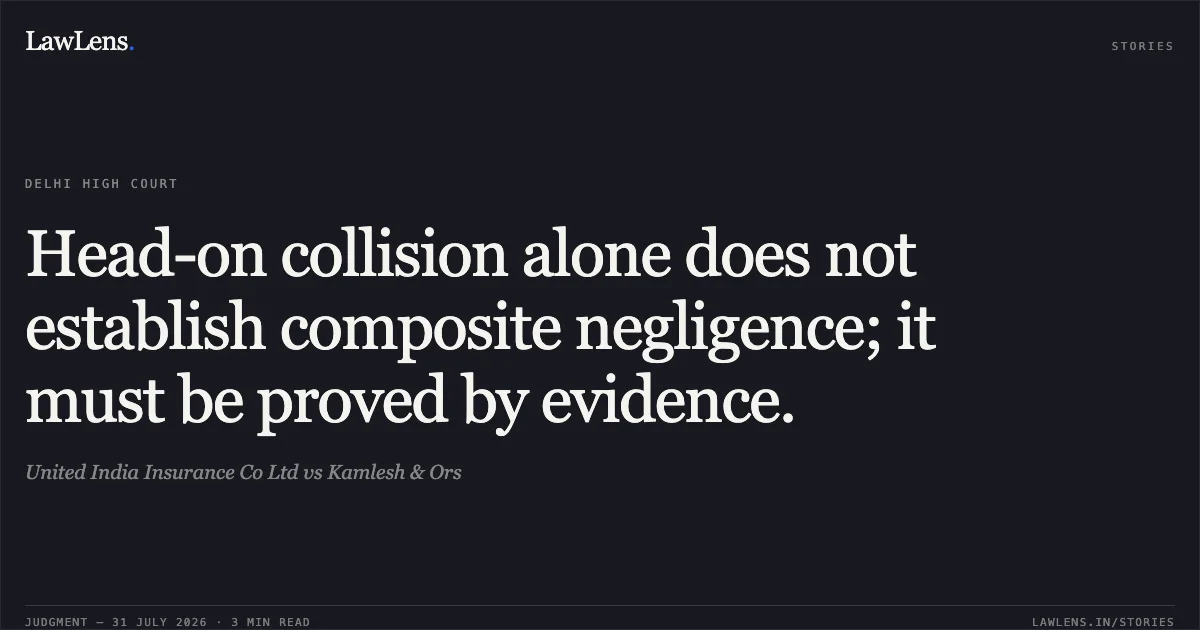
Source reference: p. 11Alleged composite negligence must be established by evidence; a head-on collision by itself does not justify an automatic 50% deduction.
Source reference: pp. 10–11Reasoning
The Court included the basic salary along with HRA, children’s education allowance, washing allowance, conveyance allowance, magazine and phone reimbursements, and provident-fund contribution, while excluding the separate ₹700 bonus as an uncertain or additional payment.
Source reference: pp. 5–6The resulting monthly income was fixed at ₹28,023, or ₹3,36,276 annually. After deducting income tax of ₹15,627.60, the annual income was assessed at ₹3,20,649.
Source reference: pp. 5–6Since the deceased was still on probation and no documentary evidence established a contractual right to increments, his employment could not be treated as permanent merely because he had held jobs with different companies; accordingly, only 40% future prospects were granted.
Source reference: pp. 6, 10As there were at least four dependants, personal expenses were reduced by one-fourth rather than one-third.
Source reference: p. 10The Insurance Company failed to produce the tempo driver, site plan or other evidence proving contributory or composite negligence.
Source reference: pp. 10–11The eyewitness account indicated that the tempo was travelling on the left side and that the truck approached from the opposite direction; the charge-sheet was also filed against the truck driver alone.
Source reference: pp. 10–11Hence, no deduction for composite negligence was warranted.
Source reference: pp. 10–11The Court recalculated the dependency and conventional compensation in accordance with the applicable precedents.
Source reference: pp. 11–12Holding
The Court partly allowed the Insurance Company’s appeal and modified the award while rejecting the claimants’ request for further enhancement.
The compensation was recalculated as follows: loss of dependency ₹53,86,752; loss of consortium ₹2,00,000; loss of estate ₹15,000; and funeral expenses ₹15,000, totalling ₹56,16,752, with interest at 7.5% per annum.
Source reference: p. 12The alleged composite negligence was rejected.
Source reference: p. 12The excess amount of ₹1,95,848, together with accrued interest, was directed to be refunded to the Insurance Company, while the balance deposited amount and accrued interest was directed to be released to the claimants in a lump sum.
Source reference: pp. 12–13Both appeals were disposed of accordingly.
Source reference: pp. 12–13Original Court PDF
United India Insurance Co LtdvsKamlesh & Ors
Click to open original judgment
Original judgment, available to read, download and summarize on LawLens.in