Facts
On October 29, 2013, a woman’s torso was found in a plastic bag at Charai Lake, Chembur.
Source reference: para. 2(a)Subsequent investigations identified the deceased as Kanti Karunakar Shetty via DNA profiling.
Source reference: para. 19Witnesses (P.W. 2, 3, and 6) observed the Appellant disposing of the bag at the lake.
Source reference: para. 47-52Pursuant to the Appellant's disclosure, the deceased's head was recovered from a nala.
Source reference: para. 82The Trial Court convicted the Appellant under Sections 302 (murder) and 201 (causing disappearance of evidence) of the IPC.
Source reference: para. 1The Appellant challenged this, citing gaps in the circumstantial chain, specifically regarding "last seen together" and lack of exclusive knowledge of the crime scene.
Source reference: para. 8Issues
1. Whether the prosecution established a complete chain of circumstantial evidence to prove the Appellant's guilt for the offence of murder under Section 302 IPC.
Source reference: para. 18, 1192. Whether the Appellant can be convicted under Section 201 IPC for destruction of evidence despite an acquittal under Section 302 IPC.
Source reference: para. 128Law Applied
The Court applied Section 302 (Murder) and Section 201 (Causing disappearance of evidence) of the Indian Penal Code.
Source reference: para. 1It relied on the "Five Golden Principles" (Panchsheel) of circumstantial evidence established in Sharad Birdhichand Sarda v. State of Maharashtra.
Source reference: para. 12, 13Regarding the "last seen theory," it followed Anand Jakkappa Pujari v. State of Karnataka, requiring a small time gap and corroboration.
Source reference: para. 22For Section 201, it applied the doctrine from Palvinder Kaur v. State of Punjab and V.L. Tresa v. State of Kerala, which holds that an accused may be convicted of screening an offender even if not proved to be the primary murderer.
Source reference: para. 126, 132Reasoning
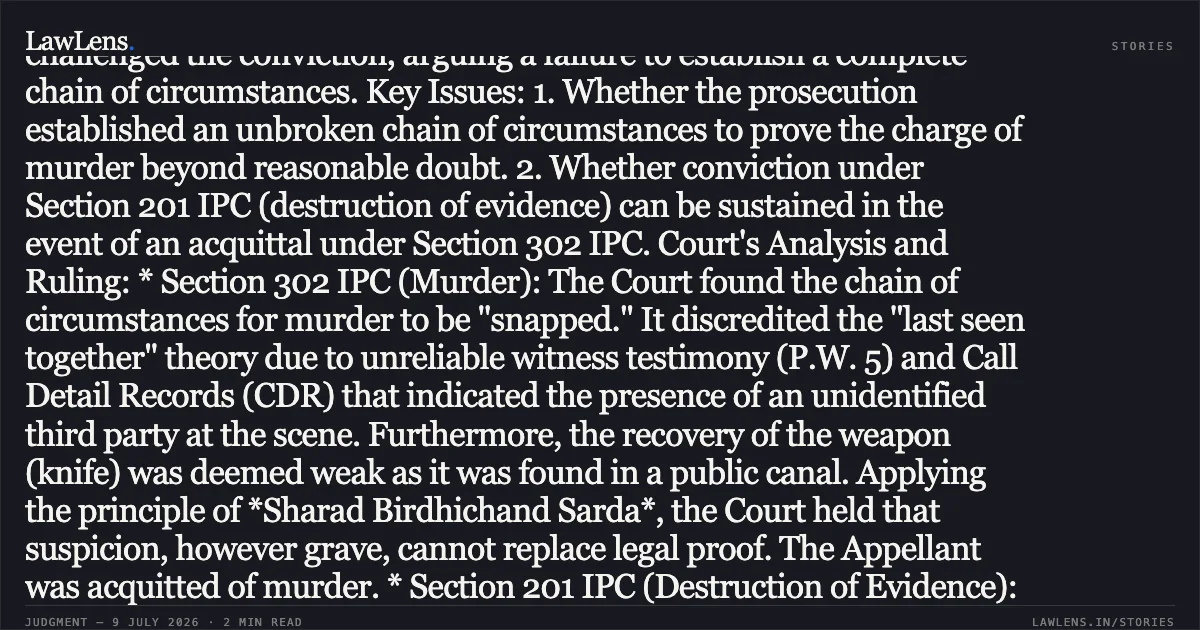
The Court found the chain for murder broken. First, the "last seen" testimony of P.W. 5 was deemed unreliable due to an unexplained 1.5-month delay in recording his statement.
Source reference: para. 25-29Second, Call Detail Records (CDR) showed an unidentified third person at the deceased's location during the material time, creating a plausible hypothesis of third-party intervention.
Source reference: para. 39-41Third, the recovery of blood-stained articles from Room No. 224 was not conclusive as the room was shared with three others.
Source reference: para. 96However, the charge under Section 201 was fully established. The Court relied on the consistent testimonies of P.W. 2, 6 (witnesses at the lake), and P.W. 3 (rickshaw driver) who identified the Appellant disposing of the torso.
Source reference: para. 57, 127This, coupled with the recovery of the head at his instance, proved he had knowledge of the murder and intentionally sought to screen the offender.
Source reference: para. 133Holding
The Court partly allowed the appeal. It held that while suspicion was grave, the prosecution failed to prove the Appellant committed the murder "beyond reasonable doubt," thus acquitting him under Section 302 IPC.
The Court sustained the conviction under Section 201 IPC, holding that acquittal for murder does not ipso facto result in acquittal for destroying evidence if knowledge of the crime and disposal of the body are proved.
Source reference: para. 136-137Since the Appellant had already served approximately 13 years (exceeding the 2-year sentence for Section 201), the Court ordered his immediate release.
Source reference: para. 140Acts & Sections Cited
1 provisions across 1 statute referred to in this judgment. Each provision opens on LawLens.
Bharatiya Nagarik Suraksha Sanhita, 20231
Original Court PDF
Prabhakar Kutty ShettyvsThe State Of Maharashtra
Click to open original judgment
Original judgment, available to read, download and summarize on LawLens.in