Facts
The appellants were candidates for the post of Panchayat/Prakhand Teachers under the 2006 and 2008 Recruitment Rules. Despite being on the merit list, they were not appointed during the initial phases (concluded by 2010)
Source reference: p. 38, 42Years later, between 2012 and 2017, vacancies arose due to resignations or deaths of previously appointed teachers
Source reference: p. 39The appellants approached District Appellate Authorities (DAA) in 2016-17, who directed their appointment against these "future" vacancies
Source reference: p. 39Following their appointment, the State stopped their salaries, leading to writ petitions. Subsequently, the State Appellate Authority (SAA) set aside the DAA orders and the appellants' appointments with retrospective effect
Source reference: p. 40A Single Judge of the High Court upheld the SAA's decision on March 7, 2025, which the appellants challenged in these intra-court appeals
Source reference: p. 40Issues
1. Whether the State Appellate Authority (SAA) order passed in the absence of a Chairman (Judicial) suffers from the vice of coram non judice?
Source reference: p. 60, para. 412. Whether the delay condoned by the SAA in entertaining the State’s appeals after six years was legal?
Source reference: p. 61, para. 423. Whether the life of a merit list from the 2006-2008 selection process can be revived to fill vacancies arising in 2012 and onwards?
Source reference: p. 61, para. 444. Whether the retrospective termination and direction for recovery of salary are sustainable?
Source reference: p. 62, para. 46Law Applied
The court applied the Bihar State Teaching Institutions Teachers and Employees (Disputes Redressal and Appeal) Rules, 2020, specifically Rule 4(iii) regarding the composition of the SAA
Source reference: p. 63Regarding public employment, the court relied on State of Orissa v. Rajkishore Nanda, holding that a merit list is not a "perpetual reservoir" for future vacancies
Source reference: p. 42, 87It applied Articles 14 and 16 of the Constitution of India, emphasizing that appointments must follow transparent recruitment processes
Source reference: p. 42For the limitation issue, it cited Collector (Land Acquisition) v. Katiji, prioritizing "substantial justice" over technical delays in matters of public interest
Source reference: p. 44, 78Regarding recovery of wages, it referenced the principles in Rita Mishra v. Director, Primary Education and R. Vishwanatha Pillai v. State of Kerala concerning the validity of appointments versus fraudulent procurement
Source reference: p. 59, 95Reasoning
The Court reasoned that under Rule 4(iii) of the 2020 Rules, the SAA can function with the Chairman (Administrative) alone unless complex legal interpretations are required, thus the SAA order was valid
Source reference: p. 72Regarding the merit list, the Court found that the 2006/2008 recruitment process concluded in 2010; consequently, any vacancies arising after 2012 are "future vacancies" to be governed by the 2012 Rules, which mandated the Teacher Eligibility Test (TET)—a qualification the appellants lacked
Source reference: p. 91The DAAs exceeded their jurisdiction by directing appointments years after the panel's life expired
Source reference: p. 89The Court condoned the State's delay because the appellants had obtained DAA orders without impleading necessary State authorities, making the State's later challenge a matter of public interest
Source reference: p. 80-81However, the court distinguished the appellants' case from those involving active forgery; since they worked based on a (now-quashed) DAA order rather than personal fraud, equity prevented the recovery of wages already paid for services rendered
Source reference: p. 97-98Holding
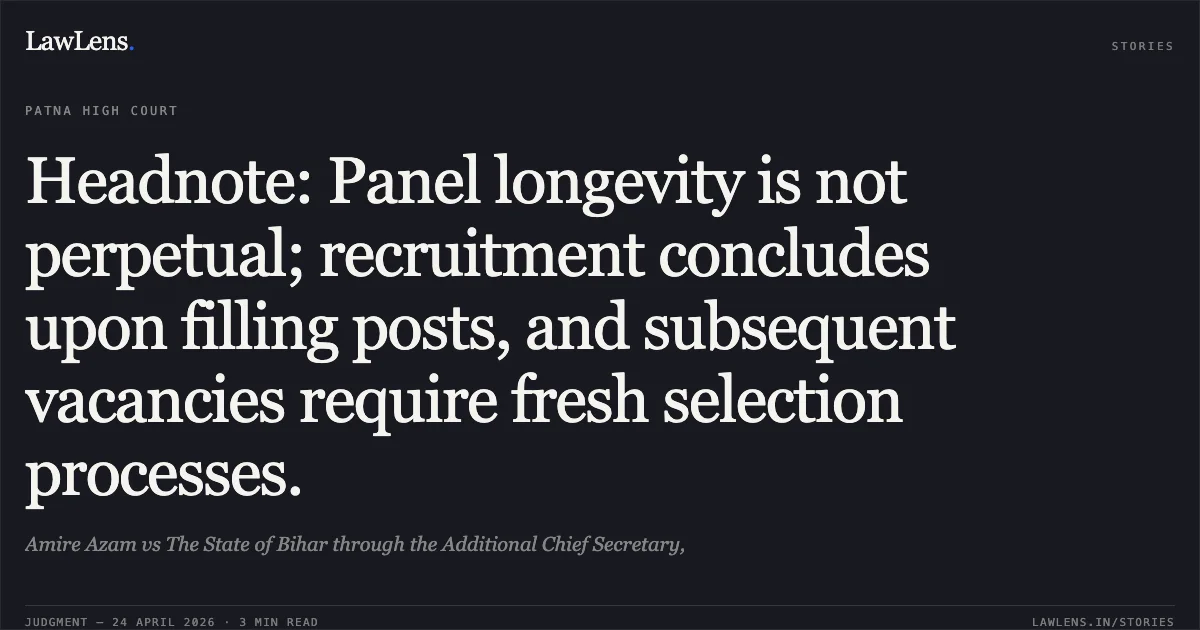
The life of a merit list cannot be extended indefinitely to fill future vacancies
The Court dismissed the Letters Patent Appeals, upholding the Single Judge's decision that the appointments were illegal and dehors the rules. (1) The termination of the appellants is upheld but shall take effect from the date of the SAA's order, not retrospectively. (2) The direction for recovery of salaries already disbursed is set aside. (3) Appellants are entitled to salary only for the actual period of service rendered until the SAA order.
Source reference: p. 99, 102, 103Acts & Sections Cited
10 provisions across 5 statutes referred to in this judgment. Each provision opens on LawLens.
BIHAR PANCHAYAT RAJ ACT, 20063
Right of Children to Free and Compulsory Education Act, 20091
Bihar Private Schools ( Fee Regulation) Act, 20191
Indian Penal Code, 18603
Original Court PDF
Amire AzamvsThe State of Bihar through the Additional Chief Secretary,
Click to open original judgment
Original judgment, available to read, download and summarize on LawLens.in