Facts
On 1 August 2002, the appellant-claimant was travelling with his wife on motorcycle No. GJ-6-NN-6268 when a truck driven allegedly rashly and negligently by respondent No. 1 came from the opposite direction and collided with the motorcycle, causing the claimant grievous injuries, including a head injury resulting in hemiplegia.
Source reference: para. 2The claimant was engaged in farming, cattle breeding and service with Kantharia Dudh Utpadan Sahakari Mandali; his annual income was assessed at Rs.60,000, which was not disputed.
Source reference: para. 7The Motor Accident Claims Tribunal awarded Rs.5,20,000 with interest at 9% per annum.
Source reference: para. 1The claimant appealed, challenging the adequacy of compensation, particularly the assessment of functional disability and amounts awarded under non-pecuniary heads.
Source reference: para. 2.3; paras. 4–4.3Issues
Whether the claimant was entitled to an addition towards future prospects on his assessed annual income, considering his age of 46 years.
Source reference: paras. 4, 7Whether the claimant’s functional disability should be assessed at 100%, instead of the Tribunal’s assessment of 55%, in view of his hemiplegia and inability to continue his pre-accident avocation.
Source reference: paras. 4.1, 8–9Whether the compensation awarded under pain, shock and suffering, attendant charges and loss of amenities of life required enhancement.
Source reference: paras. 4.2–4.3, 10–14Law Applied
The Court applied the principles governing computation of motor accident compensation under the Motor Vehicles Act, particularly the assessment of loss of future earning capacity based on functional disability rather than merely physical disability.
Source reference: no citationRelying on National Insurance Co. Ltd. v. Pranay Sethi, (2017) 16 SCC 680, and Sidram v. Divisional Manager, United India Insurance Co. Ltd., (2023) 3 SCC 439, it held that 25% should be added towards future prospects for a claimant aged 46 years.
Source reference: para. 7Under Raj Kumar v. Ajay Kumar, disability must be evaluated by distinguishing bodily disability from its impact on the claimant’s capacity to perform his particular occupation; functional disability may therefore exceed the percentage of physical disability.
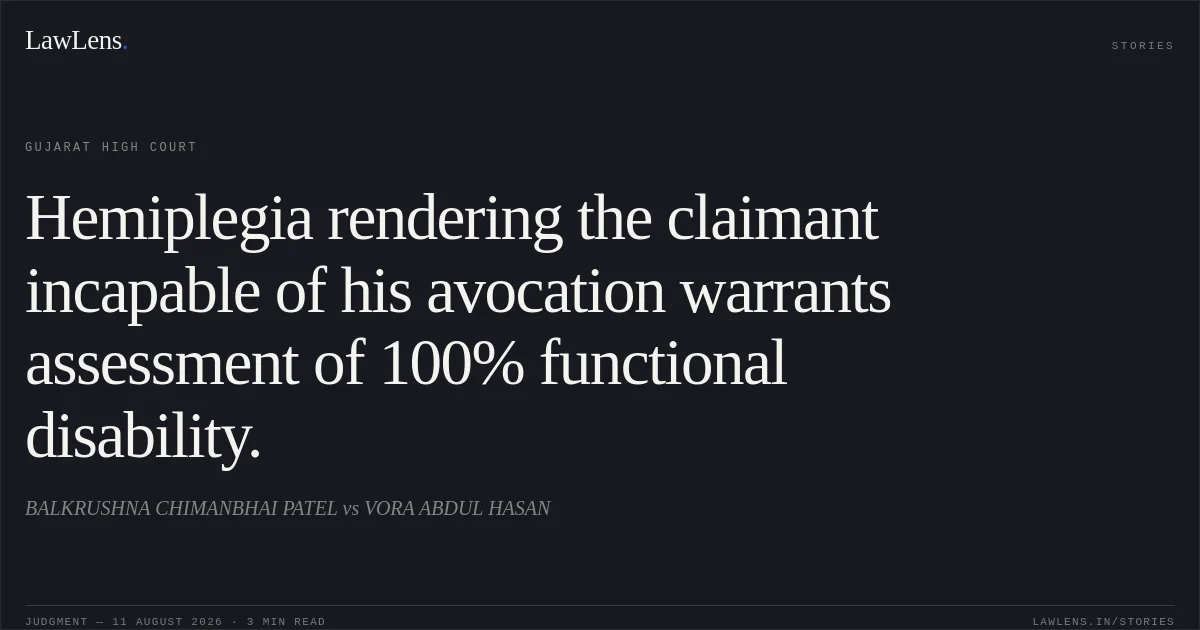
Source reference: para. 8Relying on Parminder Singh v. New India Assurance Co. Ltd., (2019) 7 SCC 217, the Court recognised that hemiplegia may justify assessment of functional disability at 100% where the claimant is incapable of pursuing his previous avocation.
Source reference: para. 9The Court also applied the principle that just compensation must be awarded for pain and suffering, attendant care and loss of amenities having regard to the nature and consequences of the injuries.
Source reference: paras. 10–14Reasoning
The Court accepted the Tribunal’s assessment of the claimant’s annual income at Rs.60,000 and added 25% for future prospects, resulting in an annual income of Rs.75,000.
Source reference: para. 7Although the medical evidence certified 70% disability of the body as a whole, the Court held that the relevant inquiry was the effect of hemiplegia on the claimant’s ability to perform his actual work in farming, cattle breeding and related activities.
Source reference: para. 8Since half of his body had become non-functional and he could no longer pursue the avocation carried on before the accident, the Court treated his functional disability as 100%, applied the multiplier of 13 applicable to his age, and calculated future loss of income at Rs.9,75,000.
Source reference: para. 9Considering his head injury, surgery, prolonged hospitalisation, continuing disability and inability to lead a normal life, the Court enhanced pain, shock and suffering to Rs.3,00,000, awarded Rs.1,50,000 for attendant charges, and granted Rs.2,00,000 for loss of amenities of life.
Source reference: paras. 10–14The awards for actual loss of income, medical expenses, and special diet and transportation were maintained.
Source reference: para. 13Holding
The appeal was partly allowed and the Tribunal’s award was modified.
The total compensation was enhanced to Rs.16,91,000, comprising Rs.9,75,000 for future loss of income, Rs.30,000 for actual loss of income, Rs.11,000 for medical expenses, Rs.25,000 for special diet and transportation, Rs.1,50,000 for attendant charges, Rs.2,00,000 for loss of amenities, and Rs.3,00,000 for pain, shock and suffering.
Source reference: para. 15After deducting the Rs.5,20,000 already awarded, the claimant became entitled to an additional Rs.11,71,000, with interest at 9% per annum from the date of filing of the claim petition until realisation.
Source reference: paras. 15–16Respondent No. 3–Insurance Company was directed to deposit the additional compensation with interest within six weeks, after which the Tribunal was to disburse the amount to the claimant subject to deduction of deficit court fees, if any, and due verification.
Source reference: paras. 18–19Acts & Sections Cited
1 provisions across 1 statute referred to in this judgment. Linked provisions open on LawLens.
Persons With Disabilities (Equal Opportunities, Protection Of Rights And Full Participation) Act, 19951
Original Court PDF
BALKRUSHNA CHIMANBHAI PATELvsVORA ABDUL HASAN
Click to open original judgment
Original judgment, available to read, download and summarize on LawLens.in