Facts
The appellants, former employees or associates of the Food Corporation of India (FCI), filed Writ Petitions seeking a Writ of Mandamus.
Source reference: p. 5Their primary grievance was that a 2014 proposal for amending the Food Corporation of India Act, based on certain official internal communications and their own representations, had not been fructified.
Source reference: p. 5They sought directions to compel the authorities to act upon these internal notes and representations.
Source reference: p. 5The Writ Court dismissed the petitions on 20.07.2023, ruling that a Mandamus cannot be issued to direct respondents to process internal communications for legislative amendments.
Source reference: p. 3, 5The appellants challenged this dismissal via Intra-Court Appeals.
Source reference: no citationIssues
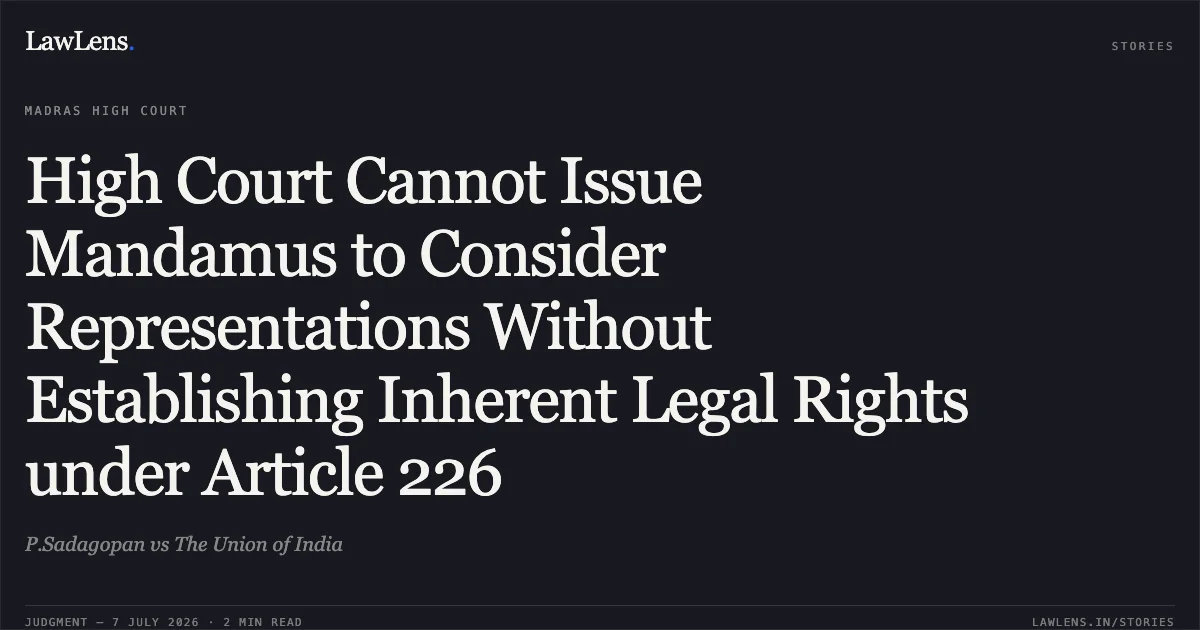
1. Whether the High Court, in the exercise of judicial review under Article 226, can issue directions to dispose of representations in a routine manner without the petitioner establishing a legal right or its infringement.
Source reference: p. 3-42. Whether a Writ of Mandamus can be issued to compel the Government to initiate or process internal communications for the purpose of amending an Act.
Source reference: p. 5Law Applied
The Court applied the principles of judicial review under Article 226 of the Constitution of India, emphasizing that a petitioner must establish a clear legal right or the infringement of such a right to maintain a writ petition.
Source reference: p. 4It relied on the precedent set by the Constitution Bench of the Hon’ble Supreme Court in High Court Bar Association, Allahabad vs. State of U.P. and others (2024 INSC 150), which held that Constitutional Courts should refrain from fixing time-bound schedules for disposals or interfering in administrative/judicial prioritization except in exceptional circumstances.
Source reference: para. 37(c) / p. 5Reasoning
The Court reasoned that issuing "blind" directions to consider representations without examining the underlying legal rights is improper, as it may lead to the consideration of claims on extraneous grounds or allow the High Court’s order to be misused to create administrative files for indirect goals.
Source reference: p. 4Regarding the specific relief sought, the Court observed that the appellants’ grievance centered on legislative amendments to the Food Corporation of India Act.
Source reference: p. 5The Court held that internal communications and notes regarding potential legislative changes do not create an enforceable legal right.
Source reference: p. 5Since the power to amend an Act is a legislative/policy matter, the judiciary cannot issue a Mandamus to compel the executive to process internal notes for that purpose.
Source reference: p. 5The Court found the writ petitions to be "misconceived" because the grievance addressed did not fall within the realm of judicial review.
Source reference: p. 4-5Holding
The Court held that directions to consider representations cannot be issued unless the petitioner establishes a legal right or infringement.
Furthermore, it held that no Writ of Mandamus lies to compel the government to act on internal communications for amending a statute.
Source reference: p. 5The High Court dismissed the Writ Appeals, confirming the order of the Writ Court and closing all connected miscellaneous petitions with no costs awarded.
Source reference: p. 6Acts & Sections Cited
1 provisions across 1 statute referred to in this judgment. Linked provisions open on LawLens.
Letters Patent of the High Court1
Original Court PDF
P.SadagopanvsThe Union of India
Click to open original judgment
Original judgment, available to read, download and summarize on LawLens.in