Facts
The applicant, a "child in conflict with law," was accused of throwing water and acid at a classmate (the victim) during a chemistry class on September 8, 2025, due to a prior grudge
Source reference: para. 5Following an investigation, a Challani Report (No. 01 of 2025) was filed, and the Juvenile Justice Board, Tehri Garhwal, took cognizance and issued summons on November 12, 2025, for offences under Sections 115(2) and 124(1) of the Bharatiya Nyaya Sanhita (BNS)
Source reference: para. 4-5Subsequently, the natural guardians of both the applicant and the victim amicably settled the dispute outside of court and filed a joint compounding application (I.A. No. 1 of 2026) to quash the proceedings
Source reference: para. 6Issues
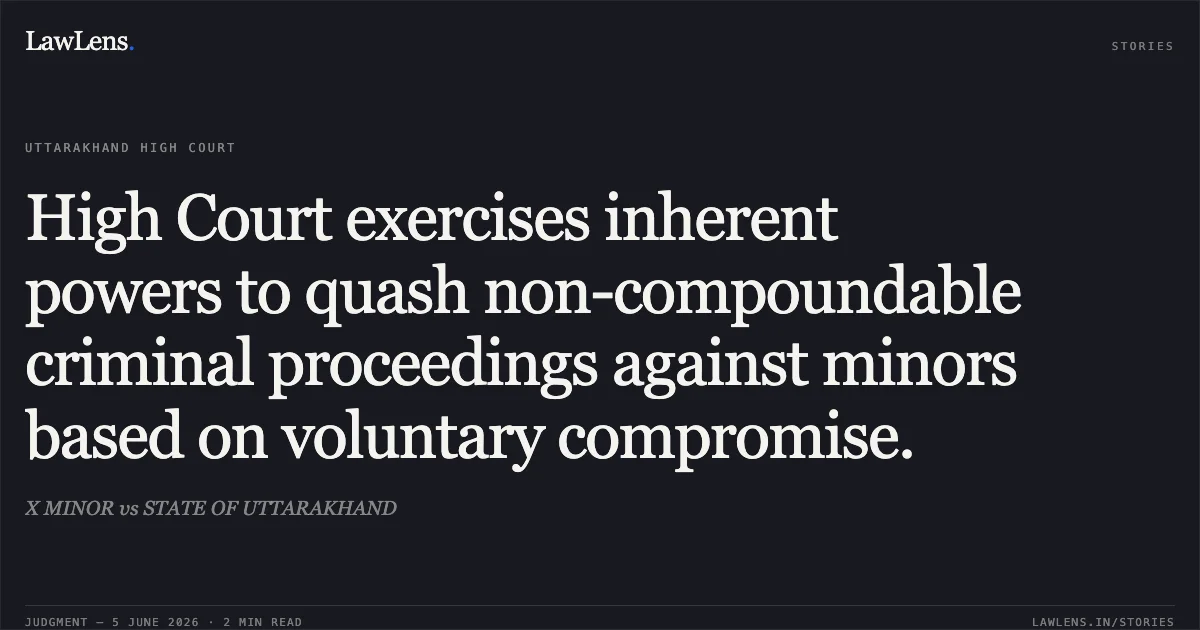
Whether the High Court can exercise its inherent jurisdiction to quash criminal proceedings involving non-compoundable offences on the basis of a private settlement between the parties
Source reference: para. 11-13Whether the quashing of proceedings is appropriate in a case involving minor students to serve the ends of justice and rehabilitation
Source reference: para. 14Law Applied
The Court relied on its inherent jurisdiction under Section 482 of the Cr.P.C. (and corresponding provisions under current law) to prevent the abuse of the process of law
Source reference: para. 11It applied the principles from Gian Singh v. State of Punjab (2012), which allows quashing of private disputes if a settlement advances the ends of justice
Source reference: para. 11It further relied on Narinder Singh v. State of Punjab (2014), which held that proceedings should be quashed when a settlement renders the possibility of conviction remote
Source reference: para. 12Finally, it cited Parbatbhai Aahir v. State of Gujarat (2017) and State of M.P. v. Laxmi Narayan (2019) regarding the court's duty to consider the nature of the offence and the impact on society while promoting substantial justice
Source reference: para. 13Reasoning
The Court observed that although the alleged offences under BNS are not compoundable, the dispute was essentially personal and arose from a quarrel between school-going children of "tender age"
Source reference: para. 11, 14The Court noted that the victim had recovered and the natural guardians had voluntarily entered into a compromise to protect the "future, education, and rehabilitation" of both minors
Source reference: para. 14By interacting with the guardian of Respondent No. 2 via video conferencing and in person, the Court verified that the settlement was made without coercion
Source reference: para. 7, 10The Court reasoned that since the complainant no longer wished to pursue the case, the likelihood of a successful prosecution was "remote and bleak," thus continuing the trial would be a futile exercise and an abuse of the judicial process
Source reference: para. 12, 14Holding
The Court answered the issues in the affirmative, holding that giving "quietus to the litigation" served the best interests of the minors and the ends of justice
The Court allowed the compounding application and quashed Challani Report No. 01 of 2025, the summoning/cognizance order dated November 12, 2025, and the entire proceedings of Criminal Case No. 09 of 2025 pending before the Juvenile Justice Board, Tehri Garhwal
Source reference: para. 15Acts & Sections Cited
3 provisions across 2 statutes referred to in this judgment. Each provision opens on LawLens.
Bharatiya Nyaya Sanhita, 20232
Code of Criminal Procedure, 19731
Original Court PDF
X MINORvsSTATE OF UTTARAKHAND
Click to open original judgment
Original judgment, available to read, download and summarize on LawLens.in