Facts
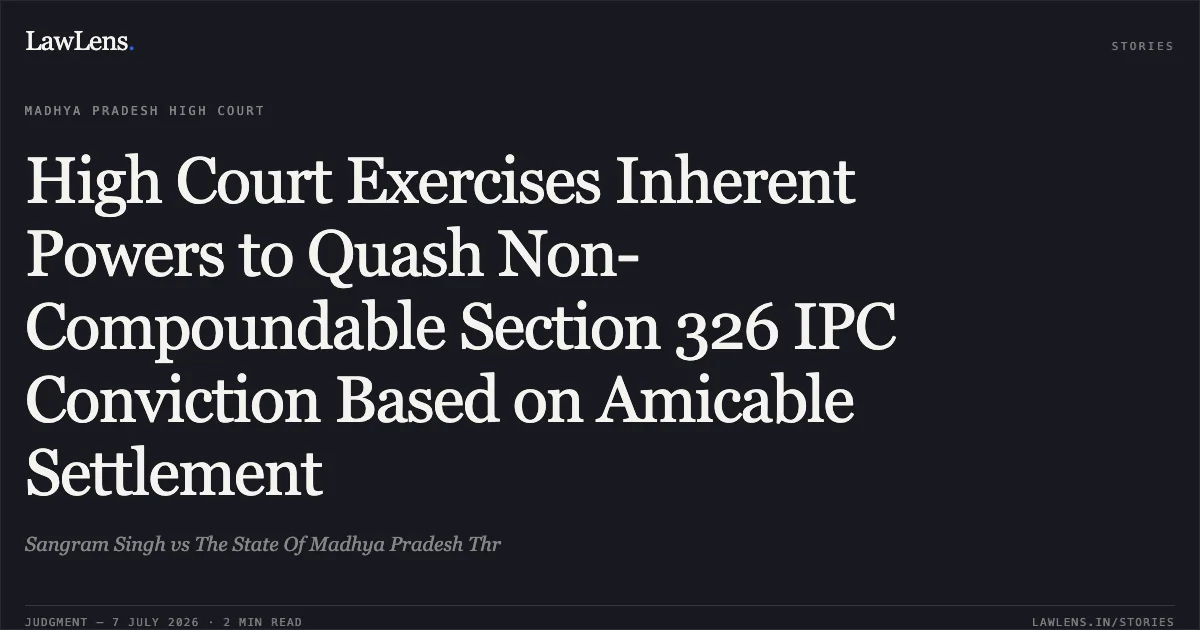
The appellants were convicted by the Third Additional Sessions Judge, Guna, in S.T. No. 266/2014 for causing grievous injuries to Savitri Bai with an axe following a dispute over erecting a boundary.
Source reference: p. 1-2Appellant No. 1 was sentenced under Section 326/34 IPC, and Appellant No. 2 under Section 326 IPC, both receiving seven years of rigorous imprisonment.
Source reference: p. 1During the pendency of the appeal, the parties filed a joint application (I.A. No. 2711/2026) for compounding the offence based on an amicable settlement.
Source reference: p. 2The Principal Registrar verified the compromise, confirming it was voluntary and without coercion.
Source reference: p. 2Issues
1. Whether a High Court can exercise its inherent powers under Section 482 of the Cr.P.C. to quash proceedings or set aside a conviction for a non-compoundable offence like Section 326 IPC on the basis of a compromise.
Source reference: p. 32. Whether the interest of justice warrants the acquittal of the appellants despite the non-compoundable nature of the offence.
Source reference: p. 3-4Law Applied
The court primarily analyzed Section 326 of the IPC (causing grievous hurt by dangerous weapons) and Section 320 of the Cr.P.C., which lists compoundable offences.
Source reference: p. 3It relied on Shiji @ Pappu and others v. Radhika and another (2011), which established that while a court may not permit compounding of non-compoundable offences under Section 320, the High Court may quash proceedings using inherent powers.
Source reference: p. 3It further cited Popular Muthiah v. State of Tamilnadu (2006), holding that inherent powers under Section 482 Cr.P.C. can be exercised concurrently with appellate or revisional jurisdiction without a formal application.
Source reference: p. 3Reasoning
The court observed that although Section 326 IPC is non-compoundable, the dispute was private in nature and had been fully resolved through a voluntary settlement.
Source reference: p. 2-3The court reasoned that since the offence was not of "fatal gravity" or involving significant "moral turpitude," enforcing the sentence would be counterproductive.
Source reference: p. 3-4It found that rejecting the compromise would create a permanent rift between the parties and impose a lifelong social stigma on the appellants.
Source reference: p. 3-4Consequently, the court determined that invoking inherent jurisdiction was necessary to achieve "complete justice" and that there was no statutory embargo preventing the High Court from exercising this power during an appeal.
Source reference: p. 4Holding
The court answered the issues in the affirmative, allowing the appeal and invoking its inherent jurisdiction under Section 482 Cr.P.C.
The judgment of conviction and sentence dated 26.08.2026 passed in S.T. No. 266/2014 was set aside, and the appellants were acquitted of all charges.
Source reference: p. 4The court ordered the discharge of bail bonds and the refund of any fines deposited.
Source reference: p. 4Acts & Sections Cited
5 provisions across 2 statutes referred to in this judgment. Each provision opens on LawLens.
Code of Criminal Procedure, 19733
Indian Penal Code, 18602
Original Court PDF
Sangram SinghvsThe State Of Madhya Pradesh Thr
Click to open original judgment
Original judgment, available to read, download and summarize on LawLens.in