Facts
The applicant sought the quashing of proceedings in Special Sessions Trial No. 54 of 2022.
Source reference: para. 4Respondent No. 2 (the victim's mother) lodged an FIR alleging that her 14-year-old daughter was enticed away and sexually assaulted by co-accused persons.
Source reference: para. 5The applicant was later charge-sheeted under Section 67-B of the IT Act and Section 17 of the POCSO Act on allegations of recording the incident and circulating the video.
Source reference: para. 5However, the victim (PW-1) turned hostile, denying the allegations in both her Section 164 Cr.P.C. statement and her trial deposition.
Source reference: para. 6, 10Subsequently, the applicant and respondents 2 and 3 entered into a voluntary compromise and filed a joint compounding application (I.A. No. 1 of 2026).
Source reference: para. 7, 10Issues
1. Whether the High Court can exercise its inherent powers under Section 482 Cr.P.C. to quash criminal proceedings involving non-compoundable offences under the POCSO and IT Acts based on a compromise and the hostility of the victim.
Source reference: para. 11, 13Law Applied
The Court primarily applied Section 482 of the Code of Criminal Procedure regarding the inherent powers of the High Court to prevent abuse of process and secure the ends of justice.
Source reference: para. 11It relied on the landmark precedents of Gian Singh v. State of Punjab, which allows quashing of non-compoundable private disputes.
Source reference: para. 12Narinder Singh v. State of Punjab, which emphasizes quashing when the possibility of conviction is "remote and bleak".
Source reference: para. 12Parbatbhai Aahir v. State of Gujarat, reiterating that inherent powers must be used to ensure justice.
Source reference: para. 12Statutory provisions involved included Section 67-B of the Information Technology (Amendment) Act, 2000, and Sections 14(1), 17, and 21 of the POCSO Act, 2012.
Source reference: para. 4, 5Reasoning
The Court observed that although the offences are non-compoundable, the victim’s categorical denial of the incident in her Section 164 Cr.P.C. statement and trial testimony (PW-1) effectively neutralized the prosecution's case.
Source reference: para. 10, 13The Court found no prima facie evidence on record to support the allegations of recording or disseminating objectionable material.
Source reference: para. 10Applying the "remote possibility of conviction" test from Narinder Singh, the Court reasoned that continuing the trial would be a futile exercise and a waste of judicial resources given the amicable settlement and the victim's stance.
Source reference: para. 13The Court noted the compromise was voluntary and without coercion, making this an "appropriate case" for the exercise of inherent jurisdiction to prevent the abuse of the process of law.
Source reference: para. 10, 11Holding
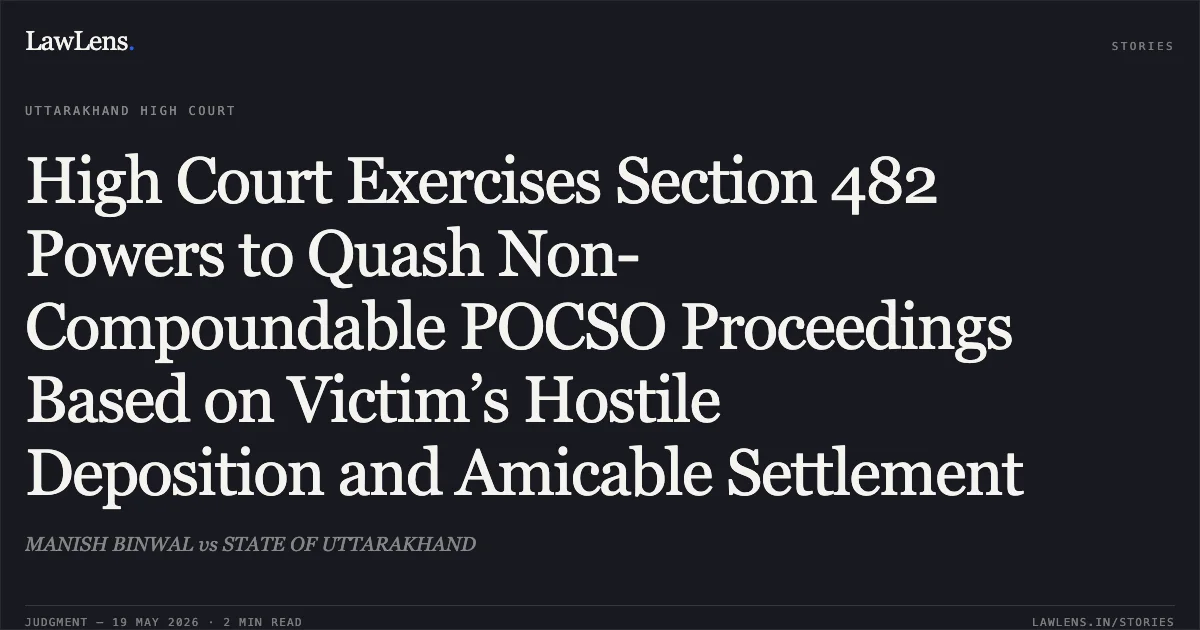
The Court answered the issue in the affirmative, holding that the possibility of conviction was extremely remote and continuation would amount to an abuse of process.
The Court allowed Compounding Application I.A. No. 1 of 2026 and consequently quashed the entire proceedings of Special Sessions Trial No. 54 of 2022 pending before the Special Sessions Judge (POCSO), Champawat, qua the applicant.
Source reference: para. 14, 15Acts & Sections Cited
5 provisions across 2 statutes referred to in this judgment. Each provision opens on LawLens.
Protection of Children from Sexual Offences Act, 20123
Code of Criminal Procedure, 19732
Original Court PDF
MANISH BINWALvsSTATE OF UTTARAKHAND
Click to open original judgment
Original judgment, available to read, download and summarize on LawLens.in