01Facts
The reference text does not set out the factual background, the procedural history of the suit or appeals, or the parties' contentions. The excerpt begins at the Court's discussion of the law governing second appeals.
¶ 2402Issues
i.1. Whether the High Court, exercising jurisdiction under Section 100 CPC, may reappreciate evidence and substitute its own view for the findings of fact recorded by the first appellate court.
¶ 24 · ¶ 28ii.2. Whether the High Court may interfere with the first appellate court's findings only where a substantial question of law has been framed, and whether a judgment rendered without following that procedure can be sustained.
¶ 25–26iii.3. Whether the High Court may interfere with the first appellate court's findings of fact where those findings are contrary to mandatory law or settled Supreme Court position, are based on inadmissible evidence, or are arrived at without evidence.
¶ 27–2803Law Applied
Section 100 CPC, as amended in 1976, confines second appeals to substantial questions of law.
In Navaneethammal v. Arjuna Chetty, AIR 1996 SC 3521, the High Court may not reappreciate evidence to reach another possible view and set aside the first appellate court's findings of fact.
¶ 24In Kshitish Chandra Purkait v. Santosh Kumar Purkait, (1997) 5 SCC 438, the High Court must be satisfied that the case involves a substantial question of law, not merely a question of law.
¶ 25In Dnyanoba Bhaurao Shemade v. Maroti Bhaurao Marnor, (1999) 2 SCC 471, the High Court may exercise Section 100 jurisdiction only on substantial questions of law framed at admission, and must decide the appeal on those questions; a judgment rendered otherwise cannot be sustained.
¶ 26In Kondira Dagadu Kadam v. Savitribai Sopan Gujar, AIR 1999 SC 2213, the High Court may substitute its opinion on fact only if the first appellate court's conclusions are contrary to mandatory law or settled Supreme Court positions, rest on inadmissible evidence, or are arrived at without evidence.
¶ 27The first appellate court is the final court of fact, and the High Court's interference is confined to the recognised exceptions.
¶ 28Provisions in the judgment · 1 · Linked ones open on LawLens
Code of Civil Procedure, 1908 Section 100
04Reasoning
The excerpt does not apply these principles to the facts of the present appeal, so the Court's reasoning on the specific dispute is not available. The Court's discussion proceeds by restating settled authority.
The Court establishes that the first appellate court is the final fact-finding court and that Section 100 CPC does not permit the High Court to re-weigh evidence.
¶ 24, 28The power to interfere is conditional on framing and deciding substantial questions of law.
¶ 25–26The Court identifies the narrow grounds on which a finding of fact may be disturbed: illegality contrary to mandatory law or binding precedent, reliance on inadmissible evidence, or findings without evidence. The Court's selection of these authorities indicates that the High Court's review of the first appellate judgment is to be limited to these categories.
¶ 27–2805Holding
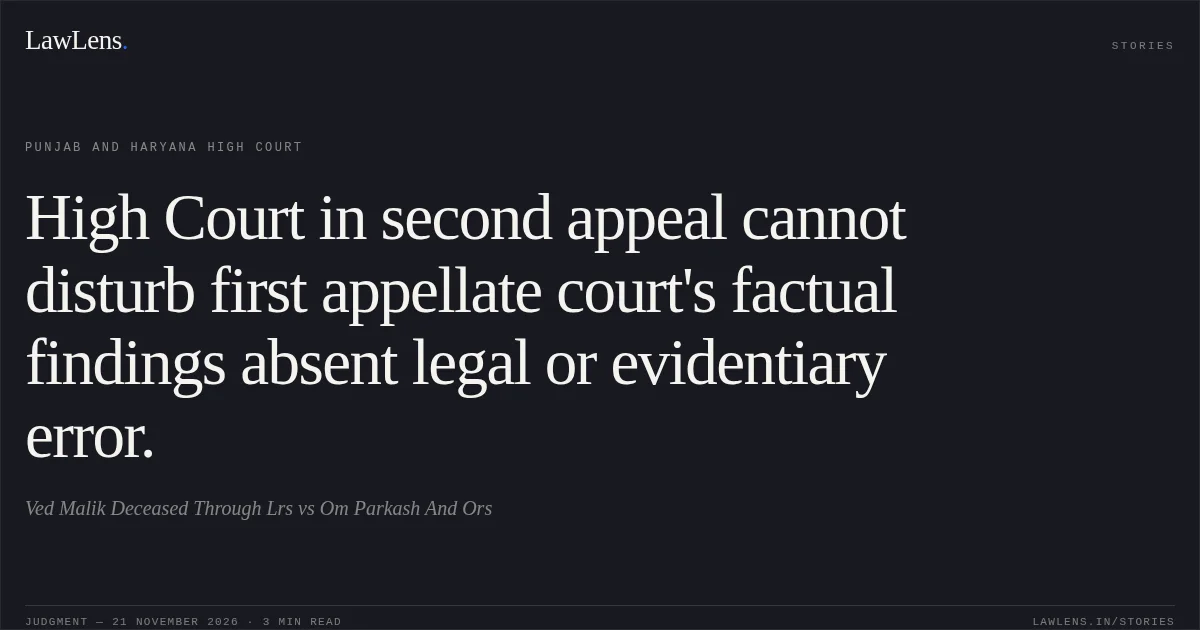
Under Section 100 CPC, the High Court cannot interfere with the first appellate court's findings of fact except where those findings are contrary to mandatory provisions of law or binding Supreme Court pronouncements, are based on inadmissible evidence, or are arrived at without evidence.
¶ 28Second appeals must be decided on substantial questions of law framed at admission.
¶ 26The excerpt does not contain the Court's final order, the disposition of the appeal, or any specific directions or relief granted.
Original Court PDF
Ved Malik Deceased Through LrsvsOm Parkash And Ors
Click to open original judgment
Original judgment, available to read, download and summarize on LawLens.in