01Facts
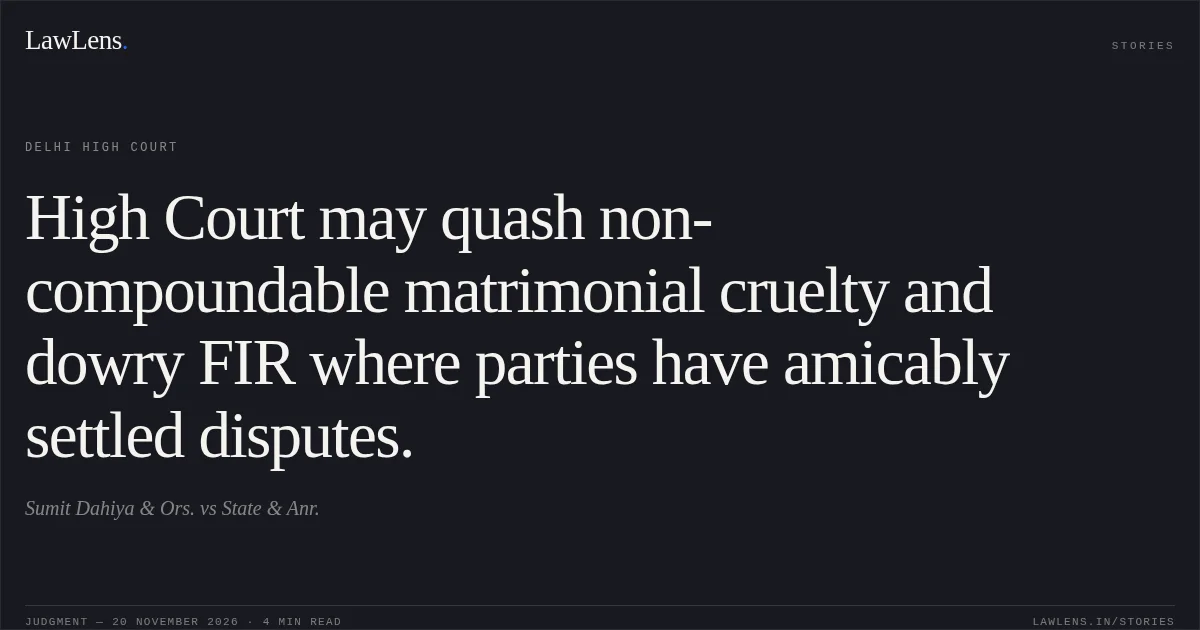
The petitioners, the husband (Petitioner 1) and his parents, sought quashing of FIR No. 498/2025 (dated 25.10.2025, P.S. K.N. Katju Marg, Rohini) under BNS Sections 85, 316(2), 3(5), 115(2) (corresponding to IPC 498A, 406, 34, 323) and Section 4 of the Dowry Prohibition Act, 1961, together with all consequential proceedings
¶ 1 · pp. 1–2The husband married the complainant (Respondent 2) on 04.12.2024 according to Hindu rites
¶ 2 · p. 2The complainant alleged pre-marriage dowry demands (property, car, watches), physical assault and harassment for insufficient dowry, and wrongful retention of her jewellery
¶ 3 · p. 2The husband and complainant executed an MOU-cum-Settlement Deed dated 23.12.2025 (Annexure P-3)
¶ 4 · pp. 2–5The complainant confirmed the deed in court, stated she entered it voluntarily without coercion, and was identified by the Investigating Officer, who also identified the petitioners
¶ 5 · p. 5The marriage was dissolved by mutual-consent divorce on 23.05.2026 under Section 13B(2) of the Hindu Marriage Act, 1955 (HMA No. 792/2026)
¶ 6 · p. 5The settlement amount of ₹7,00,000 was paid in full (₹3,50,000 earlier and ₹3,50,000 by bank draft handed over in court), as confirmed by the complainant
¶ 7(b) · pp. 5–6The complainant stated she does not wish to pursue the case
¶ 7(c) · p. 602Issues
i.1. Whether the criminal proceedings under Sections 498A/406/34/323 IPC (BNS equivalents) and Section 4 of the Dowry Prohibition Act, 1961 may be quashed under Section 528 BNSS (inherent power) on the basis of a settlement between husband and wife, although the offences are non-compoundable.
¶ 1 · p. 1 · ¶ 7 · pp. 5–6 · ¶ 13 · p. 11ii.2. Whether continuation of the prosecution, in light of the settlement, divorce by mutual consent, and the complainant's stated unwillingness to proceed, would amount to an abuse of process and defeat the ends of justice.
¶ 7(d) · p. 6 · ¶ 13 · p. 1103Law Applied
Section 528 BNSS (pari materia to Section 482 CrPC) is the source of inherent power to quash FIRs.
¶ 1 · p. 1Gian Singh v. State of Punjab, (2012) 10 SCC 303, holds that the High Court may quash non-compoundable offences arising out of matrimony, particularly dowry, or family disputes, where the parties have amicably settled and conviction is hardly likely, and that serious offences of mental depravity or moral turpitude are excluded.
¶ 8 · pp. 6–7Narinder Singh v. State of Punjab, (2014) 6 SCC 466, requires the High Court to secure ends of justice or prevent abuse of process, to quash predominantly civil matrimonial or family disputes resolved between the parties, and to assess whether conviction is remote and continuation would cause oppression.
¶ 9 · pp. 7–8Jitendra Raghuvanshi v. Babita Raghuvanshi, (2013) 4 SCC 58, holds that Section 320 CrPC is no bar to quashing in matrimonial disputes settled amicably and without pressure.
¶ 10 · pp. 8–9Navneesh Aggarwal v. State of Haryana, 2025 SCC OnLine SC 1680, holds that prosecution arising from a matrimonial relationship already ended by divorce should not linger as harassment.
¶ 11 · pp. 9–10Shamsher Singh v. State, 2026 SCC OnLine Del 7626, a Coordinate Bench decision quashing a Section 498A/DP Act FIR on settlement and divorce, was followed.
¶ 12 · pp. 10–11Provisions in the judgment · 12 · Linked ones open on LawLens
Bharatiya Nagarik Suraksha Sanhita, 2023 Section 528
Code of Criminal Procedure, 1973 Section 482Section 320
Bharatiya Nyaya Sanhita, 2023 Section 85Section 316Section 3Section 115
Indian Penal Code, 1860 Section 406Section 34Section 323
Dowry Prohibition Act, 1961 Section 4
Hindu Marriage Act, 1955 Section 13
04Reasoning
The Court treated the dispute as matrimonial and private, placing it within the category of offences that Gian Singh and Narinder Singh permit to be quashed despite non-compoundability.
¶ 7(a) · pp. 5–6 · ¶ 8–9 · pp. 6–8The Court examined the settlement's execution and its implementation. The complainant confirmed the MOU before the Court, and the IO identified the parties. She affirmed the settlement was voluntary and free of coercion, as required by Jitendra Raghuvanshi.
¶ 5 · p. 5 · ¶ 10 · pp. 8–9The Court found the settlement had been acted upon: the divorce was granted, and the full ₹7,00,000 was paid and acknowledged.
¶ 6–7(b) · pp. 5–6On the second Narinder Singh inquiry, the Court held conviction chances remote because the complainant no longer wished to pursue the case and the parties had moved on.
¶ 7(c)–(d) · p. 6The Court further noted that the FIR does not involve heinous crime or public interest, and that continuing the case would only perpetuate hostility.
Shamsher Singh, as quoted in para. 12 · pp. 10–11The Court concluded that continuing the proceedings would waste judicial time and defeat the ends of justice. The reliance on Navneesh Aggarwal, which was decided in exercise of Article 142 powers, is noted, but the Court relied on Section 528 BNSS and did not invoke Article 142.
¶ 11 · pp. 9–10 · ¶ 12 · pp. 10–11 · ¶ 13 · p. 1105Holding
Both issues were answered in the affirmative. Because the matrimonial dispute was private, fully settled, acted upon, and followed by divorce by mutual consent, with conviction remote and the complainant's joint request for quashing, the petition could be allowed under Section 528 BNSS in light of Gian Singh, Narinder Singh, and Jitendra Raghuvanshi.
¶ 13 · p. 11FIR No. 498/2025 (dated 25.10.2025, P.S. K.N. Katju Marg, Rohini District) under BNS Sections 85/316(2)/3(5)/115(2) and Section 4 of the Dowry Prohibition Act, 1961, together with all proceedings arising from it, stand quashed qua all petitioners.
¶ 14 · p. 11Original Court PDF
Sumit Dahiya & Ors.vsState & Anr.
Click to open original judgment
Original judgment, available to read, download and summarize on LawLens.in