Facts
The petitioner, Usha Rani, challenged the disciplinary order dated 28 October 2024 in D.P. No. 1 of 2024, by which she was reduced from the post of Sheristadar of a Sub Court to the post of Head Clerk of a Sub Court/District Munsif Court in Class IV, Category 3 of the Tamil Nadu Judicial Ministerial Service.
Source reference: p.2, para.1She contended that the punishment was victimising, that there was no direct oral or documentary evidence supporting the charges, and that the relevant records had been received by her predecessor in 2001; according to her, the charges were founded on presumptions and assumptions.
Source reference: p.2, para.2Instead of pursuing the statutory appeal, she invoked the writ jurisdiction under Article 226 of the Constitution and sought quashing of the disciplinary order and restoration to the post of Head Clerk.
Source reference: p.1; p.2, para.3Issues
1. Whether the writ petition should be entertained when the petitioner had an available statutory appellate remedy against the disciplinary punishment.
Source reference: p.2, para.32. Whether the factual disputes concerning the evidence, records, and imposition of punishment under Rule 8 of the Tamil Nadu Civil Services (Discipline and Appeal) Rules should initially be examined by the statutory Appellate Authority rather than by the High Court in writ jurisdiction.
Source reference: p.2, para.2; p.2, para.3Law Applied
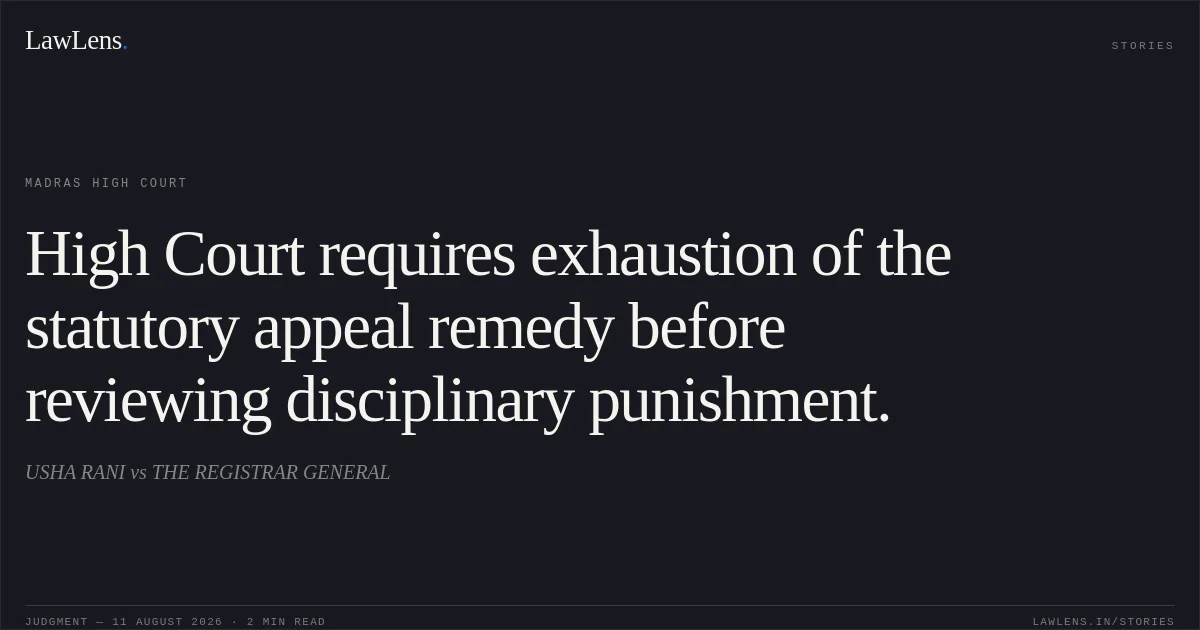
The Court applied the principle that where a statutory appeal is available against a disciplinary order, the aggrieved employee should ordinarily exhaust that remedy before invoking the High Court’s jurisdiction under Article 226, particularly where adjudication of disputed facts and evaluation of disciplinary records are required.
Source reference: p.2, para.2; p.2–3, para.3The Court also recognised the statutory framework governing punishment under Rule 8 of the Tamil Nadu Civil Services (Discipline and Appeal) Rules and held that the appellate remedy is valuable and would assist the High Court in exercising judicial review effectively.
Source reference: p.2, para.2; p.2–3, para.3No judicial precedent was cited in the order.
Source reference: no citationReasoning
The Court noted that the petitioner’s challenge involved disputed factual questions regarding the records relied upon, the evidentiary basis of the charges, and the propriety of the punishment imposed under Rule 8.
Source reference: p.2, para.2Since the petitioner had not preferred the statutory appeal, the Court declined to undertake the initial factual adjudication in writ proceedings. As the appeal lay before the Registrar General of the High Court, the Court directed the petitioner to pursue that remedy, thereby preserving the statutory appellate process while leaving the merits of the disciplinary case open for examination.
Source reference: p.2–3, para.3Holding
The writ petition was disposed of without adjudicating the merits of the disciplinary punishment.
The petitioner was granted liberty to file a statutory appeal before the Registrar General within 30 days from receipt of the order. The Appellate Authority was directed to entertain the appeal without raising limitation and to decide it on merits and in accordance with law as expeditiously as possible.
Source reference: p.3, para.3No costs were awarded, and the connected miscellaneous petition was closed.
Source reference: p.3, para.4Original Court PDF
USHA RANIvsTHE REGISTRAR GENERAL
Click to open original judgment
Original judgment, available to read, download and summarize on LawLens.in