Facts
The petitioner, engaged in marketing and selling consumer electronic products, had entered into a Manufacturing and Purchase Agreement with the respondent on 24 May 2022, containing an arbitration clause under Clause 14. That agreement expired by efflux of time.
Source reference: pp. 2–3; paras. 2–3In March 2023, the parties allegedly altered their arrangement: the respondent supplied Semi Knocked Down (“SKD”) kits, while the petitioner manufactured finished goods on a job-work basis.
Source reference: pp. 2–3; paras. 2–3The petitioner circulated a draft Manufacturing Service Agreement by email on 13 March 2023, containing an arbitration clause providing for Delhi as the venue.
Source reference: pp. 2–3; paras. 2–3A subsequent draft circulated by the respondent on 27 June 2023 provided for Gurugram as the seat and included a pre-arbitration dispute-resolution process. Neither draft was signed or formally executed, although the parties continued the job-work arrangement, with the respondent supplying SKD kits and the petitioner manufacturing goods and raising invoices.
Source reference: p. 3; para. 3After disputes arose, the respondent first invoked the arbitration clause in the 2022 Agreement and subsequently issued a fresh notice invoking Clause 12 of the 13 March 2023 draft agreement.
Source reference: pp. 3–4; para. 4The respondent also initiated proceedings under Section 9 of the Arbitration and Conciliation Act, 1996, in which the petitioner did not appear and was proceeded against ex parte.
Source reference: pp. 3–4; para. 4In proceedings under Section 11(6) of the Act, the petitioner appeared but did not object to reference of the disputes to arbitration.
Source reference: p. 5; para. 5The High Court appointed a Sole Arbitrator on 9 February 2026.
Source reference: p. 5; para. 5Before the Arbitrator, the petitioner filed an application under Section 16 contending that no binding arbitration agreement existed because the draft agreement had never been executed.
Source reference: pp. 5–6, 13–15; paras. 7, 20–21The Arbitrator rejected the application on 15 July 2026, holding, inter alia, that a binding arbitration arrangement could arise from the parties’ correspondence and subsequent conduct.
Source reference: pp. 5–6, 13–15; paras. 7, 20–21The petitioner challenged that order under Articles 226 and 227 of the Constitution.
Source reference: no citationIssues
1. Whether a writ petition under Articles 226 and 227 of the Constitution is maintainable against an order of an Arbitral Tribunal rejecting a jurisdictional objection under Section 16 of the Arbitration and Conciliation Act, 1996.
Source reference: p. 8; para. 112. Whether the Arbitrator’s rejection of the petitioner’s objection—concerning the existence of a binding arbitration agreement arising from an unsigned draft and the parties’ subsequent conduct—disclosed patent lack of jurisdiction or manifest perversity warranting interference at the interlocutory stage.
Source reference: pp. 13–15; paras. 18–22Law Applied
Section 5 of the Arbitration and Conciliation Act, 1996 embodies the policy of minimal judicial intervention in arbitral proceedings.
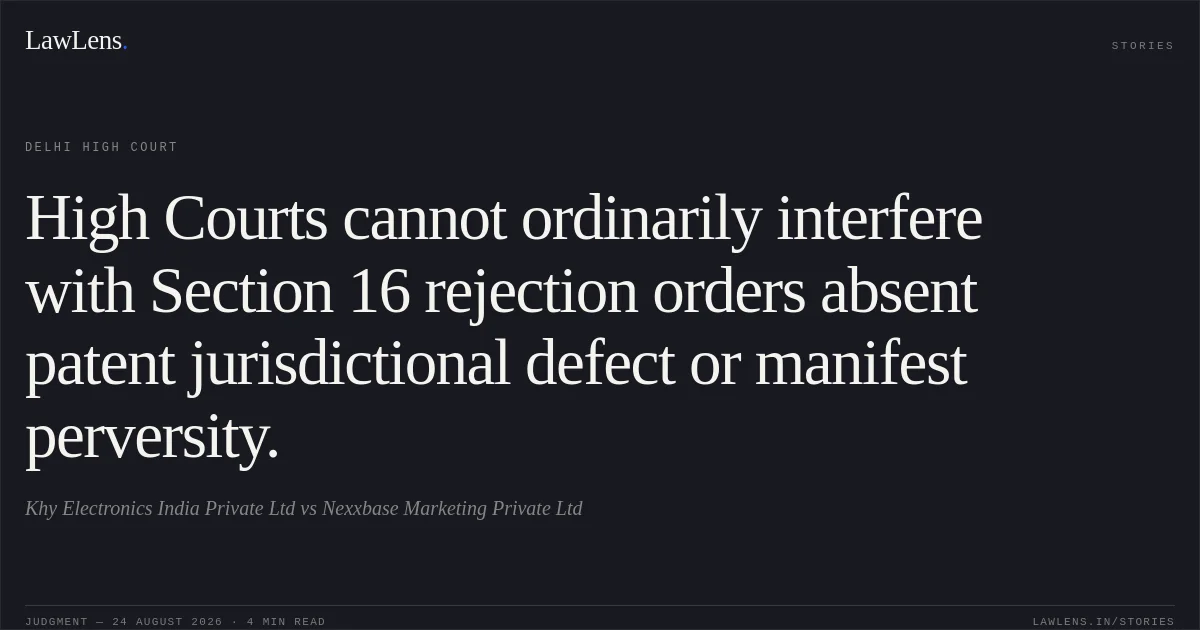
Source reference: p. 8; para. 12Section 16 incorporates the kompetenz-kompetenz principle, authorising the Arbitral Tribunal to rule on its own jurisdiction, including objections regarding the existence or validity of the arbitration agreement; where such an objection is rejected, the Tribunal must continue the proceedings and the objection may ordinarily be raised under Section 34 after the final award.
Source reference: p. 8; para. 13Section 37(2)(a) provides an appeal where a Section 16 objection is accepted, but not where it is rejected.
Source reference: p. 9; para. 13In SBP & Co. v. Patel Engineering Ltd., (2005) 8 SCC 618, the Supreme Court held that arbitral orders should not routinely be interfered with under Articles 226 or 227 and that a party ordinarily must await the final award.
Source reference: pp. 9–10; para. 14Deep Industries Ltd. v. ONGC, (2020) 15 SCC 706, Punjab State Power Corporation Ltd. v. EMTA Coal Ltd., (2020) 17 SCC 93, and Bhaven Construction v. Executive Engineer, (2022) 1 SCC 75, restrict constitutional interference to exceptional cases involving patent lack of inherent jurisdiction or perversity that “stares one in the face”.
Source reference: p. 10; para. 15Tarini Prasad Mohanty v. Sunflag Iron & Steel Co. Ltd., 2026 INSC 566, and Manash Kamal Bezboruah v. M/s Bokahola Tea Co. Pvt. Ltd., 2026 INSC 701, reaffirm that contractual interpretation and factual assessment concerning the existence or nature of an arbitration agreement should not ordinarily be undertaken in writ jurisdiction, particularly while the arbitral proceedings and evidence remain pending.
Source reference: pp. 10–12; paras. 16–17Reasoning
The High Court held that the petitioner’s challenge required examination of whether the unsigned draft agreement became binding through correspondence and subsequent conduct—namely, the supply of SKD kits, manufacture of finished goods, acceptance of performance, and raising of invoices.
Source reference: pp. 13–15; paras. 18, 20–21The Arbitrator had considered the petitioner’s objection, the pleadings, the drafts, the parties’ correspondence, the subsequent conduct, Section 7 of the Arbitration and Conciliation Act, and Sections 8 and 9 of the Indian Contract Act, 1872, and had given reasons for concluding that a binding arbitration arrangement could have arisen by conduct.
Source reference: p. 13–14; para. 20Even if that conclusion were ultimately erroneous, the Arbitrator had jurisdiction to decide the objection, and an alleged error in contractual interpretation did not amount to inherent lack of jurisdiction or perversity of the exceptional kind required for intervention under Articles 226 or 227.
Source reference: pp. 11–15; paras. 16–22The petitioner’s failure to object to the reference when the Section 11 petition was considered further reinforced the Court’s refusal to interfere, although the Court did not treat that circumstance as conclusively determining the existence of the arbitration agreement.
Source reference: p. 13; para. 19Holding
The writ petition was dismissed because the impugned order did not suffer from patent lack of jurisdiction or manifest perversity warranting constitutional interference.
The Court held that the correctness of the Arbitrator’s conclusion regarding the existence of a binding arbitration agreement, including whether the parties’ conduct amounted to acceptance of the draft agreement, remained open for consideration at the appropriate stage, ordinarily in proceedings under Section 34 after the final award.
Source reference: pp. 14–15; paras. 21–24The pending application was also dismissed, with no final opinion expressed on the merits of the disputes or on the ultimate validity of the arbitration agreement.
Source reference: p. 15; paras. 23–24Acts & Sections Cited
27 provisions across 2 statutes referred to in this judgment. Linked provisions open on LawLens.
Arbitration and Conciliation Act, 1996
Indian Contract Act, 18722
Original Court PDF
Khy Electronics India Private LtdvsNexxbase Marketing Private Ltd
Click to open original judgment
Original judgment, available to read, download and summarize on LawLens.in