Facts
On 14 January 1997, Smt. Samshul Nisa alias Sharbatul Nisha reported that, at approximately 1:00 a.m., unidentified persons falsely claiming to be police officials knocked on her door. When her son, Najam alias Kamal Aziz, opened it, he was shot and struck with a sharp-edged weapon. The FIR was registered against unknown persons under Section 302 IPC at Police Station Maina Ther, Moradabad.
Source reference: p. 1; paras. 2–3The post-mortem disclosed a gunshot injury to the right temporal region, an incised injury to the forehead, and pellets recovered from the deceased’s brain; the gunshot injuries were certified as the cause of death.
Source reference: p. 1; para. 4Initially, a charge-sheet was filed only against co-accused Arbab alias Bachhu. The applicant, Azeem Wasif alias Babboo, was not charge-sheeted because the investigation revealed that he had left India for England on 31 December 1996. A subsequent investigation led to a charge-sheet against him, which he challenged under Section 482 Cr.P.C.
Source reference: p. 2; para. 5The applicant relied on his passport, visa, and immigration records to establish that he had not returned to India before 14 January 1997.
Source reference: p. 2; paras. 6–10During the trial of co-accused Arbab, the complainant stated that neither Arbab nor the applicant was involved in the murder. The Investigating Officer also admitted that the applicant was abroad at the relevant time, while another prosecution witness stated that he was not an eyewitness and that the offence had been committed by unknown persons.
Source reference: pp. 6–7; paras. 17–19The complainant’s legal heir did not oppose the applicant’s petition and conceded that no reliable ocular or circumstantial evidence connected the applicant with the offence.
Source reference: p. 4; para. 12Issues
1. Whether the High Court could consider the applicant’s plea of alibi at the stage of proceedings under Section 482 Cr.P.C. on the basis of unimpeachable official documentary evidence showing that he was abroad when the offence occurred?
Source reference: p. 4; para. 142. Whether continuation of the criminal proceedings against the applicant would amount to an abuse of the process of the Court when the prosecution material disclosed no reliable ocular or circumstantial evidence linking him to the murder?
Source reference: pp. 6–7; paras. 20–233. Whether the charge-sheet and consequential criminal proceedings under Section 302 IPC were liable to be quashed in exercise of the High Court’s inherent jurisdiction?
Source reference: p. 7; paras. 23–25Law Applied
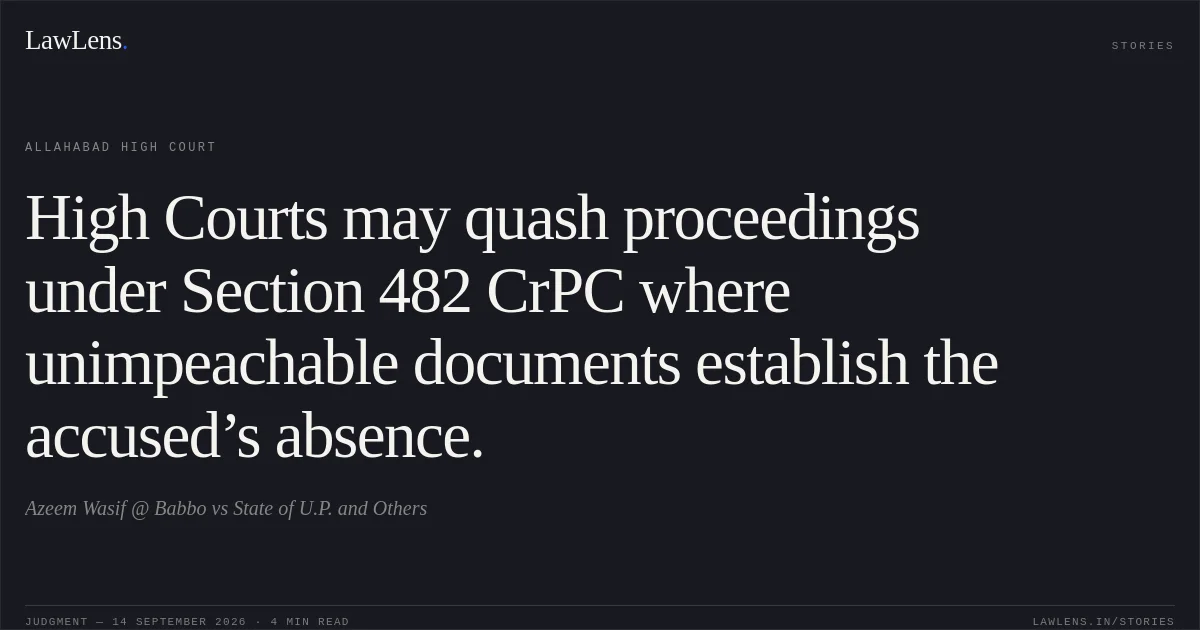
The Court exercised its inherent jurisdiction under Section 482 Cr.P.C. to prevent abuse of process and secure the ends of justice, while the underlying offence was punishable under Section 302 IPC.
Source reference: p. 7; paras. 23–25Relying on Rajiv Thapar v. Madan Lal Kapoor, the Court applied the four-step test for considering defence material at the pre-trial stage: the material must be of sterling and impeccable quality, must completely negate the prosecution allegations, must remain unrebutted, and continuation of the trial must amount to abuse of process.
Source reference: p. 4; para. 14Prashant Bharti v. State (NCT of Delhi) and Harshendra Kumar D. v. Rebatilata Koley establish that proceedings may be quashed where unimpeachable documents completely demolish the prosecution case.
Source reference: p. 4; para. 14Mirza Iqbal alias Golu v. State of Uttar Pradesh recognizes that official records demonstrating the accused’s absence may be considered under Section 482 Cr.P.C.
Source reference: p. 4; para. 14Following Rahul v. State of U.P., the Court held that the ordinary rule requiring an alibi to be proved at trial is not inflexible where official, authentic, and unrebutted records conclusively establish the accused’s absence; the contrary principle in Rajendra Singh v. State of U.P. applies primarily to disputed affidavits or material requiring cross-examination.
Source reference: pp. 4–5; para. 14Reasoning
The Court found that the applicant’s passport, visa, and airport records showed that he departed India on 31 December 1996, arrived in England, and had not returned before the incident on 14 January 1997.
Source reference: pp. 6–7; paras. 16, 18, 21This documentary evidence was produced during investigation, had not been alleged to be fabricated, and remained unrebutted by the prosecution.
Source reference: pp. 6–7; paras. 16, 18, 21The Court therefore treated it as unimpeachable material satisfying the Rajiv Thapar–Rahul test.
Source reference: no citationThe prosecution case was further weakened because the FIR named no assailant, the complainant later denied the applicant’s involvement, the alleged witness Sharif Ahmed disclaimed eyewitness knowledge, and no other reliable ocular or circumstantial evidence connected the applicant with the murder.
Source reference: pp. 1, 6–7; paras. 3, 17–20In these circumstances, requiring the applicant to undergo a criminal trial despite conclusive material establishing his absence would serve no legitimate purpose and would constitute an abuse of the process of the Court.
Source reference: p. 7; paras. 22–23Holding
The High Court held that the applicant’s alibi was supported by unimpeachable and unrebutted documentary evidence and that the prosecution lacked reliable ocular or circumstantial evidence connecting him with the offence.
Continuation of the proceedings would therefore amount to an abuse of process under Section 482 Cr.P.C.
Source reference: p. 7; para. 23The application was allowed, and the charge-sheet dated 7 December 1997, the proceedings arising from Case Crime No. 23 of 1997 under Section 302 IPC, and all consequential proceedings against Azeem Wasif alias Babboo were quashed.
Source reference: p. 7; paras. 24–25Acts & Sections Cited
3 provisions across 2 statutes referred to in this judgment. Each provision opens on LawLens.
Code of Criminal Procedure, 19732
Indian Penal Code, 18601
Original Court PDF
Azeem Wasif @ BabbovsState of U.P. and Others
Click to open original judgment
Original judgment, available to read, download and summarize on LawLens.in