Facts
The petitioner alleged that private respondents Nos. 4 to 15 entered his house, assaulted him, and threatened to kill him. He contacted the emergency helpline 112 and submitted a complaint at Police Station Dhanoura on 6 June 2026, followed by a representation to the Superintendent of Police, Seoni, on 8 June 2026.
Source reference: paras. 2–4; pp. 1–2He alleged that no FIR was registered against respondents Nos. 5 to 12 and sought a writ directing the authorities to consider his representation and take action on the basis of the complaint/FIR. The State submitted that NCR No. 0221/2026 had already been registered for non-cognizable offences and that the petitioner had an alternative remedy before the competent Magistrate under Sections 156(3), 200 and 202 of the CrPC.
Source reference: paras. 2–4; pp. 1–2Issues
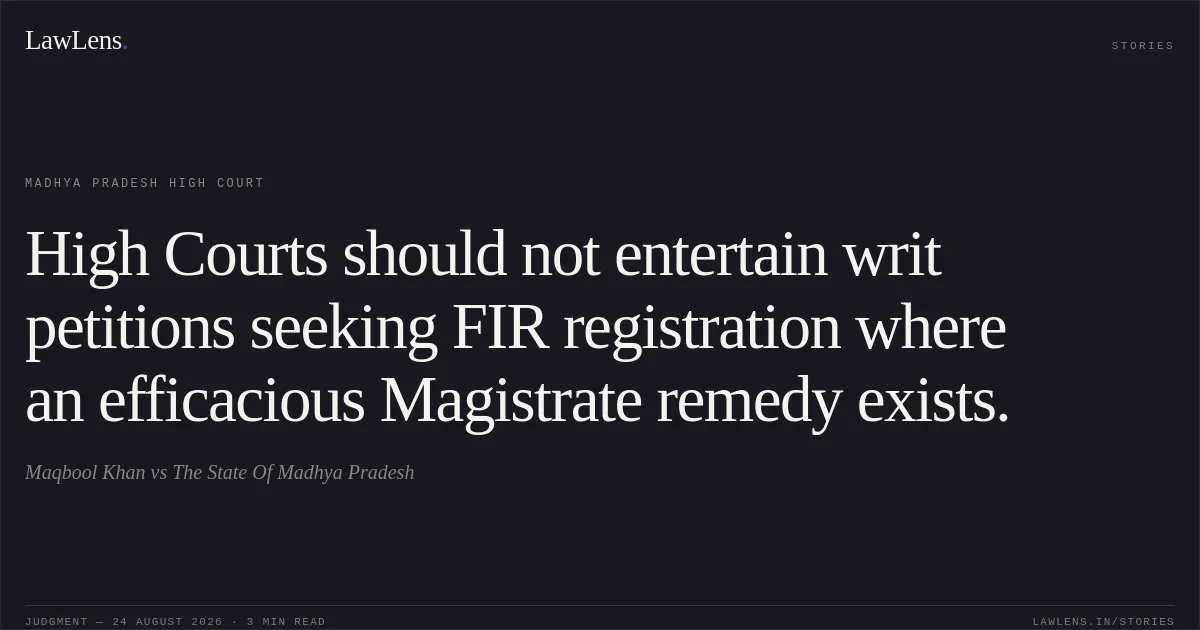
1. Whether the High Court should entertain a writ petition under Article 226 seeking registration of an FIR, proper investigation, or police protection when the petitioner has an efficacious statutory remedy before the Magistrate under Section 156(3) CrPC.
Source reference: paras. 3, 5–8; pp. 2–52. Whether the petitioner was entitled to a direction against the police authorities despite the registration of an NCR and his failure to invoke the alternative remedies under the CrPC.
Source reference: paras. 2–4, 8–9; pp. 1–2, 5–6Law Applied
The Court applied Article 226 of the Constitution in light of the principle that the existence of an alternative efficacious remedy ordinarily warrants refusal to exercise writ jurisdiction. Under Sections 154(3) and 156(3) CrPC, an aggrieved complainant may approach the Superintendent of Police and thereafter the Magistrate for registration of an FIR and proper investigation.
Source reference: paras. 5–7; pp. 2–5Section 156(3) confers wide powers on the Magistrate to direct registration of an offence, order a proper investigation, require a change of investigating officer where necessary, and monitor the investigation, though the Magistrate cannot investigate personally. The Court relied principally on Sakiri Vasu v. State of U.P., (2008) 2 SCC 409, and M. Subramaniam v. S. Janaki, Criminal Appeal No. 102 of 2011, decided on 20 March 2020, as well as Sudhir Bhaskarrao Tambe v. Hemant Yashwant Dhage, (2016) 6 SCC 277, and Shweta Bhadoriya v. State of M.P., (2017) 1 MPLJ (Cri) 338, which discourage recourse to writ jurisdiction for grievances concerning non-registration of an FIR or inadequate investigation where the Magistrate’s remedy is available.
Source reference: paras. 5–7; pp. 2–5Reasoning
The Court noted that the petitioner had already approached the police authorities, while the State asserted that an NCR had been registered for non-cognizable offences and appropriate action had been taken. Even assuming that the petitioner remained dissatisfied or believed that cognizable offences had been disclosed, the Court held that Section 156(3) CrPC provided a direct and effective remedy before the competent Magistrate for seeking registration of an FIR and/or proper investigation.
Source reference: paras. 3–8; pp. 2–5Applying Sakiri Vasu and the subsequent authorities, the Court concluded that the petitioner had approached the High Court prematurely without exhausting the statutory remedy. Consequently, the writ jurisdiction under Article 226 was not required to be exercised.
Source reference: paras. 3–8; pp. 2–5Holding
The petition was dismissed as not maintainable in view of the petitioner’s failure to avail the alternative efficacious remedy under the CrPC.
The Court granted liberty to the petitioner to approach the competent Magistrate under the provisions of the CrPC/Bharatiya Nagarik Suraksha Sanhita, 2023, for redressal of his grievance.
Source reference: para. 9; p. 6Acts & Sections Cited
8 provisions across 1 statute referred to in this judgment. Each provision opens on LawLens.
Code of Criminal Procedure, 19738
Original Court PDF
Maqbool KhanvsThe State Of Madhya Pradesh
Click to open original judgment
Original judgment, available to read, download and summarize on LawLens.in